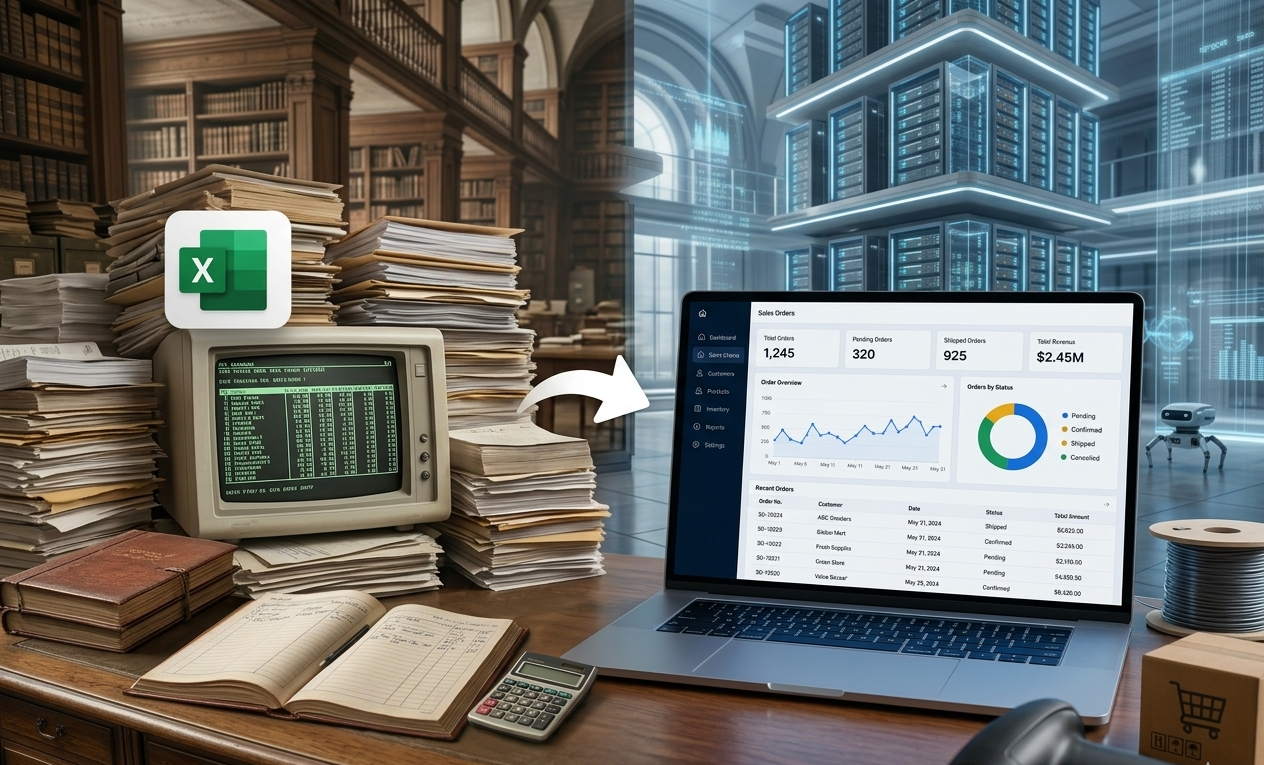
For many wholesale distributors, spreadsheets have been the default way to manage sales orders for years. They are familiar, flexible, and easy to start with. But as order volumes grow, customer expectations rise, and sales teams become more mobile, spreadsheets quickly begin to show their limits.
A missed update in one file can delay an order. A wrong price entered manually can affect margins. A sales representative may take an order over the phone, share it via email, and then wait for someone at the office to confirm stock, pricing, or dispatch details. What looks like a simple process on the surface often becomes a chain of manual follow-ups behind the scenes.
This is why more businesses are moving toward digital sales order management. It helps wholesale distributors replace scattered spreadsheets, calls, and messages with a more organized, accurate, and transparent way to manage orders from start to finish.
What is Digital Sales Order Management?
Digital sales order management is the process of capturing, processing, tracking, and managing sales orders through a digital platform instead of relying on manual tools like spreadsheets, emails, paper forms, or phone calls.
In a wholesale distribution business, this usually means sales teams, distributors, dealers, and internal teams can work from one connected system. Product details, pricing, customer information, order history, and order status are available in one place.
The goal is not just to digitize a spreadsheet. The real goal is to make the entire sales order process faster, more reliable, and easier to control.
Why Spreadsheets Are Becoming a Problem for Wholesale Distributors
Spreadsheets are useful when a business is small or when order volumes are low. But wholesale distribution rarely stays simple for long. As more products, customers, salespeople, pricing rules, and delivery locations are added, spreadsheets become harder to manage.
The biggest challenges usually come down to a few practical issues:
• Spreadsheets depend on manual updates. Someone has to enter data correctly, update formulas, share the latest file, and confirm that everyone is working from the same version.
• Version confusion creates order mistakes. One team member may use an older file while another updates a newer one, leading to duplicate orders, incorrect quantities, missed products, or wrong customer details.
• There is limited real-time visibility. Once an order is entered in a spreadsheet, sales teams may not know whether it has been approved, processed, packed, dispatched, or delayed without manually following up.
Digital Sales Order Management Improves Accuracy Across Every Order
Accuracy is one of the biggest benefits of digital sales order management. In wholesale sales, even a small error in quantity, pricing, discount, SKU selection, or delivery address can create delays and customer dissatisfaction.
A digital system improves accuracy by standardizing the order process. Instead of manually entering every detail into a spreadsheet, users can select products from a digital catalog, apply predefined pricing, and submit orders through a structured workflow.
This helps teams:
• Reduce manual entry errors
• Maintain consistent pricing and discounts
• Avoid missing important order details
For example, if a customer has a specific price list or discount structure, the system can apply it automatically. Sales representatives do not need to remember every pricing rule or check multiple files before placing an order.
Importance of Real-Time Visibility in Wholesale Order Management
Wholesale distribution depends on coordination. Sales teams, operations teams, warehouse staff, finance departments, distributors, and customers all need reliable information.
When order data is scattered across spreadsheets and messages, visibility becomes limited. Teams often spend time asking basic questions such as:
• Has this order been confirmed?
• Is the product available?
• Has the order been dispatched?
• Is there a payment issue?
• When will the customer receive the order?
A digital sales order management platform gives teams a clearer view of the order journey. Everyone can track progress from order creation to fulfillment. This helps reduce follow-ups, improve accountability, and create a better customer experience.
How does it help sales teams work faster?
Sales representatives often work under pressure. They meet customers, collect orders, respond to product queries, check prices, and coordinate with internal teams. If they have to depend on spreadsheets or office staff for every detail, their productivity suffers.
With digital sales order management, sales teams can create orders directly from a mobile or web-based platform. They can access product catalogs, check customer-specific information, review order history, and submit orders without waiting for manual support.
This makes the sales process smoother. Instead of spending time on administrative work, sales teams can focus on building relationships, identifying opportunities, and increasing order value.
For wholesale distributors, this speed can make a real difference. Faster order placement means faster processing, faster fulfillment, and faster revenue realization.
The Role of a Digital Product Catalog in Better Order Management
A digital product catalog is one of the most valuable parts of a modern sales order management system. Instead of sending static product lists or manually checking item codes, sales teams and customers can browse available products in a structured, easy-to-use format.
A strong digital catalog usually includes:
• Product images to help users identify items quickly
• Descriptions and categories to make browsing easier
• Variants, pricing, and availability to support accurate order placement
This gives customers the clarity they need to make better buying decisions while reducing confusion during order creation.
It also creates a more professional B2B buying experience. Even when buyers place large or repeat orders, they still expect convenience, accuracy, and speed. A clear digital catalog makes wholesale ordering feel more organized, reliable, and dependable.
The Main Benefits of Digital Sales Order Management
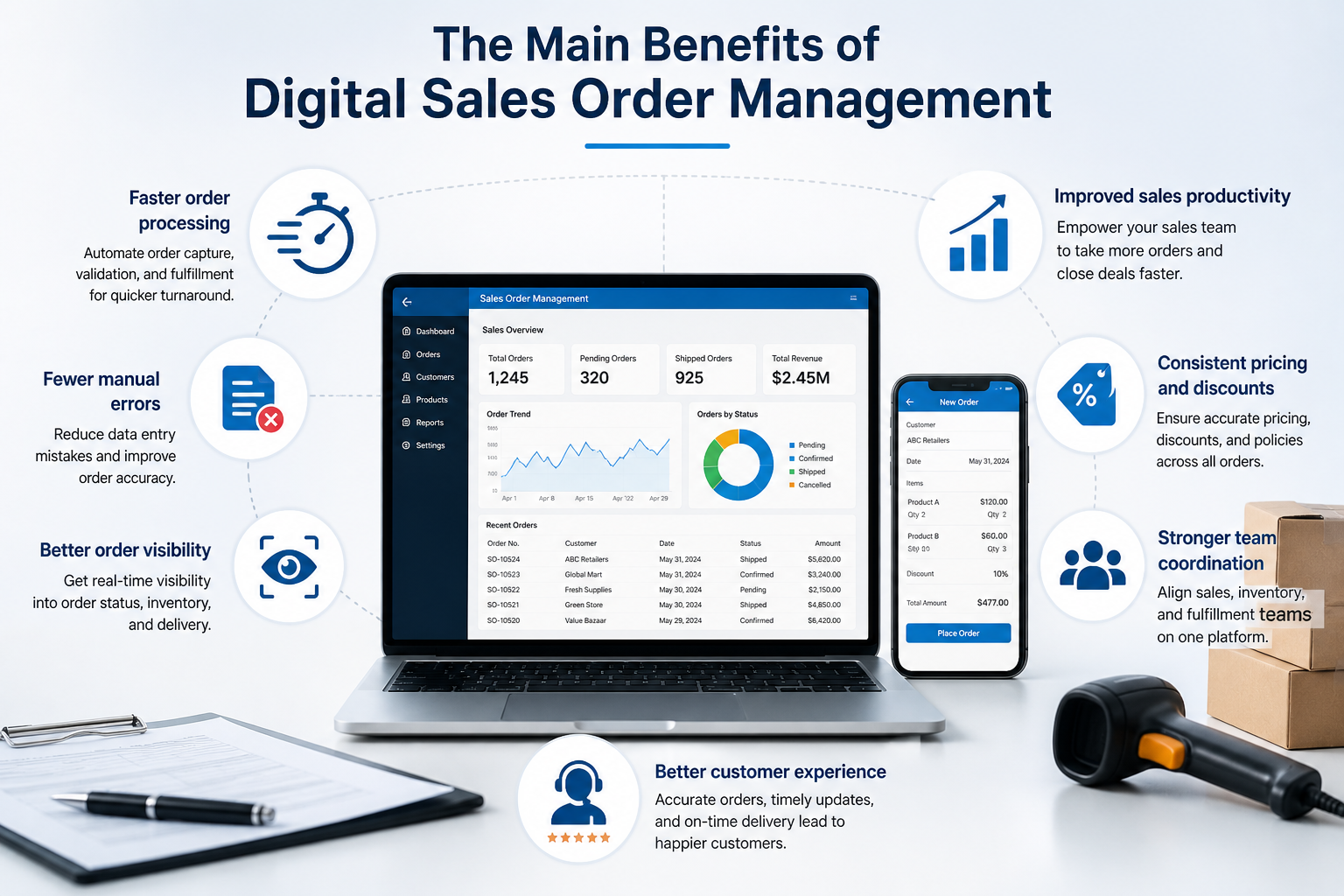
Digital sales order management does more than make ordering convenient. For wholesale distributors, it improves daily execution while supporting long-term growth.
Here are the key benefits:
• Faster order processing: Sales teams can create and submit orders quickly without waiting on manual confirmations.
• Fewer manual errors: Structured workflows reduce mistakes in quantities, pricing, discounts, SKUs, and customer details.
• Better order visibility: Teams can track whether an order is created, approved, processed, dispatched, or delayed.
• Improved sales productivity: Sales representatives spend less time on admin work and more time serving customers.
• Consistent pricing and discounts: Predefined rules help ensure the right price is applied for the right customer.
• Stronger team coordination: Sales, warehouse, finance, and operations teams can work from the same order information.
• Better customer experience: Customers get faster responses, clearer updates, and more accurate fulfillment.
How does it support business growth?
Manual systems often work until the business starts growing. Then the same processes that once felt manageable begin to create delays.
A distributor with ten customers may be able to manage orders on spreadsheets. But what happens when there are hundreds of customers, multiple sales representatives, thousands of SKUs, and different pricing rules across regions?
Digital sales order management gives businesses a more scalable foundation. As order volumes increase, the system can continue supporting structured workflows, standardized approvals, and centralized information.
This makes growth less chaotic. Businesses can expand without depending entirely on manual coordination.
What to Look for in a Digital Sales Order Management Solution
The right solution should be easy to use and practical for real sales teams. A complicated system may look impressive, but if people avoid using it, it will not solve the problem.
Look for a platform that supports product catalogs, quick order placement, customer-specific pricing, order tracking, and mobile accessibility. It should also be flexible enough to match the way your distribution business operates.
At Supplymint, our DigiSales solution is designed for B2B sales order workflows. We help businesses manage product catalogs, bulk ordering, quotes, order summaries, and tracking in a more organized digital environment.
Final Words
Wholesale distribution is changing. Customers expect faster service, sales teams need better tools, operations teams need accurate data, and business leaders need clearer visibility.
Spreadsheets may feel familiar, but familiarity should not come at the cost of growth.
Digital sales order management helps distributors move from manual coordination to structured execution. It reduces errors, improves speed, strengthens customer trust, and gives teams the confidence to handle more orders without more chaos.
At Supplymint, we built DigiSales to help businesses simplify B2B sales ordering and manage the entire order journey with more clarity and control. If your current order process feels slow, scattered, or difficult to control, it may be time to modernize the way your business manages sales.
Frequently Asked Questions
1. What is the biggest advantage of digital sales order management?
The biggest advantage is control.
Spreadsheets may store information, but they do not actively manage the sales order process. A digital sales order management system gives businesses better control over order accuracy, pricing, visibility, and fulfillment.
It helps teams clearly understand what was ordered, who placed the order, what price was applied, and what stage the order is currently in.
2. Will spreadsheets disappear completely?
Not completely. Many businesses may still use spreadsheets for reporting, analysis, or temporary planning. However, spreadsheets are no longer ideal as the main system for managing sales orders.
Sales order management needs structure, speed, visibility, and accountability. A digital platform is better suited for that level of operational control.
3. Can digital sales order management improve customer experience?
Yes. Digital sales order management can significantly improve customer experience by making the ordering process faster, clearer, and more predictable.
Customers get more accurate orders, quicker responses, and better visibility into order progress. This reduces delays, repeated follow-ups, and uncertainty.
In wholesale distribution, that clarity helps build stronger customer trust.
4. Is digital sales order management only for large distributors?
No. Digital sales order management is useful for businesses of different sizes.
Large distributors use it to manage complex operations, multiple regions, high order volumes, and larger sales teams. Small and mid-sized distributors can also benefit because it reduces manual workload, improves accuracy, and helps teams work more efficiently.
5. How do you know it is time to replace spreadsheets?
It may be time to replace spreadsheets when your current process starts slowing down your team or affecting customer satisfaction.
Common signs include:
• Order volumes are increasing
• Sales teams are working from different locations
• Customers frequently ask for order updates
• Pricing rules are becoming harder to manage
• Errors are affecting fulfillment or customer satisfaction
• Teams rely heavily on calls, emails, or messaging apps
These may seem like small inefficiencies, but over time they reduce speed, control, and customer confidence.