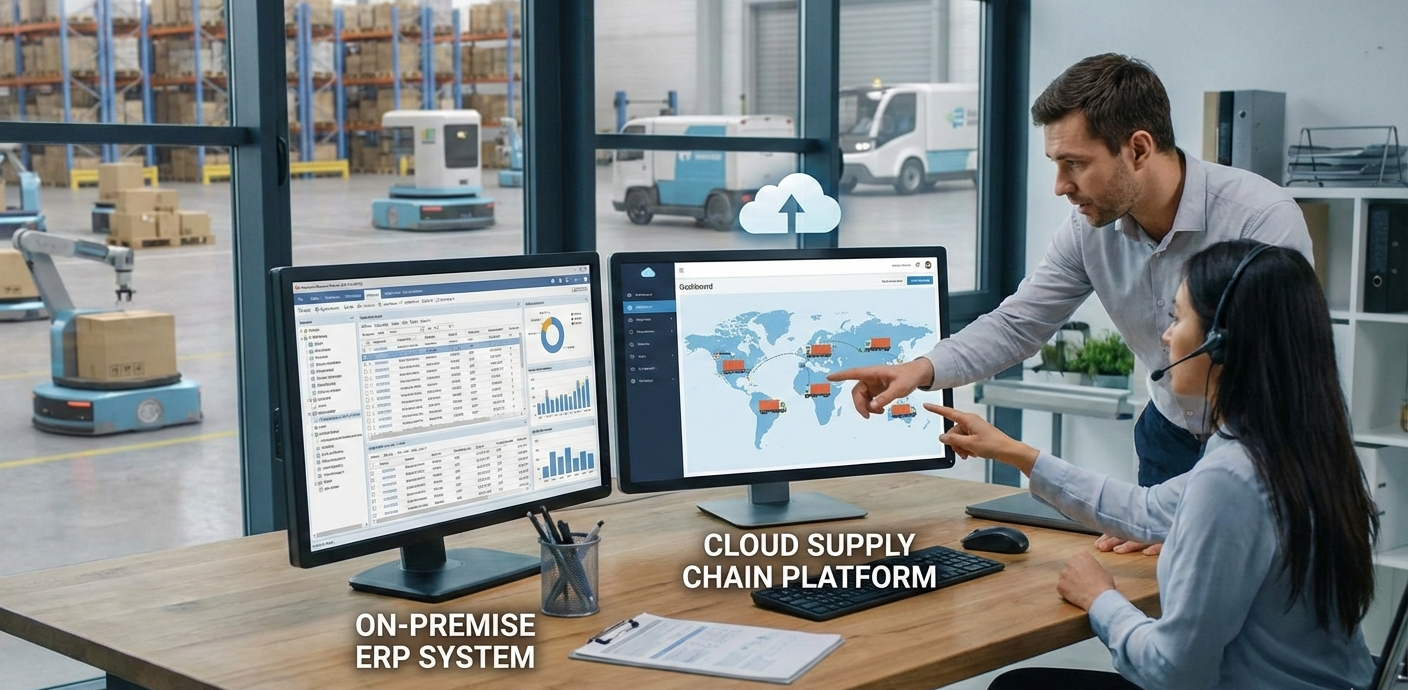
For years, ERP systems were the backbone of supply chain operations. They centralized data, standardized processes, and helped businesses scale. But supply chains in 2026 look very different. Demand shifts faster, sourcing is global, lead times are unpredictable, and brands operate across retail, D2C, marketplaces, and omnichannel networks, all at once.
This growing complexity has forced leaders to question whether traditional ERP systems can still keep up, or if cloud supply chain software offers a more agile alternative. As businesses rethink how they plan, procure, and respond in real time, the conversation has shifted from systems of record to systems of action.
What Is an ERP System?
An ERP (Enterprise Resource Planning) system is a centralized software platform designed to manage a company’s core internal operations in one place. Its primary goal is to create a single source of truth for business data, ensuring consistency across teams and departments.
Traditional ERP systems were built to handle standardized, back-office processes such as finance, accounting, human resources, procurement, and basic operations. By integrating these functions, ERPs helped organizations reduce data silos and improve internal efficiency.
ERPs became the default choice for growing businesses because they offered structure, control, and compliance at scale. For many years, they worked well in relatively stable environments where processes changed slowly and supply chains were predictable.
What Is Cloud Supply Chain Software?
Cloud supply chain software is purpose-built to manage supply chain planning and execution in fast-moving, complex environments. Unlike traditional ERP systems, it focuses specifically on how goods are planned, sourced, produced, and moved, rather than on general business administration.
These platforms are cloud-native, modular, and API-first by design. This means businesses can deploy only the supply chain capabilities they need, such as demand planning, procurement, inventory management, or production tracking, and integrate them easily with existing ERP, finance, and eCommerce systems.
Most importantly, cloud supply chain software is built for real-time visibility. It continuously connects data across suppliers, factories, warehouses, and stores, enabling teams to respond faster to demand changes, supply disruptions, and operational bottlenecks, something legacy ERP systems were never designed to handle at speed.
Why Traditional ERP Struggles in 2026 Supply Chains
Traditional ERP systems struggle because they were not designed for real-time, multi-channel supply chains.
Most ERP platforms were built for stability, not constant change. In today’s volatile supply chain environment, this creates several critical gaps:
• Rigid workflows that assume predictable demand, fixed suppliers, and linear planning cycles
• Slow customization cycles, where adapting to new sourcing models or fulfillment strategies requires long development timelines
• Poor handling of demand volatility, driven by heavy reliance on historical data and static forecasting methods
• Limited real-time visibility into factories, vendors, and upstream partners, resulting in delayed or fragmented insights
Where Cloud Supply Chain Software Wins
Cloud supply chain software excels in environments where speed, visibility, and adaptability directly impact revenue and customer experience. Instead of locking teams into fixed planning cycles, it enables faster, continuous decision-making across the supply chain.
• Faster planning cycles by allowing teams to update forecasts, inventory plans, and purchase decisions in near real time rather than waiting for monthly or quarterly ERP-driven planning runs.
• Better demand sensing through live signals from sales channels, promotions, and market changes, helping businesses respond to demand shifts before they turn into stockouts or excess inventory.
• Real-time procurement and production tracking that connects buyers, vendors, and factories on a single platform, giving teams clear visibility into order status, delays, and capacity constraints as they happen.
• Easier integration with ERP systems, where cloud supply chain software works alongside ERP as a system of action, feeding accurate, real-time operational data back into finance and accounting without replacing core ERP functions.
Do You Still Need ERP in 2026?
Yes, many businesses still need ERP, but not as their primary supply chain planning system.
ERP platforms continue to play an important role in areas where stability, control, and compliance matter most. Finance, accounting, statutory reporting, and audit requirements are all domains where ERP systems remain reliable and necessary. For these functions, consistency is more valuable than speed.
However, supply chains in 2026 demand a very different operating model. Planning, procurement, inventory decisions, and production coordination require rapid adjustments, scenario-based planning, and continuous visibility across partners. Traditional ERP systems were never designed to act as this kind of real-time command center.
ERP + Cloud Supply Chain Software: The Modern Stack
ERP: The System of Record
ERP systems continue to anchor the business where accuracy and compliance matter most. Finance, accounting, tax, audits, and finalized transactions still belong in ERP. These systems provide structure, governance, and historical continuity across the organization.
Cloud Supply Chain Software: The System of Action
Supply chain execution, however, lives in motion. Planning inventory, adjusting purchase orders, tracking production, and responding to delays require real-time inputs and fast decision loops. This is where cloud supply chain software operates—turning live data into immediate action.
How They Work Together
Instead of forcing ERP to manage dynamic supply chain decisions, cloud supply chain software handles day-to-day planning and execution. Once decisions are finalized—orders confirmed, goods received, inventory updated—the data flows back into ERP for financial reporting and control.
This modern stack creates a clear separation of responsibilities: ERP maintains accuracy and compliance, while cloud supply chain software drives speed, visibility, and adaptability. The result is a connected ecosystem that supports growth without disrupting existing systems.
Which Is Better in 2026?
For most retail and D2C brands in 2026, cloud supply chain software is the better choice for planning, agility, and execution, while ERP plays a supporting role.
• Cloud supply chain software is designed for real-time decision-making, allowing teams to respond quickly to demand changes, supply disruptions, and operational constraints.
• ERP systems remain essential for financial control, compliance, and reporting, but they are not built to manage fast-moving supply chain execution.
• Modern supply chains require continuous planning rather than fixed forecasting cycles, which cloud-based platforms support far more effectively than traditional ERP.
• Businesses that rely solely on ERP often struggle with speed, visibility, and adaptability, especially across multi-channel retail and D2C operations.
How to Decide What’s Right for Your Business
Choosing between ERP, cloud supply chain software, or a combination of both depends less on technology and more on how your business actually operates.
Business size matters, but complexity matters more: Smaller businesses with simple operations may manage with basic ERP-driven workflows. As order volumes grow, SKUs expand, and suppliers increase, the need for real-time planning and coordination becomes more critical than company size alone.
Consider how complex your supply chain really is: If you manage multiple vendors, factories, warehouses, or sales channels, static ERP processes can quickly become a bottleneck. Cloud supply chain software is better suited for environments where visibility and coordination extend beyond internal teams.
Growth velocity changes system requirements: Fast-growing retail and D2C brands need systems that can scale without constant reconfiguration. If your business model, sourcing strategy, or fulfillment network evolves frequently, flexibility becomes more important than rigid standardization.
Separate planning needs from accounting needs: ERP excels at recording what has already happened. Supply chain success, however, depends on planning what should happen next. Businesses that treat planning and execution as first-class functions often benefit from a dedicated cloud supply chain platform alongside ERP.
The Real Question Isn’t ERP vs Cloud
The debate between ERP and cloud supply chain software misses the bigger picture. In 2026, the real challenge isn’t choosing one system over another, it’s building a supply chain that can move fast, stay visible, and adapt as conditions change.
ERP systems still provide the structure businesses need for financial control and compliance. But speed, real-time visibility, and execution now define supply chain performance. That’s why forward-thinking brands are shifting toward a future-ready stack, one where cloud supply chain software leads planning and action, and ERP supports governance and record-keeping.
Brands that win in 2026 don’t choose sides; they build smarter systems.
If you’re exploring how to modernize your supply chain without disrupting your existing ERP, platforms like Supplymint are designed to help teams plan faster, execute better, and stay resilient in an unpredictable market.
Frequently Asked Questions
Can cloud supply chain software work without replacing ERP?
Yes. Cloud supply chain software is designed to work alongside ERP, not replace it. It handles planning, procurement, inventory, and execution in real time, while ERP continues to manage finance, accounting, and compliance.
Which businesses benefit most from cloud supply chain software?
Retail, D2C, and omnichannel brands with multiple suppliers, fast-changing demand, or complex fulfillment models benefit the most. These businesses need speed, visibility, and flexibility that traditional ERP systems struggle to provide.
How long does it take to implement cloud supply chain software?
Implementation is typically faster than ERP because cloud supply chain platforms are modular. Businesses can start with core planning or procurement functions and expand over time, reducing risk and time to value.
Does cloud supply chain software support real-time collaboration with vendors?
Yes. Modern cloud platforms enable live collaboration with suppliers and factories, offering visibility into order status, production progress, delays, and capacity constraints—without relying on manual updates or spreadsheets.
Is cloud supply chain software secure and reliable?
Cloud-native supply chain platforms use enterprise-grade security, role-based access, and continuous updates. In many cases, they are more secure and resilient than legacy, on-premise ERP systems.
How does Supplymint fit into a modern supply chain stack?
Supplymint acts as the system of action for supply chain planning and execution. It integrates with existing ERP systems to provide real-time visibility, faster decision-making, and better coordination across buyers, vendors, and operations.