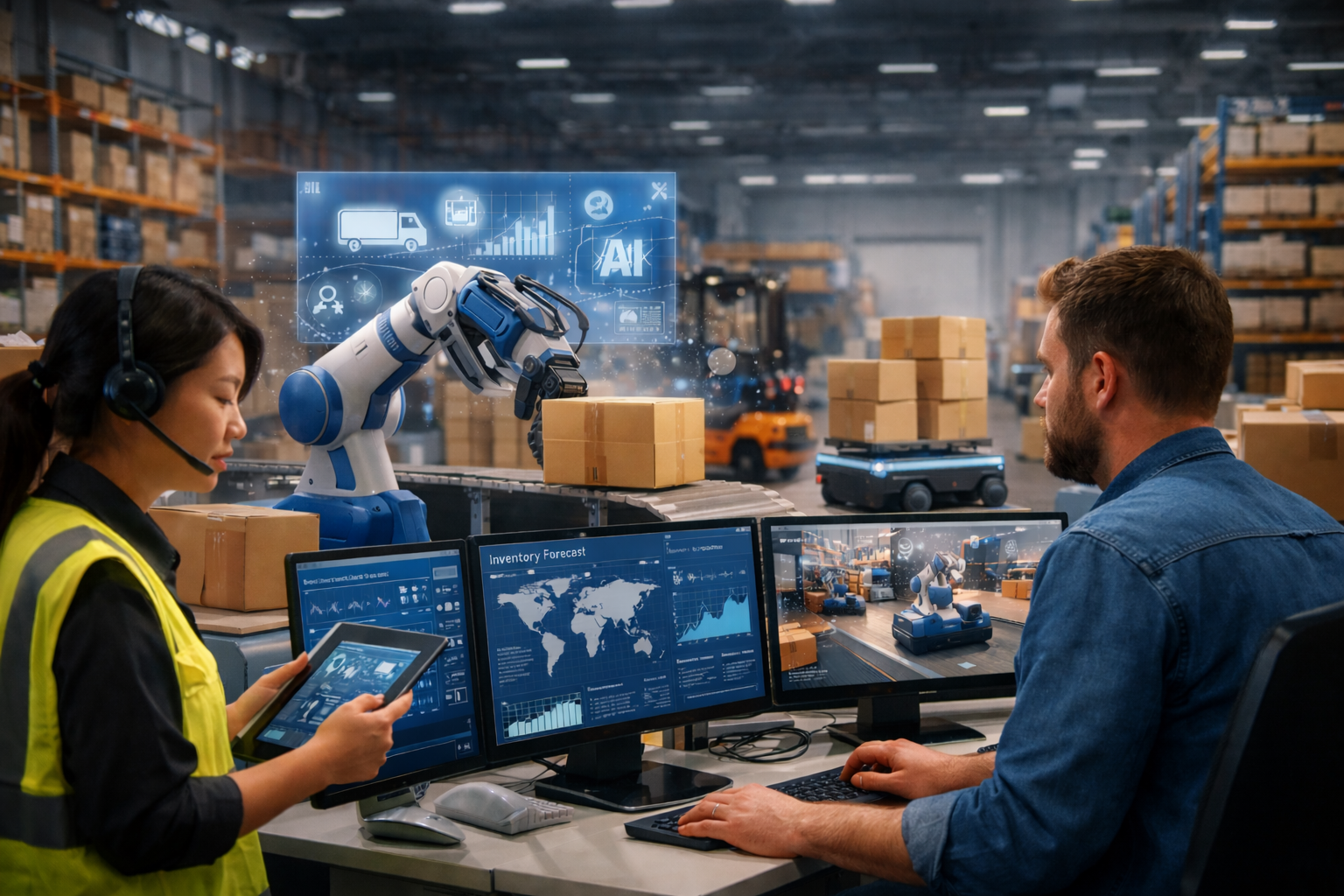
Retail supply chains in 2026 require speed, visibility, and continuous decision-making. Demand volatility is higher than ever, product lifecycles are shorter, and customers expect availability across multiple channels in real time. Yet many retail supply chains are still planned using static forecasts, delayed reports, and manual interventions.
These traditional planning approaches struggle to keep up with sudden demand shifts, supplier disruptions, and fast-moving inventory cycles. By the time insights surface, opportunities are missed and risks have already materialized.
This is where AI is transforming retail supply chain management. No longer a “nice to have,” AI enables retailers to sense change early, plan dynamically, and act with confidence, turning complexity into a competitive advantage in an increasingly unpredictable market.
What AI Means for Retail Supply Chain Management
AI in retail supply chain management uses data and machine learning to predict demand, optimize inventory, and improve execution in real time.
To understand AI’s role, it helps to separate it from automation and analytics. Automation follows predefined rules to execute tasks. Analytics looks backward, explaining what already happened. AI goes a step further, it learns from data patterns and continuously adapts its recommendations as new information comes in. In retail supply chains, AI processes real-time signals such as sales trends, promotional activity, supplier lead times, inventory movement, and inbound shipments. Instead of waiting for reports or manual reviews, it connects these signals instantly to highlight risks, forecast outcomes, and suggest actions.
Why Traditional Supply Chain Planning Breaks Down Without AI
Retail supply chains were not built for the level of volatility they face in 2026. Yet many planning processes still rely on assumptions that no longer hold true.
Traditional planning depends heavily on static forecasting, using historical sales data to predict future demand. In reality, demand now shifts dynamically due to promotions, channel mix changes, weather events, and supply-side disruptions, making static forecasts increasingly unreliable.
Many teams still rely on spreadsheets to bridge system gaps. While flexible, spreadsheets introduce manual effort, version conflicts, and delayed decision-making, especially at scale.
Without AI, organizations also struggle to react quickly to disruptions. Supplier delays, production bottlenecks, or sudden demand spikes are often identified too late, after inventory imbalances have already occurred.
Finally, traditional systems offer limited scenario planning. Testing “what if” situations, such as demand surges or supplier constraints, requires time-consuming manual analysis, reducing a team’s ability to act proactively.
Key Areas Where AI Is Transforming Retail Supply Chains
AI’s impact is most visible where planning speed, accuracy, and execution matter most.
AI-Driven Demand Forecasting & Sensing
AI moves demand planning beyond historical averages. Instead of relying solely on past sales, AI incorporates real-time sales velocity, promotional activity, seasonality shifts, and external signals.
This allows retailers to sense demand changes earlier and adjust plans continuously, rather than waiting for forecast cycles to complete.
AI for Inventory Planning & Replenishment
Balancing stockouts and overstock has always been a core retail challenge. AI improves this balance by optimizing inventory at a SKU level, factoring in demand variability, lead times, and service-level targets.
Rather than applying uniform rules across products, AI tailors replenishment decisions to individual SKUs, locations, and channels, reducing excess inventory while protecting availability.
AI in Procurement & Supplier Management
AI enhances procurement by predicting supplier lead times, identifying capacity constraints, and surfacing early risk signals.
By analyzing historical supplier performance alongside current conditions, AI helps teams make more informed sourcing decisions and adjust purchase plans before disruptions escalate.
AI for Production & Inbound Visibility
AI provides early warnings before delays occur, using signals from production schedules, shipment progress, and inbound data.
Smarter use of advance shipment notifications (ASN) and packing intelligence allows teams to plan inbound receiving more accurately, improving coordination between suppliers, factories, and warehouses.
What AI Does Better Than Traditional ERP Systems
AI-powered systems complement ERP, but they outperform ERP in areas where adaptability and speed are critical.
ERP systems operate on fixed logic and predefined workflows. AI systems continuously learn, refining recommendations as new data becomes available.
Decision speed is another differentiator. AI evaluates thousands of variables simultaneously, enabling faster responses than manual or report-driven ERP processes.
Retail’s multi-channel complexity, spanning stores, D2C, marketplaces, and fulfillment partners, is also better suited to AI-driven planning than rigid ERP structures.
Finally, AI delivers real-time insights, while ERP systems primarily generate reports after events have occurred.
Is AI Replacing Supply Chain Teams?
AI supports supply chain teams by improving decision quality and speed, not replacing human expertise.
AI excels at processing data, identifying patterns, and surfacing recommendations. Human teams provide judgment, context, and strategic oversight—especially when trade-offs are involved.
Rather than eliminating roles, AI enables teams to focus on higher-value work. Decisions are made faster, with better information, and with greater confidence, without increasing headcount.
ERP + AI + Cloud Supply Chain Software: The Modern Retail Stack
In modern retail environments, ERP, AI, and cloud supply chain software each play distinct roles.
ERP remains the system of record, managing finance, compliance, and finalized transactions.
AI-powered cloud supply chain platforms function as the system of action, continuously planning, sensing, and adjusting operations in real time.
Platforms like Supplymint are designed to sit at this intersection, using AI to power planning and execution while integrating cleanly with existing ERP systems.
This stack allows retailers to maintain financial control without sacrificing agility.
How to Know If Your Retail Supply Chain Is Ready for AI
AI readiness is less about technology and more about operational maturity.
If your business has access to consistent data across sales, inventory, suppliers, and production, AI can begin delivering value quickly.
Supply chains with multiple vendors, channels, or fulfillment models benefit most, as complexity increases the value of dynamic planning.
Planning maturity also matters. Organizations that already recognize the limits of static forecasting are better positioned to adopt AI-driven decision-making.
Finally, growth velocity is a strong indicator. Fast-growing retailers often need AI to scale planning without adding operational friction.
What the Future Looks Like Beyond 2026
Retail supply chains are moving from predictive planning to prescriptive decision-making.
AI systems will increasingly recommend not just what might happen, but what actions to take, and when.
Over time, planning cycles will become always-on, continuously adjusting as new signals emerge, rather than running on fixed schedules.
The result is a supply chain that responds to change as it happens, not after the fact.
Final Words
In 2026, AI is no longer experimental. It has become a competitive necessity for retailers navigating volatility, complexity, and rapid growth.
Winning supply chains aren’t built with bigger teams or more reports. They’re built with smarter systems that enable faster, more informed decisions at every stage of planning and execution.
If you’re evaluating how AI can improve demand sensing, inventory planning, procurement, and inbound visibility across your retail supply chain, our platform is designed to turn real-time insights into practical action, without disrupting your existing ERP stack.
Frequently Asked Questions
How long does it take to see value from AI in retail supply chains?
Many retailers begin seeing measurable improvements within weeks, especially in areas like demand sensing and inventory planning. Because AI models continuously learn from live data, value increases over time as the system adapts to business patterns.
Does AI require perfectly clean data to work effectively?
No. While data quality matters, modern AI systems are designed to work with imperfect and incomplete data. They identify patterns, filter noise, and improve accuracy as more signals become available.
Is AI supply chain software only suitable for large retail enterprises?
AI-driven supply chain platforms are increasingly used by mid-sized and growing retailers. Cloud-based deployment and modular adoption make AI accessible without the cost or complexity traditionally associated with enterprise systems.
How does AI support multi-channel retail operations?
AI connects signals across stores, D2C, marketplaces, and fulfillment partners. This unified view allows retailers to plan inventory and replenishment holistically, rather than treating each channel in isolation.
Can AI help reduce manual planning and spreadsheet dependency?
Yes. AI automates large portions of demand analysis, inventory calculations, and scenario evaluation, reducing reliance on spreadsheets and freeing teams to focus on decision-making rather than data preparation.
What should retailers prioritize before adopting AI in their supply chain?
Retailers should focus on visibility and data flow across sales, inventory, suppliers, and production. AI delivers the most value when it can access consistent, real-time operational signals.