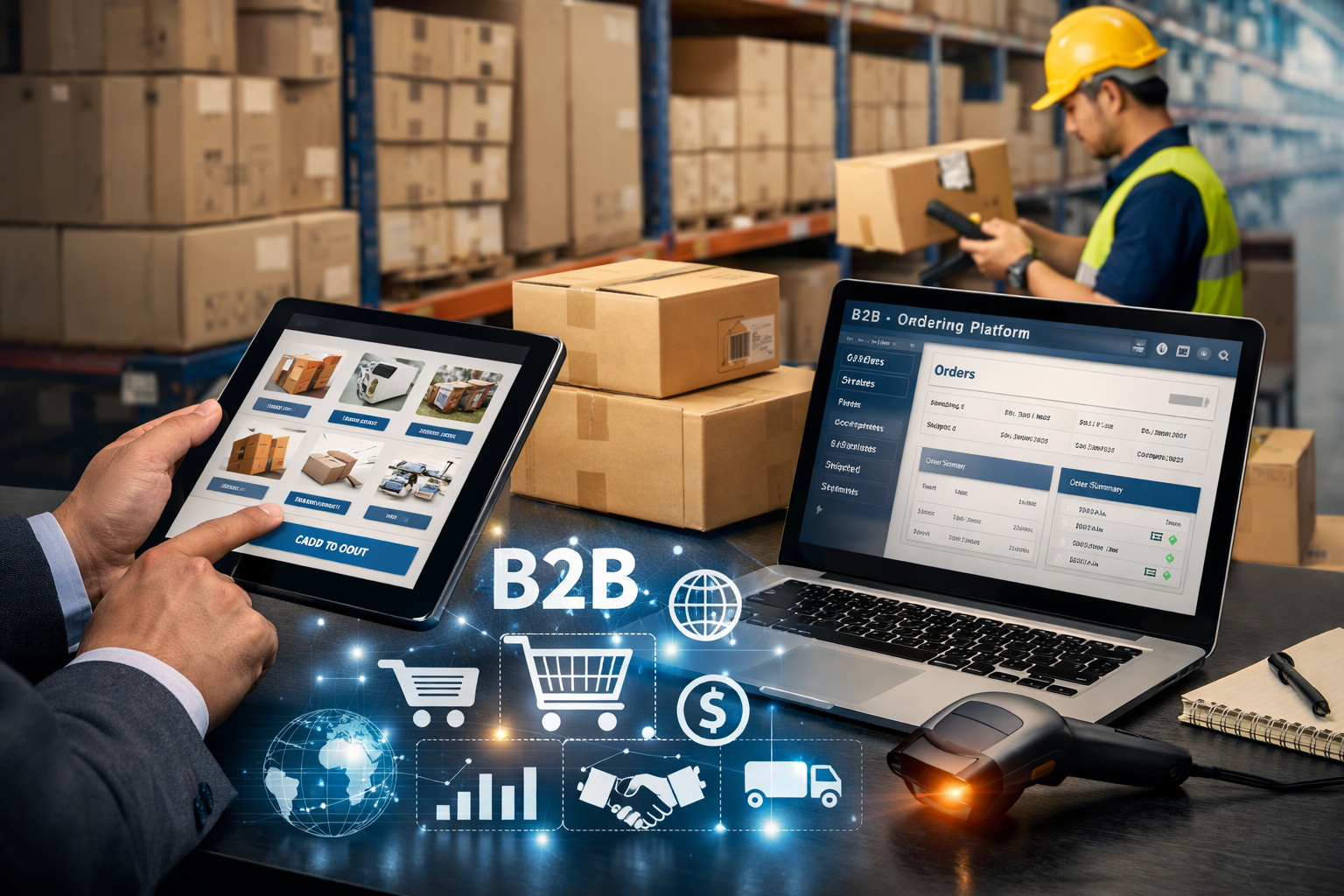
B2B commerce is going through a structural shift. For decades, ordering in B2B depended on calls, emails, spreadsheets, and direct coordination with sales representatives. That system worked when volumes were predictable and relationships were managed one-on-one. But buyer expectations have evolved. Procurement teams now expect the same speed, transparency, and control they experience in consumer ecommerce.
Yet many B2B companies still rely on manual workflows. Orders are confirmed over email. Pricing is checked offline. Credit approvals happen after submission. As volume grows, these processes slow down operations and limit scalability.
This is where self-service ordering in B2B commerce is changing the model. Modern B2B self-service ordering replaces fragmented communication with structured digital systems. Buyers place orders independently. Pricing and credit rules are built into the platform. Sales teams shift from processing orders to building relationships. This is not a trend. It is a foundational redesign of how digital B2B ordering supports growth.
What Is B2B Self-Service Ecommerce?
B2B self-service ordering refers to a digital model where business buyers place and manage orders through a secure online portal, without depending on sales representatives for routine transactions.
Unlike a simple ecommerce catalog, a true self-service B2B commerce system is built around account-specific logic. Every buyer logs into a portal that reflects their contract terms, pricing structure, approved product assortment, and credit conditions.
In a structured B2B ordering platform, the system handles complexity in the background:
• Customer-specific pricing is applied automatically
• Approved SKUs are filtered by account
• Credit limits are validated before checkout
• Outstanding balances are visible in real time
• Role-based permissions define who can order or approve
This creates consistency. Orders are accurate at submission. Compliance rules are enforced by design. Manual validation is reduced.
A mature B2B customer self-service portal is not just an ordering tool. It becomes a digital operating layer for transactions between suppliers and buyers.
Why Traditional B2B Ordering No Longer Scales
Traditional B2B sales models were built around personal relationships. Sales reps handled communication, pricing discussions, and order confirmations. Finance teams verified credit after orders were placed. Operations manually entered data into ERP systems.
At low volume, this approach worked. At scale, it creates bottlenecks.
Common issues in manual B2B ordering include:
• Delays caused by back-and-forth communication
• Pricing mismatches due to outdated spreadsheets
• Manual data entry errors
• Post-order credit rejections
• Sales teams overloaded with admin tasks
As companies grow, complexity increases. More SKUs. More customers. More pricing tiers. More approval workflows. Manual coordination becomes fragile.
Industry research highlights the urgency of digital transformation. Analysts predict that a large majority of B2B interactions are now happening online. A growing percentage of buyers prefer digital channels over direct rep communication for routine purchases. Younger procurement professionals expect intuitive interfaces and 24/7 access.
Without a scalable self-service B2B sales model, growth depends on hiring more sales staff. That increases cost without improving efficiency. In contrast, digital systems scale with volume. The marginal cost of processing the next order decreases.
This is why wholesale self-service ordering is becoming central to modern B2B strategy.
Why B2B Buyers Prefer Self-Service Ordering
Buyer behavior is changing. Procurement teams want autonomy, transparency, and speed. They prefer systems that reduce friction and give them control.
1. Control Over the Buying Process
Buyers want to manage their own timelines. They want to browse products, compare options, and place orders without waiting for responses. Digital self-service for B2B allows them to initiate transactions instantly.
2. 24/7 Ordering Capability
B2B operations run across time zones and schedules. A digital portal works outside business hours. Orders can be placed at night, on weekends, or during peak seasons without delay.
3. Reduced Communication Overhead
Email chains slow down decision-making. Phone calls create documentation gaps. A structured B2B ordering platform eliminates unnecessary back-and-forth by validating pricing, availability, and credit at checkout.
4. Faster Reordering
Many B2B transactions involve repeat purchases. Buyers often reorder the same SKUs in bulk. With stored order history, repeat orders take seconds instead of hours.
5. Transparency and Confidence
Buyers see contract pricing applied automatically. They see live stock status. They see available credit before submitting. This transparency builds trust.
Research consistently shows that digital experience influences supplier selection. When buyers can manage their account independently, satisfaction increases. Over time, convenience becomes a competitive advantage.
Key Features of a Scalable B2B Self-Service Ordering Platform
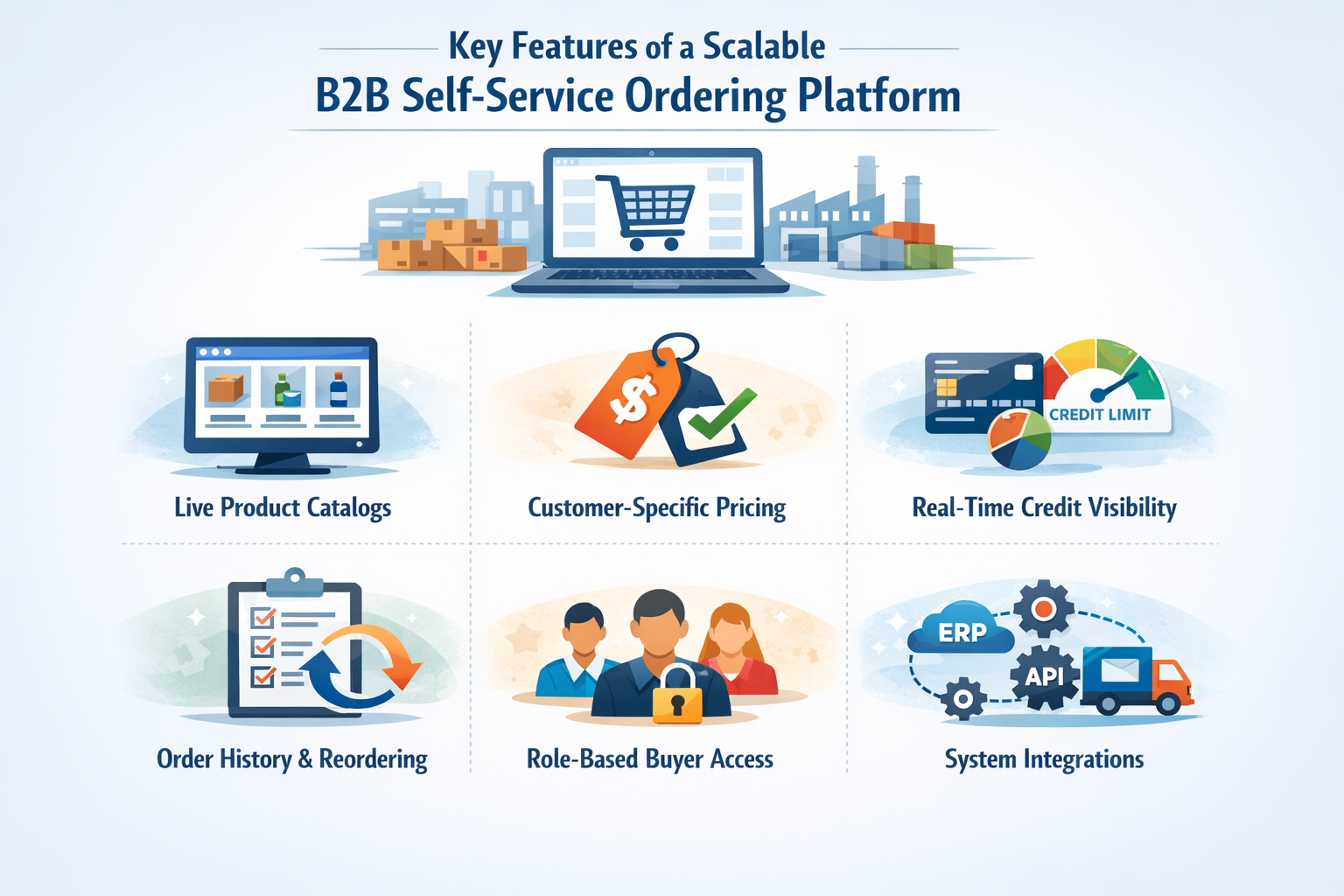
A robust self-service ordering platform must support complex B2B logic while remaining intuitive for users.
• Live Product Catalogs
A real-time catalog ensures product availability and specifications are current. Buyers see only what applies to their account. Discontinued or restricted items are automatically filtered.
• Customer-Specific Pricing
Contract pricing is embedded into the system. Discounts, tiered pricing, and negotiated terms are calculated instantly. There is no need for manual adjustments.
• Real-Time Credit Visibility
Credit limits and outstanding balances are displayed before checkout. Orders that exceed limits can trigger automated approval workflows.
• Order History & Reordering
Past transactions are stored within the portal. Buyers can duplicate previous orders or access saved procurement lists.
• Role-Based Buyer Access
Large organizations require structured permissions. Managers may approve orders. Procurement officers may place them. Finance teams may review invoices. Role-based access ensures governance.
• System Integrations
A scalable B2B ecommerce for distributors often integrates with ERP, CRM, and PIM systems. API-driven architecture ensures that data flows automatically across systems.
When these features operate together, the portal becomes a central transactional hub rather than a simple online store.
How Self-Service Ordering Helps Sales Teams Scale
A common misconception is that self-service replaces sales teams. In reality, it elevates their role.
In traditional systems, sales representatives spend significant time processing routine orders. They confirm pricing. They check stock. They follow up on payment status. These tasks consume time but do not directly generate new revenue.
With scaling B2B sales with self-service, routine transactions move online. The portal handles validation and documentation. Sales reps focus on strategic activities:
• Developing new accounts
• Expanding product adoption
• Negotiating long-term contracts
• Solving complex commercial challenges
This shift increases productivity. Revenue grows without proportional headcount increases.
Self-service sales in B2B creates leverage. The system handles volume. Sales teams handle growth.
Self-Service Ordering vs Traditional B2B Sales Models
The difference between traditional and digital models is structural.
| Dimension | Traditional Model | Self-Service B2B Commerce |
| Order Initiation | Sales rep-driven | Buyer-driven |
| Availability | Business hours only | 24/7 access |
| Pricing Accuracy | Checked manually | Automated validation |
| Credit Control | Reviewed post-order | Verified at checkout |
| Scalability | Requires more staff | Scales digitally |
| Operational Cost | High administrative burden | Reduced processing cost |
The traditional model relies heavily on people for transaction management. The digital model embeds commercial logic into systems.
As order volume increases, system-based models outperform manual processes in both cost efficiency and accuracy.
How DigiSales Enables Scalable B2B Self-Service Commerce
DigiSales is designed to support distributors and retailers operating with complex pricing structures and customer-specific terms.
Rather than positioning itself as a replacement for sales teams, DigiSales functions as an operational enabler. It provides:
• Unified digital ordering experience
• Account-specific pricing logic
• Integrated credit visibility
• Structured approval workflows
• Alignment between sales, finance, and operations
For companies seeking self-service B2B commerce platform capabilities, DigiSales helps centralize transactional control while reducing manual effort.
By consolidating product data, pricing rules, and order workflows into a single environment, businesses can grow order volume without increasing operational chaos.
Is Self-Service Ordering Replacing Sales Reps?
The short answer is no.
What changes is the distribution of work. Routine, repeatable transactions move to digital channels. Strategic, relationship-driven activities remain human.
In hybrid models:
• Buyers use the portal for standard purchases
• Sales reps handle negotiations and growth strategy
• Complex configurations may involve collaborative engagement
This combination improves efficiency while maintaining personal relationships. For large distributors, this hybrid structure offers both control and scalability.
The question is not whether self-service ordering in B2B commerce replaces people. The real question is how systems and people collaborate effectively.
Final Thoughts
B2B commerce is steadily moving toward autonomy and system-driven transactions. Buyers now expect speed, transparency, and complete digital control over their purchasing process. Manual ordering methods may still function at small volumes, but they create bottlenecks as businesses grow.
Structured B2B self-service ordering solves this by embedding pricing logic, credit controls, and approval workflows directly into digital systems. Instead of increasing headcount to manage rising order volumes, companies can scale through smarter infrastructure. Platforms like Supplymint support this shift by enabling distributors and brands to streamline ordering, align sales and operations, and maintain control without adding complexity.
Self-service is no longer just a competitive advantage. It is becoming the foundation of modern, scalable B2B commerce.
FAQs
What is B2B self-service ecommerce?
It is a digital ordering framework where business customers independently place orders through a secure portal with account-specific pricing, credit rules, and permissions.
How does self-service ordering work in B2B?
Customers log into a portal, view approved products and pricing, check stock and credit status, and place orders directly. The system validates rules automatically before submission.
Can self-service work for large distributors?
Yes. Modern B2B ecommerce for distributors supports bulk ordering, hierarchical pricing, approval workflows, and ERP integrations, making it suitable for complex operations.
Is self-service ordering secure for B2B?
Yes. Access is controlled through secure logins, role-based permissions, and account-level restrictions to protect commercial data.
What businesses benefit most from B2B self-service portals?
Distributors, wholesalers, manufacturers, and retailers with recurring orders and contract-based pricing gain the most from wholesale self-service ordering.