
Scaling a D2C brand sounds exciting from the outside. More products, more customers, more sales, more visibility. But inside the business, growth often feels messier than anyone expected. What worked at 100 SKUs starts to break at 300. By 500, your team is firefighting. By 1,000, even a small error in supply chain management can lead to stockouts, excess inventory, delayed launches, margin erosion, and unhappy customers.
This is the turning point many founders and operations leaders face. Growth is no longer just about selling more. It becomes about control. Can you keep the right products in stock? Can you forecast demand accurately? Can your suppliers, warehouses, and internal teams stay aligned as complexity multiplies?
The good news is that scaling SKU count does not have to mean losing visibility. With the right systems, planning habits, and operational discipline, D2C brands can expand fast without letting supply chain chaos take over. Here is how.
Why does scaling from 100 to 1,000 SKUs create so much supply chain complexity?
The short answer is simple: every new SKU adds more than one new product. It adds more decisions, more dependencies, and more room for error.
At 100 SKUs, many brands can still rely on spreadsheets, intuition, and frequent manual follow-ups. At 1,000 SKUs, that approach becomes fragile. Suddenly you are managing multiple product categories, seasonal patterns, bundles, variants, promotions, reorder cycles, supplier lead times, warehouse locations, and channel-level demand.
A single bestselling product may be easy to monitor. But when you have hundreds of slow movers, emerging winners, color-size variants, and promotional bundles, inventory behavior becomes harder to predict. A delay from one supplier can affect multiple launches. A bad forecast on one category can lock up working capital that should have gone into faster-moving products.
That is why supply chain management becomes a growth function, not just an operations function. It directly affects revenue, customer experience, and profitability.
What usually breaks first when D2C brands expand their SKU count?
In most cases, visibility breaks before execution does.
Teams stop trusting the numbers. One sheet says there is enough inventory. Another says a reorder is overdue. Sales teams push promotions without checking stock depth. Operations teams place urgent purchase orders based on incomplete data. Finance sees cash tightening but cannot immediately spot which inventory is underperforming.
Then the symptoms begin to show:
• Stockouts on hero SKUs
• Overstock on long-tail variants
• Missed launch timelines
• Increasing carrying costs
• Manual planning errors
• Supplier confusion
• Customer complaints due to delayed fulfillment
The issue is rarely just “more products.” The real issue is that the business is trying to manage complexity with systems built for a smaller stage.
How can D2C brands scale SKUs without losing supply chain control?
D2C brands scale successfully when they shift from reactive operations to structured planning.
That means replacing scattered decision-making with a repeatable operating model. Instead of asking, “What do we need to fix today?” high-growth brands start asking, “What decisions need to happen every week, every month, and every quarter to keep the system healthy?”
This usually comes down to five core moves:
1. Segment inventory instead of treating every SKU the same
2. Forecast demand with more nuance
3. Build supplier discipline early
4. Create tighter planning rhythms across teams
5. Use technology that gives real-time visibility
Let’s break each one down.
Why should you stop treating every SKU the same?
Not all SKUs deserve the same planning effort.
One of the biggest mistakes growing brands make is giving equal attention to every item in the catalog. But in reality, some SKUs drive the majority of revenue, some create strategic value, and some quietly drain cash and attention.
A smarter approach is to segment inventory.
You might classify products into groups such as:
Which SKUs are your core revenue drivers?
These are the products that consistently sell, generate repeat purchases, and anchor customer demand. These need the highest planning accuracy, tightest service levels, and most careful replenishment monitoring.
Which SKUs are seasonal or campaign-driven?
These products may sell extremely well during launches, holidays, or specific marketing windows. They need a different forecasting logic and closer collaboration between marketing and supply chain teams.
Which SKUs are experimental or long-tail?
These might support brand positioning or niche customer segments, but they should not consume the same working capital as proven winners. They need tighter buy quantities and clearer performance thresholds.
When brands segment inventory this way, supply chain management becomes more strategic. You stop over-planning low-impact products and start protecting the items that matter most.
How do you forecast demand when SKU count increases rapidly?
Forecasting at scale is less about guessing the future and more about reducing avoidable surprises.
As SKU count grows, simple historical averages stop being enough. New launches, promotions, regional demand shifts, bundling, seasonality, and channel-specific performance all start affecting demand patterns. If planning remains too simplistic, inventory gets distorted quickly.
Strong forecasting starts by asking better questions:
• Is this SKU stable, seasonal, or new?
• Is demand driven by repeat purchase or one-time campaigns?
• Is this sold through one channel or multiple channels?
• Is this product dependent on influencer activity, paid ads, or marketplace boosts?
• How long is the supplier lead time, and how much variability is normal?
This is where dedicated planning systems start to matter. Instead of relying on static spreadsheets, brands benefit from tools that connect sales trends, inventory positions, and replenishment timing in one place. A platform like inventory planning software can help teams move from reactive buying to forward-looking planning with more confidence.
The goal is not perfect forecasting. It is better forecasting that improves decision quality over time.
What role do suppliers play in scaling supply chain management?
Suppliers can either support your growth or quietly become the reason it stalls.
At 100 SKUs, supplier coordination might still feel manageable through messages, calls, and ad hoc follow-ups. At 1,000 SKUs, that approach becomes risky. Lead times vary. MOQs affect cash flow. Production delays can ripple across multiple collections. Communication gaps can turn into missed launches.
Brands that scale well do not just “source products.” They build supplier operating discipline.
That includes:
• Clear lead time tracking
• Defined reorder windows
• Reliable purchase order processes
• Performance reviews for fill rates and delays
• Backup suppliers for critical categories
• Shared demand visibility when possible
The relationship matters too. Suppliers are more likely to prioritize brands that plan ahead, communicate clearly, and operate consistently. When your forecasting improves, your supplier relationships usually improve with it.
In other words, better supply chain management strengthens supplier confidence, and stronger supplier confidence improves execution.
How can teams stay aligned as assortment expands?
As SKU count rises, cross-functional misalignment becomes expensive.
Marketing may want to push a product that has weak stock coverage. Merchandising may introduce too many variants without considering replenishment complexity. Finance may want leaner buys while customer experience teams push for higher availability. None of these goals are wrong. The problem happens when they operate in silos.
Growing D2C brands need one shared planning rhythm.
This usually means regular meetings and dashboards around:
• Demand forecast updates
• Inventory health by category
• Upcoming promotions and launches
• Open purchase orders
• Supplier risks
• Slow-moving and excess stock
• Cash tied up in inventory
When teams meet around shared numbers, decisions improve. Launches become more realistic. Promotions get better stock support. Reorders happen earlier. Risk becomes visible before it becomes urgent.
This is one of the most overlooked parts of scaling. The brands that stay in control are not always the ones with the biggest teams. They are the ones with the clearest operating cadence.
Why is inventory visibility so important once you cross 300 or 500 SKUs?
Because complexity hides problems until they become expensive.
Without strong visibility, businesses often discover issues too late. A hero SKU has already stocked out. An underperforming line has already accumulated too much inventory. A supplier has already missed a critical milestone. A warehouse has already run into allocation problems.
Real visibility means more than just “seeing stock levels.” It means understanding:
• What is available now
• What is in transit
• What is committed to orders
• What is at risk of stockout
• What is overbought
• What needs action this week
When that information lives across disconnected systems, speed drops. Teams spend more time reconciling data than making decisions. That is when fast-growing brands start to feel slower, even while sales continue to rise.
Good supply chain management restores speed by giving teams a reliable view of reality.
Should D2C brands reduce SKU complexity while scaling?
Sometimes, yes.
Scaling to 1,000 SKUs does not mean every SKU deserves to survive.
A larger catalog can create the illusion of growth, but more products do not always mean better business performance. In fact, too many low-performing variants often increase planning complexity without improving revenue meaningfully.
Smart brands review assortment health regularly. They ask:
• Which SKUs truly drive profit?
• Which variants create more operational burden than customer value?
• Which products are cannibalizing stronger items?
• Which launches deserve a second chance, and which should be retired?
Pruning is not a sign of failure. It is a sign of maturity. Some of the strongest brands scale by expanding intelligently, then simplifying where needed.
That balance matters. Growth should add momentum, not drag.
What systems help D2C brands stay in control as they grow?
The most valuable systems are the ones that reduce manual dependency and improve decision speed.
At a minimum, growing brands need systems that help them connect demand, purchasing, and inventory. They need fewer blind spots and fewer manual workarounds. That often includes:
• Inventory planning tools
• Demand forecasting support
• Purchase order visibility
• Supplier performance tracking
• Replenishment workflows
• Stock health reporting across categories and channels
But technology alone is not the answer. A bad process inside a better tool is still a bad process. The right platform should support a clear operating model, not replace one.
The winning combination is simple: disciplined planning plus systems that make discipline easier to maintain.
How do high-growth D2C brands make supply chain management feel manageable?
They stop trying to control everything manually.
This is an emotional shift as much as an operational one. In the early stage, founders and lean teams often stay close to every product decision. That works when the business is smaller. But at scale, manual control creates bottlenecks, not clarity.
The next stage of growth requires trust in process.
That means defining reorder rules. Creating clear ownership. Building review cadences. Monitoring the right metrics. Escalating exceptions instead of managing every SKU from scratch every day.
When brands do this well, the business feels calmer. Teams stop operating in panic mode. Inventory decisions become more predictable. Supplier conversations become more professional. Growth starts to feel sustainable, not chaotic.
That is the real promise of strong supply chain management. It does not just improve operations. It gives the business room to grow without losing confidence.
What metrics should D2C brands watch when scaling SKU count?
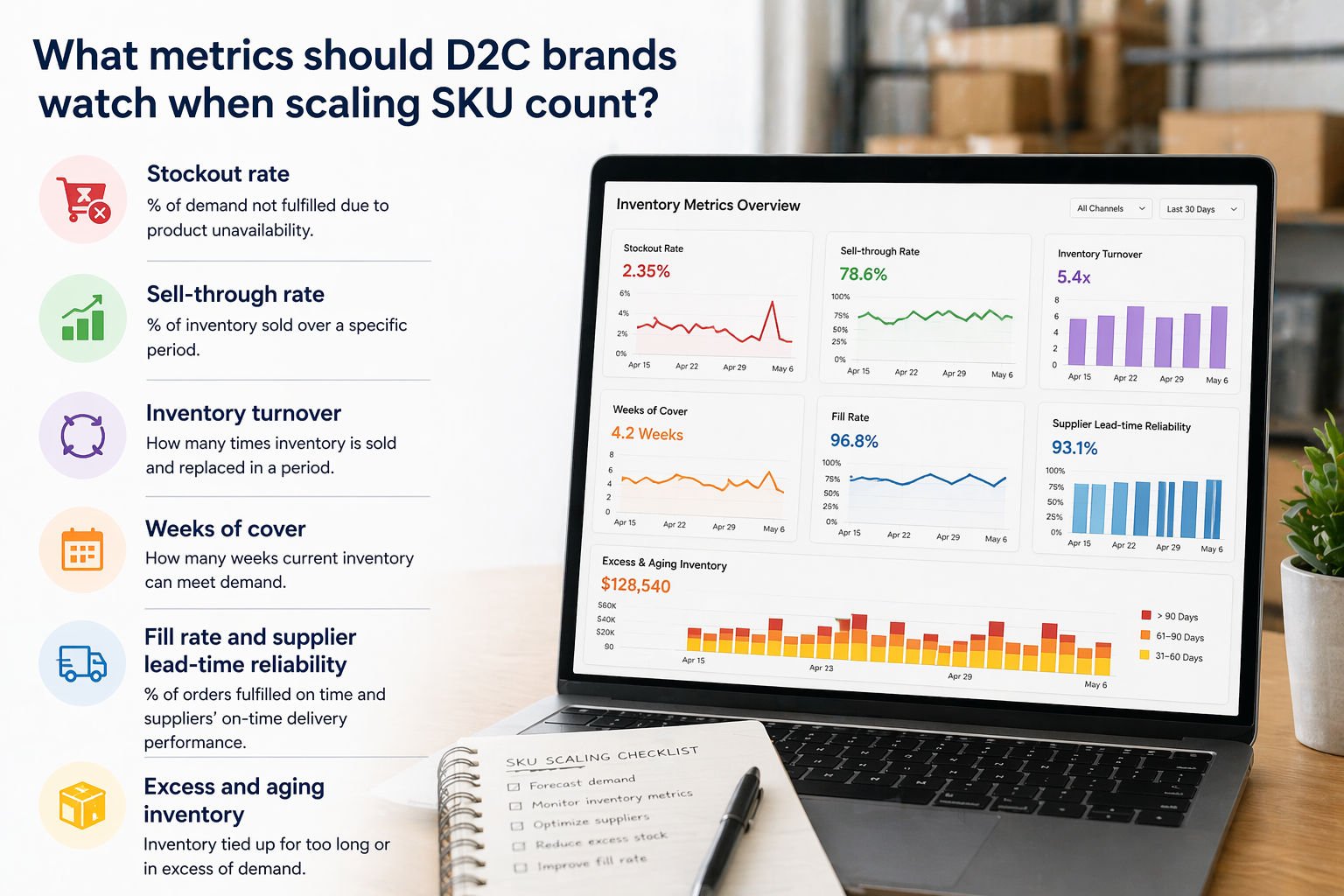
As assortment grows, vanity metrics stop being enough. High-growth brands need metrics that reveal both performance and risk.
The most useful ones often include:
1. Stockout rate
This shows how often demand cannot be fulfilled because inventory is unavailable. Frequent stockouts hurt revenue and customer trust.
2. Sell-through rate
This helps teams understand how quickly inventory is moving relative to what was bought or launched.
3. Inventory turnover
A healthy turnover rate signals that working capital is being used efficiently.
4. Weeks of cover
This helps planners understand how long current inventory will last based on expected demand.
5. Fill rate and supplier lead-time reliability
These metrics reveal whether suppliers are supporting the level of consistency the brand now requires.
6. Excess and aging inventory
This is essential for protecting cash flow and identifying underperforming assortment decisions.
The more complex the catalog becomes, the more important it is to watch these metrics in context, not isolation.
What does scalable supply chain management actually look like in practice?
It looks boring in the best possible way.
Orders are planned before they become urgent. Launch calendars and inventory plans are aligned. Teams trust the data. Suppliers know what is expected. Slow movers are reviewed before they become dead stock. Replenishment decisions are based on signals, not panic.
That may not sound glamorous, but it is what operational maturity looks like.
For D2C brands, that maturity becomes a real competitive advantage. When others are scrambling to fix stock issues, you are ready to launch. When others tie up cash in the wrong inventory, you are investing in the right products. When others disappoint customers, you stay reliable.
That is how brands scale from 100 to 1,000 SKUs without losing control.
Final thoughts
Every D2C brand loves the idea of expansion. More categories. More variants. More ways to win customers. But scaling from 100 to 1,000 SKUs is not just a merchandising milestone. It is an operational test.
Without strong supply chain management, growth creates stress faster than it creates value. But with the right planning discipline, visibility, and systems, complexity becomes manageable. Your team stops reacting and starts leading. Your inventory starts supporting growth instead of slowing it down.
If your brand is entering that next stage of SKU expansion, now is the time to strengthen the foundation before complexity outruns control. The right planning approach can help you grow faster, protect margins, and serve customers with confidence.
Frequently Asked Questions
1. How does supply chain management change when a D2C brand adds more SKUs?
As SKU count grows, supply chain management becomes more complex because forecasting, replenishment, supplier coordination, and inventory visibility all become harder. Brands need more structure, better segmentation, and stronger systems to stay in control.
2. What is the biggest inventory mistake D2C brands make while scaling?
One of the biggest mistakes is treating every SKU the same. Not every product needs the same stock depth, reorder logic, or planning attention. Segmenting SKUs helps reduce waste and improve availability.
3. When should a D2C brand move beyond spreadsheets?
Usually when manual tracking starts causing delays, confusion, or frequent stockouts. If multiple teams are using different versions of inventory data, or planning takes too much time, it is a strong sign that the business has outgrown spreadsheets.
4. Can more SKUs hurt profitability?
Yes. A larger catalog can increase carrying costs, create excess stock, and make forecasting less accurate if assortment is not managed carefully. More SKUs only help when they are backed by sound demand and smart planning.
5. What helps D2C brands scale without supply chain chaos?
The strongest foundations are clear inventory segmentation, better forecasting, disciplined supplier management, shared planning cadence across teams, and systems that provide real-time visibility into stock and replenishment.