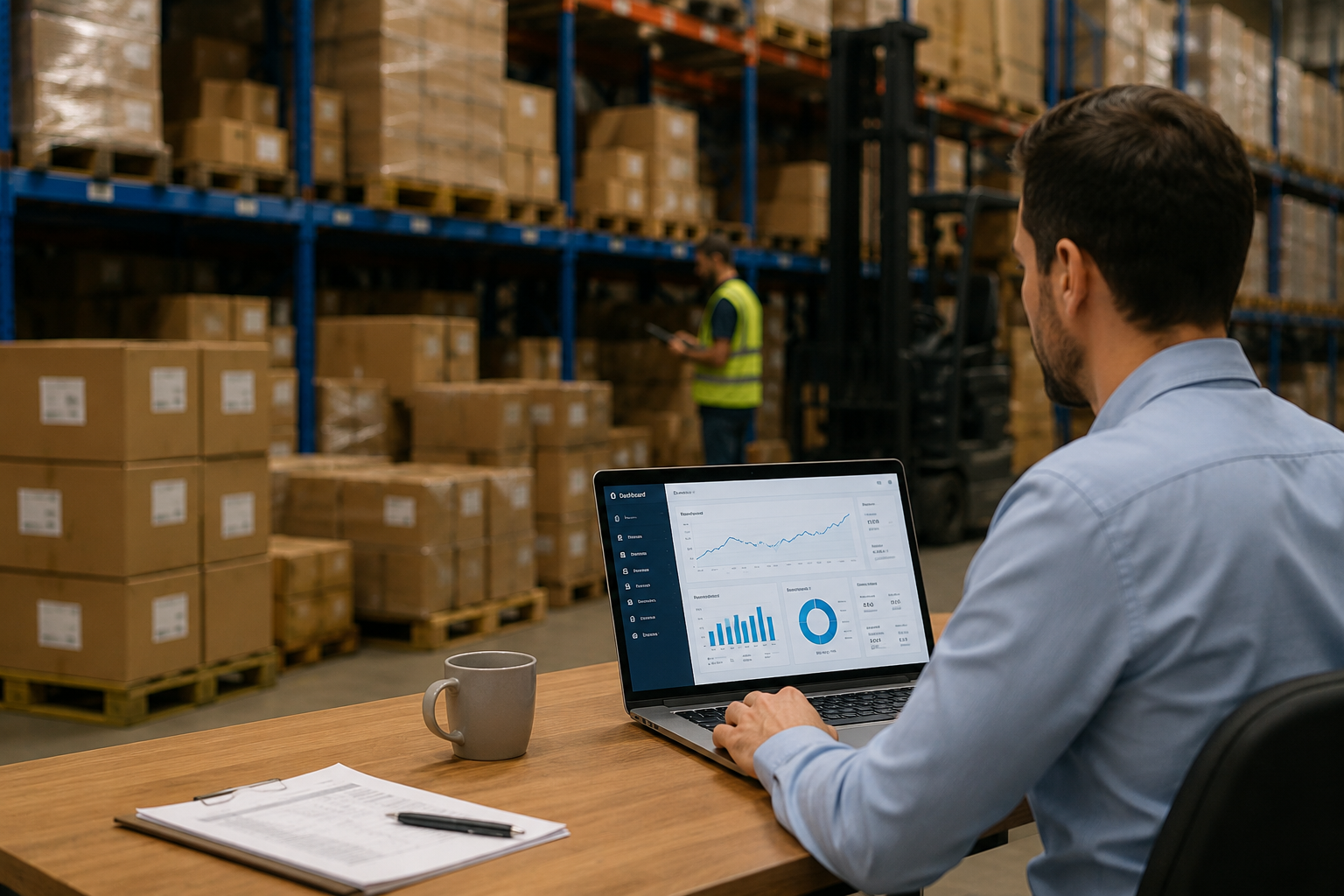
Inventory Replenishment is the process of restocking the right products, in the right quantities, at the right time so your business can meet demand without tying up cash in excess inventory.
If you run a retail or direct-to-consumer business, stockouts do not just hurt revenue. They create stress, disappoint customers, weaken trust, and leave teams scrambling to fix problems that could have been prevented.
That is why Inventory Replenishment matters so much.
When replenishment is handled well, your shelves stay healthy, your online store stays available, your warehouse moves with confidence, and your buyers, planners, and suppliers work from the same source of truth. When it is handled poorly, even a fast-growing brand can feel like it is constantly reacting instead of planning.
In this guide, you will learn what Inventory Replenishment means, why it matters, which inventory replenishment methods businesses use, how the stock replenishment process works, and how automated inventory replenishment helps modern retail and direct-to-consumer teams stay ahead.
Why stockouts feel bigger than just a missed sale
Running out of stock looks simple from the outside. A product is unavailable, and the customer moves on.
But inside the business, the impact spreads quickly.
A missed sale today can become a lost customer tomorrow. Marketing teams spend money driving traffic to products that are unavailable. Store teams face frustrated shoppers. Procurement teams rush urgent orders. Finance teams lose visibility into what inventory is actually needed and what cash is getting locked in the wrong places.
For growing brands, this pressure can feel constant.
Many businesses do not struggle because demand is impossible to predict. They struggle because their systems are disconnected. Data lives in spreadsheets, buying decisions happen late, suppliers are updated manually, and there is no reliable way to see what needs to be replenished across stores, warehouses, and channels.
Inventory Replenishment gives structure to that chaos.
What is Inventory Replenishment in simple terms?
Inventory Replenishment is the ongoing practice of refilling inventory based on demand, lead times, stock levels, and business goals.
In simple language, it answers a few critical questions:
• What should we reorder?
• How much should we reorder?
• When should we reorder it?
• Where should that inventory go?
A strong Inventory Replenishment system helps you avoid two expensive extremes.
The first is understocking, which causes stockouts, lost sales, and poor customer experience. The second is overstocking, which ties up capital, increases storage costs, and creates markdown risk.
The goal is not to keep as much stock as possible.
The goal is to keep the right stock available, without wasting cash or creating avoidable operational stress.
Inventory Replenishment is not the same as reordering blindly
Many businesses think replenishment simply means placing another purchase order when stock looks low.
That approach works for a while, especially when the business is small. But it becomes risky as the number of products, stores, suppliers, and sales channels grows.
Real Inventory Replenishment is more thoughtful.
It considers sales velocity, seasonality, supplier lead times, minimum order quantities, promotions, regional demand, store-level sell-through, transfer opportunities, and safety stock. It turns reordering from guesswork into a repeatable planning discipline.
That is what separates reactive teams from resilient supply chains.
Why Inventory Replenishment matters for retail and direct-to-consumer brands
Retail and direct-to-consumer operations move fast. Customer demand can shift because of festivals, weather, promotions, social media, marketplace trends, or regional buying patterns.
Without a reliable replenishment strategy, even popular products become risky to manage.
Here is why Inventory Replenishment matters so much:
1. It protects revenue
You cannot sell what is not available. Inventory Replenishment helps keep bestsellers in stock so demand turns into actual sales.
2. It improves customer trust
Customers remember when a product they want is unavailable. Consistent stock availability builds confidence and repeat business.
3. It reduces excess inventory
Good replenishment does not only prevent stockouts. It also helps avoid overbuying slow-moving products.
4. It improves cash flow
When your buying decisions are sharper, less working capital sits in the wrong stock. That gives the business more flexibility to invest where it matters.
5. It creates alignment across teams
Inventory Replenishment gives procurement, planning, operations, and sales teams a shared view of demand and supply priorities.
The stock replenishment process step by step
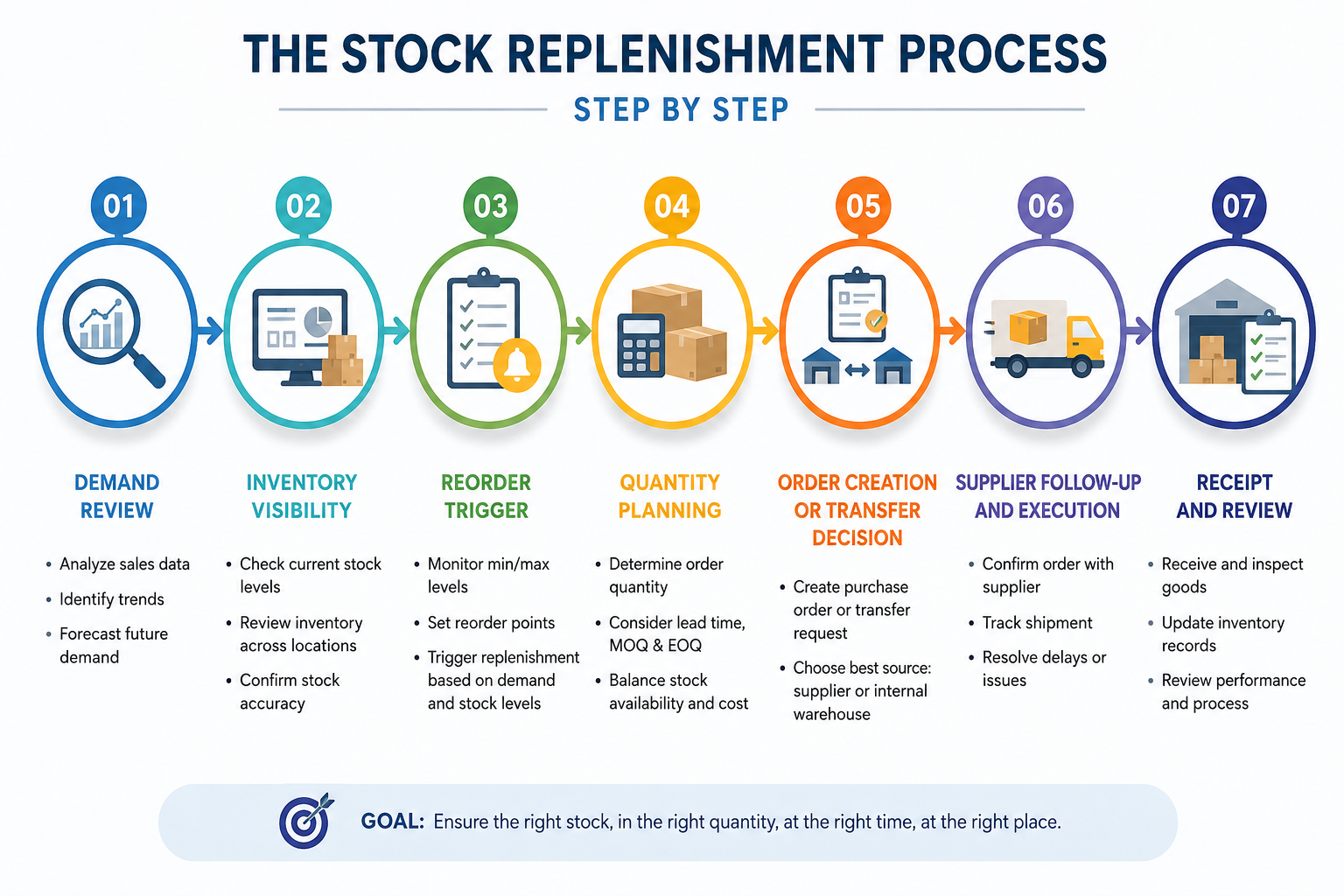
The stock replenishment process is the workflow a business follows to review stock levels, estimate future demand, and trigger restocking actions.
While each company has its own model, the basic stock replenishment process usually includes the following stages.
1. Demand review
The team reviews historical sales, current sales trends, promotions, seasonality, and channel demand. This helps estimate what is likely to sell in the coming days or weeks.
2. Inventory visibility
Current stock across stores, warehouses, and in-transit shipments is checked. Without accurate visibility, replenishment decisions are built on weak foundations.
3. Reorder trigger
A reorder signal is created based on predefined rules, forecast thresholds, or stock falling below a reorder point.
4. Quantity planning
The business decides how much stock to replenish. This may depend on safety stock, lead time demand, minimum order quantities, display requirements, and available budget.
5. Order creation or transfer decision
The next step may be creating a purchase order for the supplier or moving stock internally from one location to another.
6. Supplier follow-up and execution
Once the order is placed, supplier timelines, shipment updates, and expected receipt dates need to be tracked closely.
7. Receipt and review
When stock arrives, actual receipt is matched against what was planned. Teams then review performance and refine future replenishment decisions.
This stock replenishment process sounds straightforward, but it becomes difficult when each step is managed manually across dozens or hundreds of products and locations.
Common inventory replenishment methods businesses use
There is no one-size-fits-all answer. Different inventory replenishment methods work better for different businesses, product categories, and stages of growth.
Here are the most widely used inventory replenishment methods.
1. Reorder point method
This is one of the most common inventory replenishment methods. A product is reordered when stock falls below a predefined threshold.
It is simple and effective for businesses with steady demand and reliable supplier lead times. The challenge is keeping reorder points updated as demand changes.
2. Periodic replenishment
In this method, stock is reviewed at fixed intervals, such as weekly or monthly. Orders are placed based on what is needed at the time of review.
This approach is easier to manage administratively but can miss sudden demand spikes between review cycles.
3. Top-up replenishment
This method aims to restore stock to a target level. It is often used in store replenishment where display requirements matter.
It works well when teams want to keep shelves looking full while maintaining some control over inventory levels.
4. Demand-based replenishment
This uses actual demand patterns, sales velocity, and forecast signals to determine when and how much to restock.
Among modern inventory replenishment methods, this is more dynamic and usually more accurate than static rules.
5. Just-in-time replenishment
This method keeps inventory levels lean by receiving stock closer to the time it is needed. It can reduce holding costs but requires strong supplier reliability and excellent visibility.
For many retail businesses, it is useful in selected categories rather than across the full assortment.
Choosing the right Inventory Replenishment strategy
The best Inventory Replenishment strategy depends on your business model, product mix, supplier network, and customer expectations.
Ask these questions:
• Do you sell fast-moving essentials or trend-driven products?
• Are your lead times predictable or inconsistent?
• Do you manage multiple stores, warehouses, or channels?
• Do you need store-level replenishment, warehouse replenishment, or both?
• How often do promotions distort normal demand?
A brand with stable repeat-demand products may do well with reorder point logic. A fashion retailer with seasonal shifts may need forecast-led planning. A multi-store retailer may need a combination of purchase planning and inter-store transfers.
Strong Inventory Replenishment is rarely about one rule.
It is about matching the right logic to the right category.
The reorder point formula India businesses can use
If you are searching for the reorder point formula India teams commonly use, the basic version is straightforward:
Reorder Point = Average Daily Sales × Lead Time in Days + Safety Stock
Let us break that down.
• Average Daily Sales means how many units of a product you usually sell per day.
• Lead Time in Days means how many days it takes for new stock to arrive after placing an order.
• Safety Stock is extra inventory kept as a buffer against unexpected demand or delays.
Example
If a product sells 20 units per day, supplier lead time is 7 days, and safety stock is 50 units:
Reorder Point = 20 × 7 + 50 = 190 units
That means when available stock falls to 190 units, it is time to reorder.
For India-based businesses, the reorder point formula India teams use should also reflect local realities such as vendor delays, holiday periods, regional demand spikes, transport disruptions, and festival-driven demand. A formula is only as useful as the assumptions behind it.
Where manual replenishment starts to break
Manual planning often works until growth creates complexity.
You add more stock keeping units, more suppliers, more stores, more marketplaces, and more pressure to move faster. Suddenly, the team is checking multiple sheets, chasing updates on calls, and making high-stakes buying decisions with partial information.
At that point, even smart people make avoidable mistakes.
They over-order slow sellers because the numbers were outdated. They under-order bestsellers because promotions were not factored in. They miss transfer opportunities because stock data was not visible across locations.
This is why so many teams move toward automated inventory replenishment.
How automated inventory replenishment helps modern teams
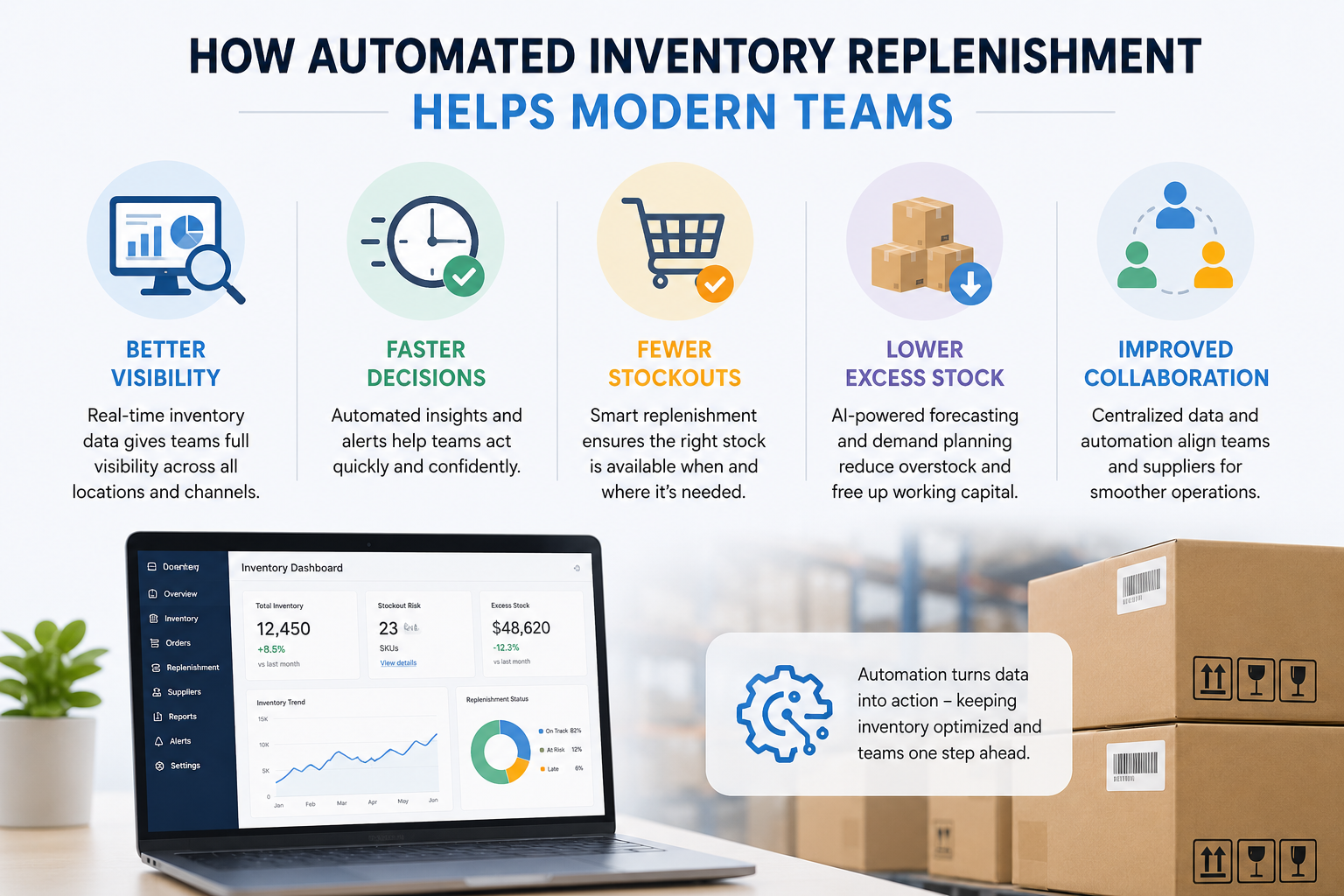
Automated inventory replenishment uses real-time data, planning rules, and forecasting logic to identify replenishment needs faster and more accurately.
Instead of waiting for someone to notice a problem, the system surfaces it early.
Here is what automated inventory replenishment can help with:
• Better visibility
Teams can see stock, demand, and replenishment needs across stores, warehouses, and channels in one place.
• Faster decisions
The system can flag exceptions, calculate reorder quantities, and recommend actions without forcing teams to start from scratch every day.
• Fewer stockouts
Automated inventory replenishment reduces the risk of missing reorder windows, especially for fast-moving products.
• Lower excess stock
Because planning is based on more complete and timely data, teams can buy with greater confidence and avoid unnecessary build-up.
• Improved collaboration
Planners, procurement teams, and leadership can work from shared dashboards rather than disconnected spreadsheets.
For growing retail and direct-to-consumer brands, automated inventory replenishment is not just about convenience. It is about building a supply chain that can scale without becoming fragile.
Signs your business needs a stronger replenishment system
You probably need a better Inventory Replenishment setup if any of these feel familiar:
• Bestsellers go out of stock more often than they should
• Slow-moving products keep piling up
• Teams rely heavily on spreadsheets and manual follow-ups
• Store transfers happen too late
• Suppliers are chased manually for every order
• Promotions create chaos instead of controlled uplift
• Different teams report different stock numbers
• Planning meetings feel reactive every single time
If that sounds familiar, the issue is probably not a lack of effort.
It is usually a lack of connected systems and consistent decision-making logic.
Best practices to never run out of stock
There is no perfect system, but these practices make Inventory Replenishment far more reliable.
• Build clean inventory visibility first
You cannot replenish well without trustworthy numbers. Make sure your stock data reflects what is actually available, reserved, in transit, and sellable.
• Segment products by behavior
Treating every product the same creates poor outcomes. Fast movers, seasonal items, new launches, and long-tail products need different replenishment logic.
• Use safety stock wisely
Safety stock protects the business, but it should not become an excuse for overstocking. Review it regularly based on demand variability and supplier performance.
• Factor in promotions and seasonality
Promotional demand is not normal demand. Replenishment plans should account for campaigns, festivals, payday cycles, and regional events.
• Review supplier lead times honestly
Planners often use ideal lead times instead of real lead times. Build replenishment decisions around actual supplier performance, not hopeful assumptions.
• Automate repeatable decisions
When teams automate repetitive calculations and alerts, they free up time for real exceptions and strategic planning.
• Keep learning from outcomes
Every stockout and every overstock situation teaches something. Review what happened, refine rules, and keep improving.
Inventory Replenishment works best when systems are connected
A replenishment strategy is only as strong as the data feeding it.
If procurement sits in one system, sales lives somewhere else, stock visibility is delayed, and planning happens in spreadsheets, the business will always be reacting later than it should.
That is why connected supply chain systems matter.
When inventory planning, procurement workflows, supplier collaboration, and execution are part of one digital flow, Inventory Replenishment becomes faster, clearer, and more dependable.
Businesses do not just need more reports. They need a better operational backbone.
That is where a unified platform can make a real difference.
Final thoughts
Inventory Replenishment is one of the clearest ways to protect sales, improve customer trust, and reduce supply chain stress in a retail or direct-to-consumer business. When it is powered by accurate data, smart rules, and connected workflows, Inventory Replenishment helps teams stay ready instead of constantly playing catch-up.
If your business is still managing planning through disconnected sheets and manual follow-ups, this is a good time to strengthen the foundation. Explore Supplymint’s Inventory Planning Software to see how a unified platform can support smarter replenishment, or contact the team to discuss what better planning could look like for your business.
Frequently Asked Questions
1. What is Inventory Replenishment?
Inventory Replenishment is the process of restocking products before they run out so a business can meet customer demand without carrying too much excess stock.
2. What is the difference between replenishment and reordering?
Reordering is simply placing a new order. Inventory Replenishment is the broader planning process that decides what to reorder, when to do it, how much to buy, and where inventory should go.
3. Which inventory replenishment methods are most common?
The most common inventory replenishment methods include reorder point, periodic review, top-up replenishment, demand-based replenishment, and just-in-time replenishment.
4. What is automated inventory replenishment?
Automated inventory replenishment uses software, real-time data, and planning rules to detect replenishment needs, calculate stock requirements, and support faster, more accurate decisions.
5. What is the reorder point formula India businesses use?
The reorder point formula India teams commonly use is: Average Daily Sales × Lead Time in Days + Safety Stock. Businesses should also adjust for supplier delays, seasonality, and local demand patterns.