
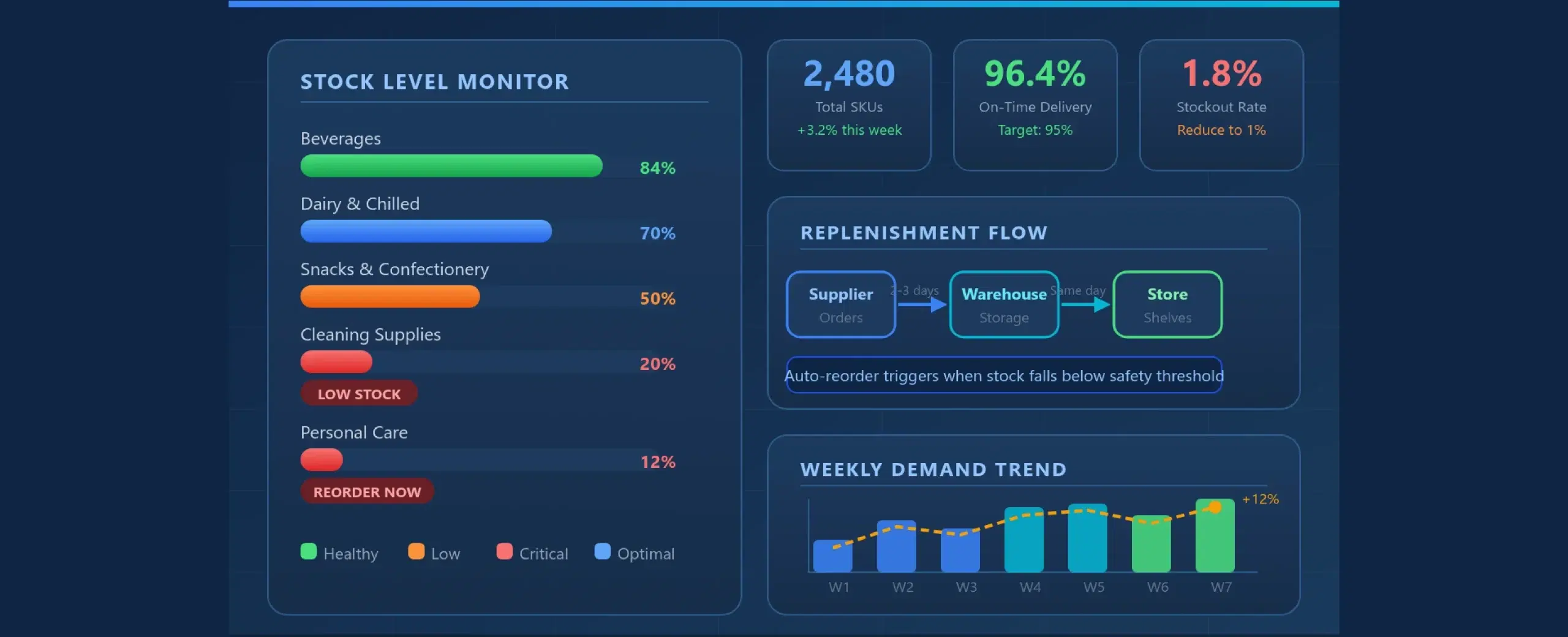
Keeping shelves full sounds simple until you are the one responsible for it.
One product sells faster than expected. Another sits untouched for weeks. A supplier delays dispatch. A festive spike suddenly changes demand. Before you know it, one store is overstocked while another is losing sales because the same product is unavailable.
That is why Optimal Inventory Levels are so important in retail. It is not just about having “enough stock.” It is about having the right stock, in the right quantity, at the right location, at the right time.
Retail replenishment planning helps businesses avoid two costly extremes: stockouts and overstocking. When done well, it protects sales, improves customer satisfaction, reduces dead stock, and keeps working capital healthy.
What Is Retail Replenishment Planning?
Retail replenishment planning is the process of deciding when to reorder inventory, how much to reorder, and where that inventory should go.
It connects demand, sales trends, stock availability, supplier lead times, store performance, and future forecasts. Instead of waiting until inventory runs out, replenishment planning helps retailers act before problems happen.
For example, if a fast-moving SKU is selling quickly in one city but slowly in another, replenishment planning helps move or reorder stock based on actual demand rather than assumptions.
In simple words, replenishment planning answers three key questions:
• What products need replenishment?
• How much inventory should be replenished?
• Which store, warehouse, or channel needs it first?
Why Are Optimal Inventory Levels Important in Retail?
Maintaining Optimal Inventory Levels helps retailers balance availability and cost.
Too little inventory creates stockouts. Customers leave disappointed, sales are lost, and brand trust weakens. Too much inventory creates blocked capital, storage pressure, markdowns, and waste.
Optimal inventory levels sit between these two risks. They help retailers meet customer demand without over-investing in slow-moving stock.
For growing retail businesses, this balance becomes even more important because inventory is spread across stores, warehouses, online channels, marketplaces, and distribution partners. Without proper planning, stock visibility becomes fragmented and decisions become reactive.
What Happens When Inventory Replenishment Goes Wrong?
Poor replenishment planning affects more than the stockroom. It impacts sales, finance, operations, and customer experience.
A stockout does not only mean one missed sale. It may also mean the customer switches to a competitor. In categories like fashion, FMCG, lifestyle, electronics, and D2C products, customers often do not wait.
Overstocking creates a different problem. Products occupy storage space, cash gets locked, and teams are forced to offer discounts just to clear inventory.
Common signs of poor replenishment include:
• Frequent stockouts of best-selling products
• Excess inventory of slow-moving SKUs
• Emergency purchasing
• High markdown dependency
• Poor warehouse-to-store allocation
• Low visibility across channels
• Manual planning through spreadsheets
• Mismatch between buying, planning, and sales teams
When these issues repeat, the business does not just lose efficiency. It loses confidence in its own planning process.
How Do Retailers Maintain Optimal Inventory Levels?
Retailers maintain optimal inventory levels by combining demand forecasting, stock visibility, reorder rules, supplier planning, and continuous performance tracking.
The goal is not to make one perfect plan at the start of the season. The goal is to keep adjusting based on what is actually happening in the market.
Here are the most important steps.
How Can Demand Forecasting Improve Replenishment Planning?
Demand forecasting helps retailers estimate future sales based on past performance, seasonality, trends, promotions, and market behavior.
Without forecasting, replenishment becomes guesswork. Teams either reorder too late or order too much “just to be safe.”
A good demand forecast considers:
• Historical sales data
• Store-wise demand patterns
• Product seasonality
• Regional preferences
• Festival or holiday demand
• Promotional campaigns
• Online and offline sales trends
• Lead time variations
For example, a winterwear brand may see early demand in northern regions while warmer regions move slower. Replenishment planning should reflect that difference instead of sending equal stock everywhere.
Forecasting gives teams the confidence to replenish based on demand signals, not panic.
Why Is Real-Time Inventory Visibility So Important?
You cannot maintain optimal inventory levels if you do not know what stock is available.
Many retailers struggle because inventory data is scattered across stores, warehouses, ERP systems, spreadsheets, and sales channels. By the time teams compile reports, the information may already be outdated.
Real-time inventory visibility helps teams see:
• Current stock levels
• Stock in transit
• Available-to-sell quantity
• Store-wise stock movement
• Warehouse stock position
• Slow-moving and fast-moving SKUs
• Pending purchase orders
• Replenishment requirements
This visibility allows planners to make faster and better decisions. Instead of buying more stock immediately, they may discover that another store has excess inventory that can be transferred.
For businesses looking to improve planning accuracy, using connected tools like inventory planning software can help teams manage stock availability, replenishment, and inventory decisions with better control.
What Is the Role of Reorder Points in Replenishment Planning?
A reorder point tells retailers when it is time to reorder stock.
It is usually based on average daily sales, supplier lead time, and safety stock. When inventory drops below this point, the system or planning team triggers replenishment.
A simple reorder point formula is:
Reorder Point = Demand During Lead Time + Safety Stock
For example, if a product sells 20 units per day and the supplier takes 7 days to deliver, the business needs at least 140 units to cover lead time. If safety stock is 40 units, the reorder point becomes 180 units.
This means replenishment should begin when inventory reaches 180 units, not when it reaches zero.
Reorder points are useful because they reduce last-minute buying and protect availability.
How Much Safety Stock Should Retailers Keep?
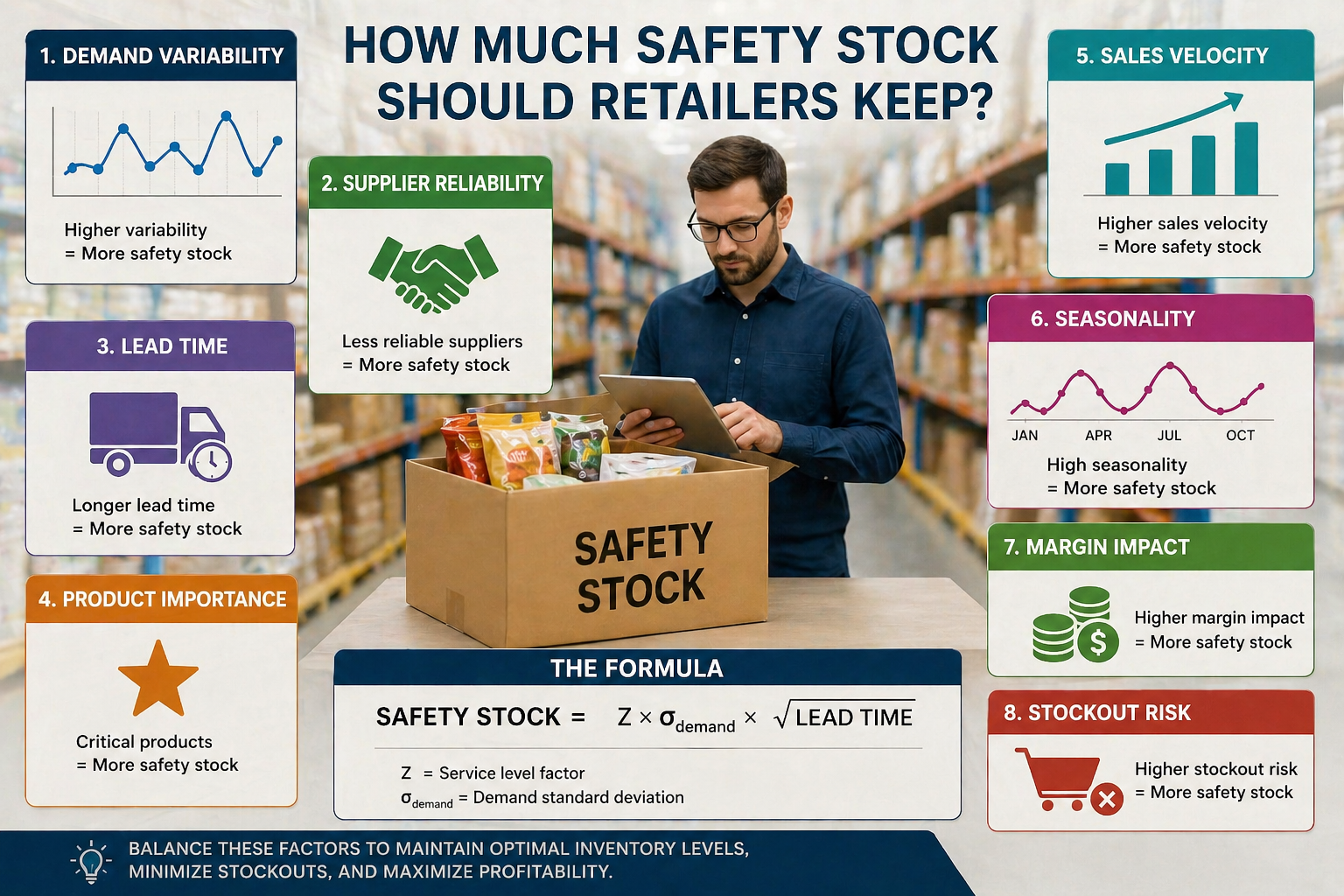
Safety stock is extra inventory kept to protect against uncertainty.
Retailers need safety stock because demand and supply are rarely perfect. Sales may spike unexpectedly. Suppliers may delay shipments. A warehouse may take longer to process transfers.
However, safety stock should not become a hidden excuse for overstocking. Too much safety stock blocks cash and creates storage pressure.
The right safety stock depends on:
• Demand variability
• Supplier reliability
• Lead time
• Product importance
• Sales velocity
• Seasonality
• Margin impact
• Stockout risk
Fast-moving, high-margin products may need stronger safety stock. Slow-moving or seasonal products may need tighter control.
The objective is not to hold more inventory. The objective is to hold smarter inventory.
How Do Lead Times Affect Optimal Inventory Levels?
Lead time is the time between placing an order and receiving stock.
If lead time is short and reliable, retailers can operate with leaner inventory. If lead time is long or unpredictable, more buffer may be needed.
Lead time includes:
• Supplier processing time
• Manufacturing time
• Dispatch time
• Transit time
• Warehouse receiving time
• Quality checks
• Store allocation time
Many retailers underestimate lead time because they only consider supplier dispatch. But replenishment planning must include the full journey from order placement to shelf availability.
Even a two-day delay can create stockouts if demand is high.
How Can Store-Level Planning Improve Replenishment?
Every store behaves differently.
A product that sells well in a metro mall may not perform the same way in a tier-2 city outlet. A size, color, category, or price point may move faster in one location than another.
Store-level replenishment planning helps retailers avoid blanket allocation.
Instead of sending the same quantity everywhere, teams can replenish based on:
• Store sales velocity
• Local demand
• Customer profile
• Regional seasonality
• Store capacity
• Current stock position
• Nearby warehouse availability
• Historical sell-through
This is especially important for fashion, footwear, lifestyle, grocery, electronics, and specialty retail where demand varies by location.
Store-level planning ensures inventory goes where it has the highest chance of selling.
What Is the Difference Between Replenishment and Allocation?
Replenishment and allocation are closely related, but they are not the same.
Allocation usually happens when new stock is distributed across stores, warehouses, or channels for the first time.
Replenishment happens after sales begin and stock needs to be refilled based on actual movement.
For example, when a new collection arrives, the first stock distribution is allocation. After two weeks, when certain stores sell faster than others, sending additional stock to those stores is replenishment.
Strong retail planning needs both. Allocation sets the starting position. Replenishment keeps inventory balanced as demand changes.
How Can Retailers Reduce Stockouts Without Overstocking?
The best way to reduce stockouts without overstocking is to improve demand sensing and replenishment accuracy.
Many retailers overbuy because they fear stockouts. But this creates excess inventory and markdown pressure. A smarter approach is to use real-time sales data, stock movement, and forecast updates to replenish more frequently and accurately.
Retailers can reduce stockouts by:
• Tracking fast-moving SKUs daily
• Setting product-wise reorder points
• Monitoring supplier lead times
• Keeping controlled safety stock
• Reviewing demand changes regularly
• Using store-level replenishment rules
• Improving warehouse-to-store coordination
• Identifying stockout risks early
The aim is not to fill every shelf with maximum stock. The aim is to maintain enough availability to serve demand without creating unnecessary inventory burden.
How Does Replenishment Planning Support Better Cash Flow?
Inventory is one of the biggest investments in retail.
When inventory is planned poorly, cash gets trapped in unsold products. This affects buying power, supplier payments, expansion plans, and profitability.
Replenishment planning improves cash flow by helping businesses buy what they actually need, when they need it.
It reduces:
• Excess purchasing
• Dead stock
• Emergency buying
• Storage costs
• Markdown losses
• Working capital blockage
At the same time, it protects revenue by ensuring high-demand products remain available.
In short, better replenishment planning helps finance and operations work toward the same goal: profitable availability.
What Metrics Should Retailers Track for Replenishment Planning?
Retail replenishment planning becomes stronger when teams track the right metrics.
Important replenishment metrics include:
1. Stockout Rate
Shows how often products are unavailable when customers want them.
2. Sell-Through Rate
Measures how much inventory is sold within a specific period.
3. Inventory Turnover
Shows how quickly inventory is sold and replaced.
4. Days of Inventory Cover
Tells how many days current stock can support expected demand.
5. Reorder Frequency
Helps understand how often products need replenishment.
6. Fill Rate
Measures how much demand is fulfilled from available stock.
7. Excess Inventory Percentage
Shows how much stock is above required levels.
8. Forecast Accuracy
Compares predicted demand with actual sales.
These metrics help retailers move from opinion-based planning to data-backed decisions.
How Often Should Retail Replenishment Plans Be Reviewed?
Replenishment plans should be reviewed regularly, not only at the end of the month or season.
Fast-moving retail environments need frequent checks because demand can shift quickly. Weekly reviews are useful for most categories, while fast-moving SKUs may need daily monitoring.
Review frequency depends on:
• Product velocity
• Category type
• Sales channel
• Seasonality
• Supplier lead time
• Promotion calendar
• Store count
• Demand volatility
For example, daily essentials may require daily replenishment checks. Fashion products may need weekly sell-through reviews. Seasonal products may need close monitoring before and during peak periods.
The more dynamic the category, the more frequently replenishment should be reviewed.
Why Manual Replenishment Planning Becomes Difficult as Retail Grows
Manual planning may work when a business has a few products and one or two locations. But as retail grows, complexity increases quickly.
Teams must manage more SKUs, more stores, more suppliers, more warehouses, and more sales channels. Spreadsheets become harder to maintain and easier to break.
Manual replenishment often leads to:
• Delayed decisions
• Data errors
• Duplicate work
• Poor collaboration
• Lack of real-time visibility
• Missed reorder triggers
• Inconsistent planning logic
• Dependency on individual planners
As the business scales, replenishment needs connected systems that can process data faster and support better decisions.
How Does Technology Help Maintain Optimal Inventory Levels?
Technology helps retailers maintain optimal inventory levels by connecting demand, supply, inventory, and replenishment data in one place.
Modern inventory planning systems can help teams:
• Track stock across multiple locations
• Forecast demand more accurately
• Identify replenishment needs
• Set reorder rules
• Monitor stock movement
• Reduce overstock and stockouts
• Improve allocation decisions
• Align buying, planning, and sales teams
• Integrate with ERP and WMS systems
Technology does not replace retail expertise. It strengthens it.
Planners still need business judgment, category knowledge, and market understanding. But with the right system, they can make faster decisions with cleaner data.
What Are Common Retail Replenishment Planning Mistakes?
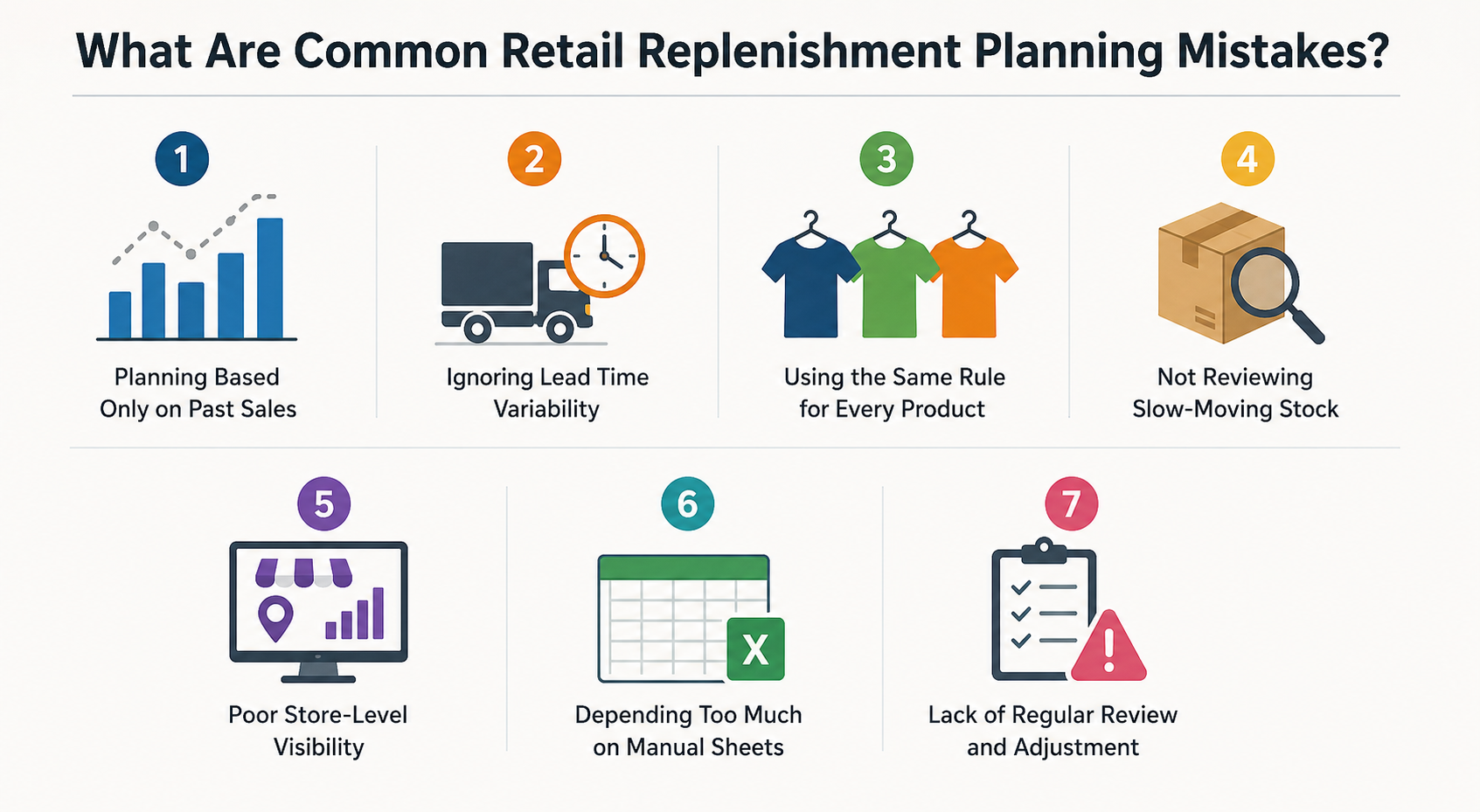
Many inventory problems come from repeated planning mistakes.
Common mistakes include:
1. Planning Based Only on Past Sales: Historical data matters, but it should be combined with current demand signals, promotions, seasonality, and market changes.
2. Ignoring Lead Time Variability: If supplier delivery time changes often, replenishment plans must include that uncertainty.
3. Using the Same Rule for Every Product: Fast-moving products, seasonal products, and slow-moving products need different replenishment strategies.
4. Not Reviewing Slow-Moving Stock: Replenishment is not only about ordering more. It is also about knowing when not to reorder.
5. Poor Store-Level Visibility: Without location-wise stock data, retailers may overstock one store while another faces stockouts.
6. Depending Too Much on Manual Sheets: Manual planning increases the chance of errors, delays, and outdated decisions.
Avoiding these mistakes can significantly improve inventory health.
How Can Retailers Build a Strong Replenishment Planning Process?
A strong replenishment planning process should be structured, data-driven, and easy for teams to follow.
Here is a practical approach:
1. Classify products based on sales velocity and importance.
2. Set reorder points for key SKUs.
3. Define safety stock levels by product and location.
4. Track supplier lead times regularly.
5. Monitor daily or weekly sales movement.
6. Review stockouts and excess inventory.
7. Use store-level demand data.
8. Align purchase planning with replenishment needs.
9. Connect inventory data across systems.
10. Keep improving based on actual performance.
The best replenishment process is not the most complicated one. It is the one teams can follow consistently.
The Real Challenges in Store-Level Replenishment
1. Size Set and Ratio Distribution
A store can receive the right number of units and still get the wrong stock. Replenishing by total quantity ignores size ratios, so a store ends up with a pile of one size and none of the sizes that actually sell. This is one of the most common replenishment failures in fashion and footwear, where a broken size set means the article is technically in stock but effectively unsellable. Getting size set distribution right means reordering against the size curve each store actually sells, not an average applied across the chain. That way every location receives wearable, sellable sets instead of leftover ratios.
2. Store Preference in Stock Distribution
Flat distribution, where every store receives the same allocation, quietly creates imbalance. A high-street store and a tier-two location do not sell the same way, so identical stock leaves one short and the other overstocked. Store preference in stock distribution weights what each location receives by its own profile: past sell-through, local demand patterns, store size, and seasonality. Moving from equal distribution to preference-based distribution is often the fastest way to reduce both stockouts and dead stock at the same time.
3. Choosing the Best Alternative SKU
When the exact SKU a store needs is unavailable, someone has to decide what goes in its place. In most retail teams this call is made from memory, which leads to inconsistent substitutions and missed sales. A better approach identifies the best alternative SKU by attribute, style, price band, and past performance, so the substitute genuinely matches demand rather than just filling a shelf. Treating alternative SKU selection as a data-led decision keeps availability high even when the first choice runs out.
4. Store-Wise Demand Visibility
Business-level stock numbers hide the truth at store level. Total inventory can look healthy while individual stores swing between shortage and surplus on the same article. Store-wise demand visibility means seeing what each location actually needs at any given moment, not what the chain needs on average. It is the foundation the other three decisions rest on, because size sets, store preference, and alternative SKU choices are only as good as the store-level demand signal feeding them.
Conclusion: Better Replenishment Creates Better Retail Performance
Retail replenishment planning is not just an inventory task. It is a business growth function.
When retailers maintain Optimal Inventory Levels, they protect sales, improve customer trust, reduce excess stock, and make better use of working capital. Instead of reacting to stockouts or clearing overstock through discounts, teams can plan with confidence.
The future of retail belongs to businesses that can sense demand early, move inventory intelligently, and respond quickly across stores, warehouses, and channels.
Frequently Asked Questions
1. What is replenishment in retail?
Retail replenishment is the process of restocking products across stores and channels to keep them available without tying up excess capital. It decides when to reorder, how much to reorder, and which location the stock should go to, based on demand, sales trends, and supplier lead times.
2. How can retailers improve replenishment orders without overstocking across multiple locations?
The key is replenishing each location against its own demand rather than a chain-wide average. When reorder quantities are set store by store, using real sell-through and lead times, high-selling stores stay stocked and slower ones stop accumulating stock they cannot move. Store-level visibility is what makes this possible across many locations at once.
3. How should retailers coordinate replenishment and allocation to improve availability and reduce excess inventory?
Allocation decides where new stock goes first, and replenishment keeps those locations topped up as they sell. When both run off the same store-level demand signal, stock flows to where it actually sells instead of sitting idle. Treating them as one connected process, rather than two separate steps, is what reduces stockouts and excess at the same time.
4. How can retailers reduce overstock and markdowns?
Overstock usually builds up when buying and replenishment ignore how individual stores and sizes actually sell. Ordering against real demand, distributing by store preference, and keeping size sets balanced prevents the slow-moving pileups that later force markdowns. The earlier the imbalance is caught, the less discounting it takes to clear.
5. What KPIs should retailers track to measure replenishment performance?
The most useful measures are stockout rate, sell-through rate, inventory turnover, excess or dead stock percentage, and fill rate against store demand. Tracked together, these show whether replenishment is keeping the right stock in the right stores rather than just moving units.
6. How do you fix broken size sets in replenishment?
Broken size sets happen when stores are replenished by total units instead of by size ratio. The fix is to reorder against the size curve each store actually sells, so every location receives complete, sellable sets. This keeps articles fully shoppable instead of leaving a store with only the sizes that do not move.