
B2B order management is complex, involving large volumes, multiple stakeholders, and coordination across systems. Many businesses still rely on manual order entry and fragmented workflows, leading to inefficiencies and delays. Orders from emails, calls, or spreadsheets increase the risk of errors like incorrect pricing or missed details.
Lack of real-time visibility makes tracking inventory and order status difficult. Managing bulk and multi-channel orders further adds complexity, creating bottlenecks across teams. These challenges highlight the need to automate order processing using a modern B2B order management system to improve speed, accuracy, and operational control.
What is a B2B order management system
A B2B order management system is software designed to manage, track, and streamline the entire lifecycle of business-to-business orders, from order creation to fulfillment and payment. Its primary purpose is to automate order processing, reduce manual effort, and ensure accuracy across high-volume, complex transactions.
It fits at the core of the supply chain by connecting sales, inventory, procurement, and logistics into a unified workflow. This ensures real-time visibility, faster decision-making, and smoother coordination between departments and partners.
Unlike B2C systems, B2B order management involves bulk orders, negotiated pricing, credit terms, and multi-step approvals, making it more complex and process-driven.
Key functions of a modern B2B order management system
A modern B2B order management system supports efficient and automated workflows across operations:
• Order capture and processing from multiple channels
• Inventory synchronization for real-time stock visibility
• Pricing and contract management based on customer agreements
• Fulfillment coordination across warehouses and logistics teams
What is order management automation
Order management automation refers to the use of software to automate the end-to-end order lifecycle, from order entry to fulfillment and invoicing. It replaces manual tasks with system-driven workflows, improving speed, accuracy, and consistency across operations.
In manual workflows, teams rely on spreadsheets, emails, and repetitive data entry, which increases delays and errors. Automated workflows, on the other hand, use predefined rules and integrations to process orders instantly, validate data, and update systems in real time without human intervention.
Processes that can be automated
Order management automation covers multiple stages of the order lifecycle:
• Order entry and validation to capture and verify order details automatically
• Inventory checks to confirm stock availability in real time
• Invoice generation based on order data and pricing rules
• Dispatch and fulfillment coordination across warehouses and logistics systems
How automation improves order management in B2B supply chains
Automation transforms how businesses handle orders by removing manual bottlenecks and connecting systems across the supply chain. A B2B order management system with built-in order management automation helps streamline workflows, improve accuracy, and ensure faster execution from order creation to fulfillment.
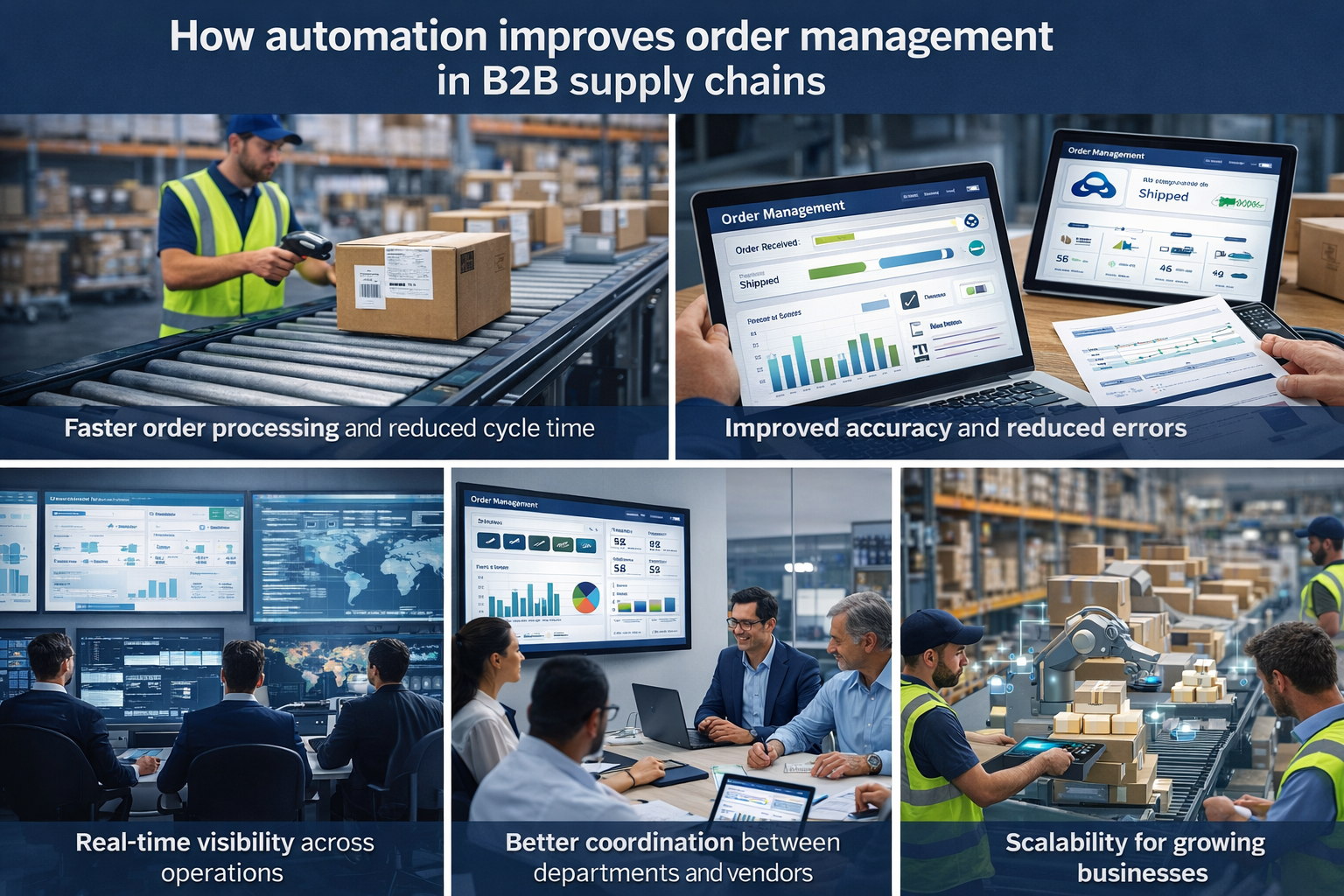
Faster order processing and reduced cycle time
When businesses automate order processing, orders are captured, validated, and routed instantly without manual intervention. This reduces processing time significantly and ensures quicker turnaround, helping businesses handle more orders efficiently.
Improved accuracy and reduced errors
Automated validation checks eliminate common issues like incorrect pricing, duplicate entries, or missing data. By reducing manual input, businesses can automate sales order management with greater accuracy and consistency.
Real-time visibility across operations
Order management automation provides centralized dashboards where teams can track orders, inventory, and fulfillment status in real time. This visibility enables faster decision-making and better control over operations.
Better coordination between departments and vendors
Integrated systems connect procurement, warehouse, and logistics teams, ensuring seamless communication. This improves coordination and reduces delays across the supply chain.
Scalability for growing businesses
As order volumes increase, automation allows businesses to scale without adding operational complexity. A strong B2B order management system ensures smooth handling of high-volume transactions without strain.
Role of order-to-cash automation in B2B operations
The order-to-cash cycle covers the complete process from receiving a customer order to collecting payment. In B2B supply chains, this cycle involves multiple steps, approvals, and financial checks, which can slow down operations if handled manually. Order-to-cash automation streamlines this entire flow by connecting order management, finance, and payment systems, ensuring faster and more accurate execution.
Stages in order-to-cash automation
1. Order creation: Sales orders are captured automatically from multiple channels and processed without manual entry, ensuring speed and consistency.
2. Credit approval: System-driven rules check customer credit limits and approve orders instantly, reducing dependency on manual reviews.
3. Invoicing: Invoices are generated automatically based on validated order data, eliminating delays and billing errors.
4. Payment collection: Payments are tracked, matched, and reconciled within the system, giving clear visibility into outstanding and completed transactions.
Benefits of order-to-cash automation
Order-to-cash automation improves both financial control and operational efficiency by removing delays and reducing manual intervention across the payment cycle.
1. Faster revenue realization: Automated workflows reduce the time between order confirmation and payment collection. Orders move quickly through invoicing and approval stages, helping businesses improve cash flow and shorten the revenue cycle.
2. Improved financial accuracy: By automating invoicing, tax calculations, and data synchronization, businesses minimize errors caused by manual entry. This ensures accurate billing, reduces disputes, and maintains consistency across financial records.
3. Reduced delays in payments: Automated reminders, real-time tracking, and system-driven workflows help ensure timely payments. Businesses gain clear visibility into outstanding invoices, making it easier to follow up and reduce payment delays.
How to automate sales order management effectively
Automating sales order management requires connecting systems, defining workflows, and ensuring real-time data flow across departments. A structured approach helps businesses automate sales order management without disrupting existing operations.
Integrating sales channels with backend systems
To automate order processing effectively, all sales channels must connect with backend systems like CRM, ERP, and a B2B order management system. This integration ensures that orders captured from different sources are processed automatically, inventory is updated in real time, and teams work with consistent data across platforms.
Automating approvals and workflows
Rule-based workflows allow businesses to automate approvals based on predefined conditions such as order value, customer type, or credit limits. This removes manual intervention, speeds up decision-making, and ensures that orders move forward without unnecessary delays.
Using centralized dashboards
Centralized dashboards provide complete visibility into orders, inventory, and fulfillment status. Teams can monitor performance, track order progress, and identify bottlenecks quickly. This level of visibility helps improve control, optimize operations, and make faster, data-driven decisions.
Key features to look for in a B2B order management system
Choosing the right B2B order management system is critical for improving efficiency and supporting long-term growth. The system should not only handle current operational needs but also support automation, scalability, and real-time decision-making.
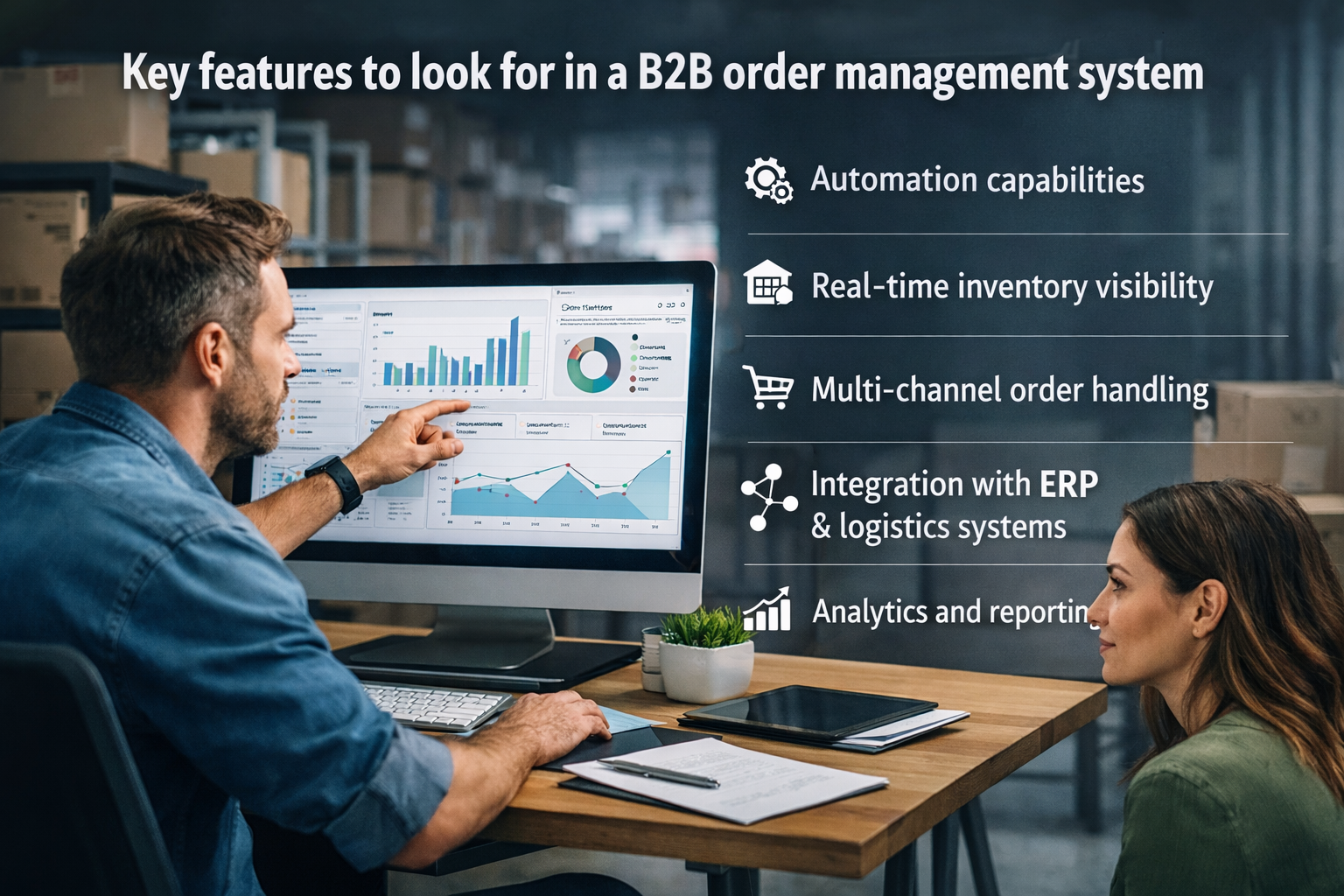
Automation capabilities
A strong system should offer end-to-end order management automation, including order capture, validation, invoicing, and fulfillment workflows. This helps businesses automate order processing and reduce manual effort across teams.
Real-time inventory visibility
Real-time tracking of inventory across warehouses and locations ensures accurate stock availability. This helps prevent stockouts, overstocking, and delays in order fulfillment.
Multi-channel order handling
The system should support orders from multiple channels such as sales teams, distributors, and digital platforms. Centralized order processing ensures consistency and eliminates duplication.
Integration with ERP and logistics systems
Seamless integration with ERP, CRM, and logistics platforms ensures smooth data flow across the supply chain. This enables better coordination between departments and faster order execution.
Analytics and reporting
Advanced reporting and dashboards provide insights into order performance, fulfillment timelines, and operational efficiency. This helps businesses make informed decisions and continuously optimize their processes.
Common challenges in implementing order management automation
While order management automation brings significant efficiency gains, implementing it comes with practical challenges that businesses need to plan for carefully.
• Data migration issues: Migrating data from legacy systems, spreadsheets, or disconnected tools can be complex. Inconsistent formats, missing records, or duplicate entries can impact system accuracy if not cleaned and structured properly before migration.
• Integration complexity: Connecting a B2B order management system with existing ERP, CRM, and logistics platforms can require technical effort. Poor integration can lead to data silos or synchronization issues, affecting real-time operations.
• Team adoption and training: Shifting from manual processes to automated workflows requires team training and change management. Resistance to new systems or lack of understanding can slow down implementation and reduce effectiveness.
• Cost and ROI concerns: Initial setup costs, software investment, and integration efforts can raise concerns. Businesses need a clear plan to measure ROI through improved efficiency, reduced errors, and faster order processing.
Best practices for successful order management automation
A structured approach ensures that order management automation delivers measurable results and avoids common implementation issues.
1. Map existing processes before automation: Start by documenting current workflows, identifying bottlenecks, and understanding dependencies across teams. This helps in designing automation that solves real operational gaps instead of replicating inefficiencies.
2. Choose scalable and flexible systems: Select a B2B order management system that can handle growing order volumes, multiple channels, and future integrations. Flexibility ensures the system adapts as business needs change.
3. Train teams and ensure adoption: Provide proper training and clear guidelines so teams understand how to use the system effectively. Strong adoption across departments is critical for achieving consistent results.
4. Continuously monitor and optimize workflows: Track system performance, identify delays or errors, and refine workflows regularly. Continuous improvement ensures long-term efficiency and better outcomes.
Industry use cases of automated order management
Order management automation delivers value across different industries by improving efficiency, accuracy, and scalability.
Retail and fashion supply chains
Retail businesses handle high volumes of SKUs and seasonal demand changes. Automation helps manage inventory allocation, streamline order processing, and ensure faster fulfillment across stores and distribution channels.
Manufacturing and distribution
Manufacturers deal with complex supply chains, bulk orders, and multiple stakeholders. Automated systems improve coordination between production, inventory, and logistics, reducing delays and improving order accuracy.
Wholesale and B2B commerce
Wholesale businesses manage large orders, negotiated pricing, and repeat transactions. Automating sales order management helps process orders faster, maintain pricing consistency, and improve customer experience.
Final Words
Automation is no longer optional when managing complex B2B supply chains and high order volumes. By adopting a modern B2B order management system, you can automate order processing, reduce errors, improve visibility, and accelerate the entire order-to-cash cycle. The result is faster operations, better coordination across teams, and a more consistent customer experience.
From streamlining workflows to enabling real-time decision-making, order management automation helps you move from reactive processes to complete operational control. It ensures that as your business grows, your systems remain efficient, scalable, and reliable. In the long run, automation strengthens your supply chain, improves financial performance, and supports sustainable growth.
If you’re still managing orders manually or dealing with disconnected systems, this is the right time to shift. With Supplymint, you can automate sales order management, gain real-time visibility, and streamline your end-to-end operations on a single platform built for B2B supply chains.
Frequently Asked Questions
1. How long does it take to implement a B2B order management system
Implementation timelines vary based on business size, system complexity, and integrations required. For most businesses, it can take a few weeks to a few months. A phased rollout approach helps ensure smoother adoption without disrupting daily operations.
2. Can order management automation work with legacy systems
Yes, modern systems can integrate with legacy tools through APIs or middleware. However, the efficiency depends on how well existing systems support integration. In some cases, partial upgrades may be required to ensure smooth data flow.
3. How secure is order management automation
Most modern platforms offer strong security features such as role-based access control, data encryption, and audit trails. This ensures that sensitive order, pricing, and customer data is protected across the system.
4. What kind of businesses benefit the most from automation
Businesses handling high order volumes, multiple sales channels, or complex pricing structures benefit the most. This includes wholesalers, distributors, manufacturers, and retail supply chains.
5. Can automation help reduce operational costs
Yes, automation reduces manual effort, minimizes errors, and improves efficiency across teams. Over time, this leads to lower operational costs and better resource utilization.
6. How do you measure the success of order management automation
Success can be measured through metrics like order processing time, error rates, fulfillment speed, and cash flow improvement. Tracking these indicators helps evaluate the impact of automation on overall business performance.