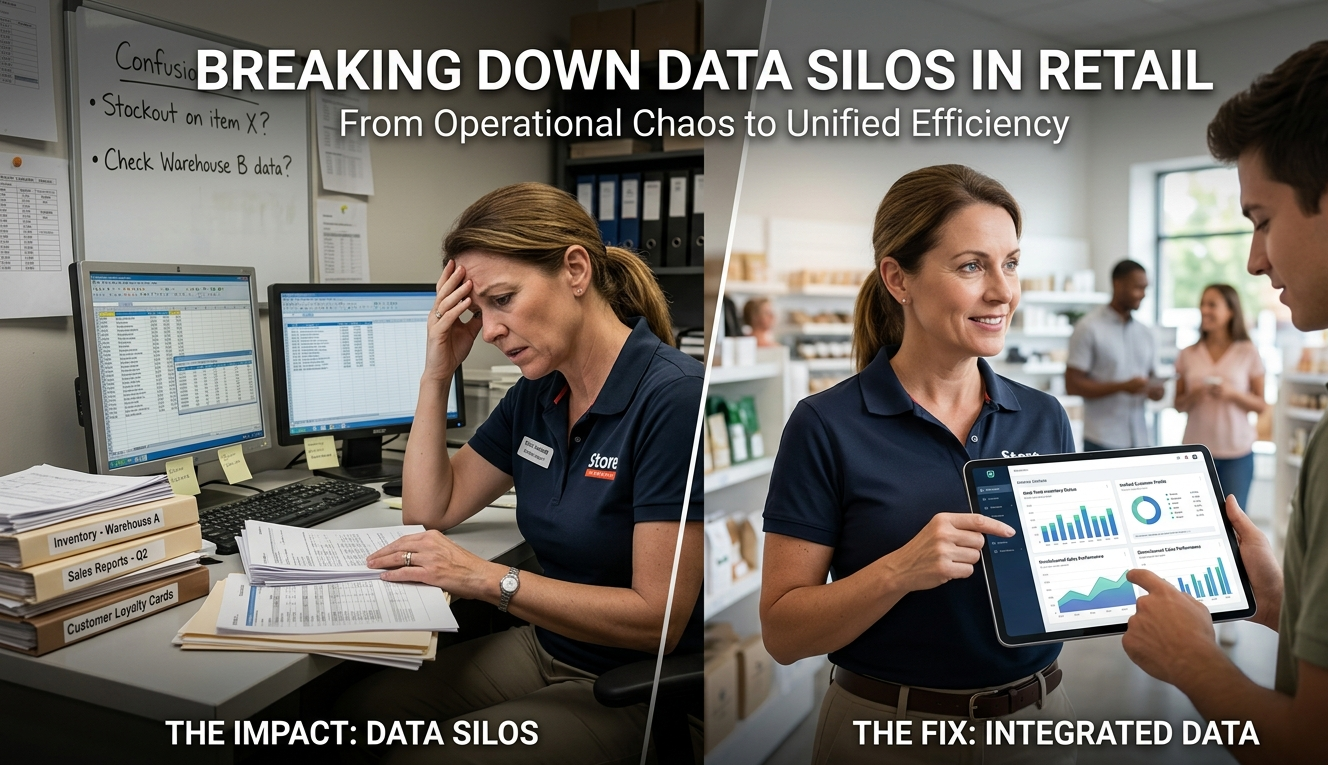
Retail businesses generate large amounts of data every day. From purchase orders and inventory levels to sales performance and vendor updates, information is constantly moving across the organization.
Yet, many teams still struggle to act on this data.
Not because it is missing. But because it is scattered.
When data lives across spreadsheets, ERP systems, and disconnected tools, it creates silos. And these silos quietly slow down operations, decisions, and growth. This article explains how data silos impact retail operations and how businesses can fix them with a more connected approach.
What Are Data Silos in Retail?
Data silos occur when information is stored in separate systems that do not communicate with each other.
In a retail setup, this often looks like:
• Inventory data in one system
• Purchase orders in another
• Planning done in spreadsheets
• Vendor updates shared through emails or messages
Each system holds valid data. But none provide a complete, unified view.
As a result, teams rely on multiple sources to understand what is actually happening.
Why Data Silos Exist in Retail Businesses
Data silos are not always intentional. They usually develop over time as businesses grow.
Some common reasons include:
• Different teams adopting tools based on their needs
• Legacy systems that do not integrate easily
• Heavy reliance on spreadsheets for flexibility
• Lack of a centralized data strategy
For example, the buying team may track orders in Excel, while the warehouse relies on an ERP. Finance may use another system altogether. Each team works efficiently in isolation, but coordination becomes difficult.
How Data Silos Impact Retail Operations
The impact of data silos rarely appears overnight. It builds gradually — slowing decisions, weakening planning, and creating hidden inefficiencies across the entire retail operation. What starts as disconnected data eventually turns into delayed execution and missed opportunities.
Slower Decision-Making
When data is scattered across systems, teams spend more time verifying information than actually using it. Instead of acting quickly, they are forced to cross-check multiple sources, align numbers with different teams, and resolve inconsistencies. This constant validation delays decisions and makes the business less responsive in a fast-moving retail environment.
Inaccurate Planning
Retail planning depends on having a clear and reliable view of data. When information is fragmented, forecasts lose accuracy and decisions become reactive instead of strategic.
Demand projections may not reflect real inventory, replenishment cycles get delayed, and buying decisions rely on incomplete insights, often resulting in overstocking in some areas and stockouts in others.
Poor Vendor Coordination
Without a unified view of purchase orders and vendor timelines, coordination becomes fragmented. Teams rely on manual follow-ups, emails, and constant communication to track progress.
As a result, delays are identified too late, supply timelines become unpredictable, and planning gets disrupted due to lack of structured visibility.
Inventory Imbalance
Disconnected systems make it difficult to maintain balanced inventory across locations. Some stores may hold excess stock while others face shortages, leading to inefficient transfers and lost sales opportunities. Over time, this imbalance directly impacts revenue, increases holding costs, and reduces overall operational efficiency.
Reduced Team Efficiency
When systems do not communicate, teams are forced to fill the gaps manually. Repetitive data entry, spreadsheet tracking, and continuous coordination become part of daily operations.
Instead of focusing on growth and optimization, teams spend valuable time managing data, ultimately slowing down productivity and limiting scalability.
Signs Your Retail Business Has Data Silos
If any of the following situations sound familiar, data silos may be affecting your operations:
• Different reports show different numbers
• Teams rely heavily on spreadsheets alongside core systems
• Frequent follow-ups are required to get updates
• Decision-making takes longer than expected
• There is limited visibility into real-time operations
How to Fix Data Silos in Retail
Eliminating data silos requires a structured approach. It is not just about adopting new tools, but about connecting existing processes.
Centralize Data Sources: Bring key operational data into a unified environment where it can be accessed easily. This reduces dependency on multiple disconnected systems.
Integrate Systems: Ensure that systems used across departments can share data with each other. Integration helps eliminate duplication and ensures consistency.
Standardize Processes: Define clear workflows for:
• Purchase order tracking
• Inventory updates
• Vendor communication
Reduce Manual Dependencies: Minimize reliance on spreadsheets and manual tracking wherever possible. Automation improves both speed and reliability.
The Role of a Single Source of Truth
A single source of truth means that all teams rely on the same, consistent data.
Instead of switching between systems, teams access one unified view of operations.
What Changes with a Single Source of Truth
| Without a Single Source of Truth | With a Single Source of Truth |
| Data scattered across multiple systems | Centralized and unified data |
| Conflicting reports across teams | Consistent data across departments |
| Time spent validating information | Immediate access to reliable data |
| Delayed decision-making | Faster, real-time decisions |
| Limited visibility into operations | Complete operational visibility |
How Technology Helps Eliminate Data Silos
Modern retail operations cannot function efficiently on disconnected systems. To eliminate data silos, businesses need technology that connects processes, teams, and data into a single, unified workflow.
Instead of managing procurement, inventory, planning, and sales across separate tools, modern platforms bring everything together, allowing information to flow seamlessly across the entire supply chain.
This connected approach ensures that key functions such as procurement and vendor management, inventory planning and tracking, purchase order visibility, and sales and distribution workflows are no longer isolated. Each function feeds into the other, creating a continuous and reliable flow of data across operations.
As a result, teams no longer rely on manual coordination or fragmented updates. They work with a shared, real-time view of the business, where decisions are based on accurate and up-to-date information.
Platforms like Supplymint enable this shift by integrating procurement, planning, and execution into a single system, helping businesses move from fragmented data to complete operational visibility.
Final Words
If your teams are still managing procurement, inventory, and planning across disconnected tools, it is time to move to a more unified approach. Supplymint’s platform is designed to eliminate data silos by connecting procurement, inventory planning, and execution workflows into one system, giving you complete visibility and control over your operations.
Whether you are looking to streamline vendor management, improve inventory accuracy, or bring better coordination across teams, Supplymint provides the foundation for a truly connected retail ecosystem.
Explore how Supplymint can help you build a single source of truth and scale your retail operations with clarity and efficiency.
Frequently Asked Questions
1. What are the early warning signs of data silos in retail systems?
Some early signs include delays in generating reports, frequent data mismatches between teams, and heavy reliance on spreadsheets alongside core systems. If teams constantly need to confirm numbers before making decisions, it often indicates underlying data fragmentation.
2. Can small or mid-sized retail businesses face data silo issues?
Yes, data silos are not limited to large enterprises. In fact, growing retail businesses often experience them more frequently as they adopt multiple tools over time without proper integration. As operations expand, disconnected systems can quickly become a bottleneck.
3. How long does it take to eliminate data silos in a retail business?
The timeline depends on the complexity of existing systems and processes. For businesses with multiple legacy tools, it may take a few months to fully transition. However, adopting a centralized platform can significantly accelerate the process and deliver visible improvements early on.
4. Do data silos affect customer experience in retail?
Yes, indirectly but significantly. Poor inventory visibility can lead to stockouts, delayed deliveries, or inaccurate order fulfillment. Over time, these issues impact customer satisfaction and brand trust.
5. What role does automation play in reducing data silos?
Automation reduces manual data handling and ensures that information flows consistently across systems. It minimizes errors, improves data accuracy, and helps maintain real-time synchronization between different functions.
6. Is it possible to integrate existing systems instead of replacing them?
In many cases, yes. Businesses can integrate existing tools to improve data flow. However, managing multiple integrations can become complex over time, which is why many retailers prefer unified platforms that bring all functions into a single system.
7. How do data silos impact financial performance?
Data silos often lead to excess inventory, missed sales opportunities, and inefficient resource allocation. These inefficiencies increase operational costs and reduce overall profitability.
8. What should businesses consider before choosing a supply chain platform?
Key factors include ease of integration, scalability, real-time visibility, and the ability to connect core functions like procurement, inventory, and sales. The platform should support long-term growth without adding complexity.