
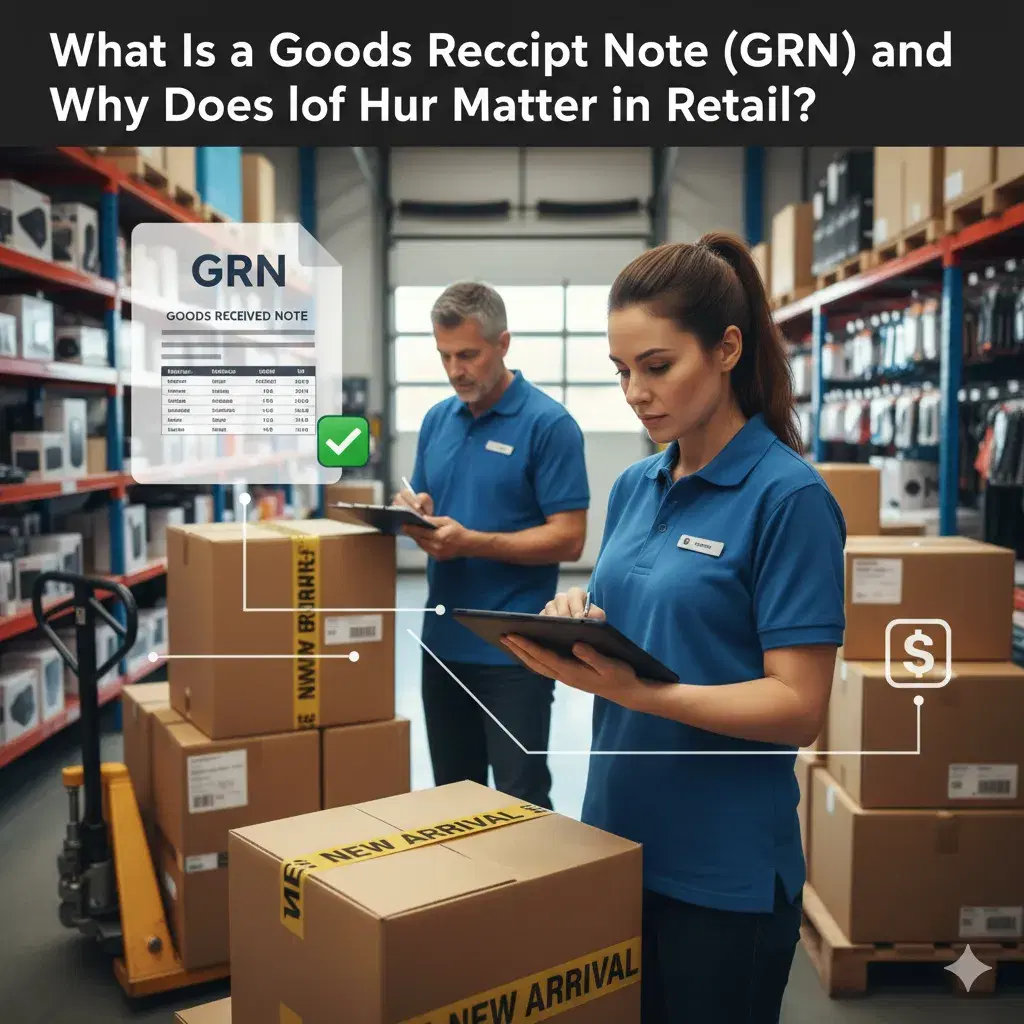
In retail, even the smallest mistake in inventory can snowball into big problems, empty shelves when customers are ready to buy, overstock piling up in warehouses, and payment disputes with suppliers that strain relationships. Inventory accuracy isn’t just important; it’s the backbone of profitability and customer trust.
This is where a Goods Receipt Note (GRN) steps in. Think of it as the first checkpoint in the journey of your stock, the document that verifies whether what was ordered is exactly what was delivered. By capturing the details of every delivery, a GRN creates accountability between suppliers and retailers, safeguards financial transactions, and ensures that operations flow without costly interruptions.
What Is a GRN? GRN Full Form and Meaning
GRN full form: Goods Receipt Note. It is also called a Goods Received Note. Both terms mean the same document.
A GRN is an official document a store or warehouse creates when goods arrive from a supplier. It records what was delivered and checks it against the purchase order, confirming that the right products, in the right quantity, and in the right condition were received. In retail, the GRN is the first checkpoint between a delivery and your inventory records.
A standard GRN typically includes:
• Supplier details for traceability
• Purchase Order (PO) number for cross-checking
• Product descriptions to verify the items received
• Quantities delivered compared to what was ordered
• Delivery date to maintain timelines and accountability
In short, a GRN is more than a receipt, it’s a safeguard for inventory accuracy and a foundation for smooth retail operations.
What Is a GRN Number?
A GRN number is the unique reference code assigned to each Goods Receipt Note. It links one specific delivery to its purchase order and supplier invoice, so procurement, warehouse, and finance teams can track and reconcile that receipt later. Every GRN gets its own number, which creates a clear audit trail from delivery to payment.
GRN Format: What a Goods Receipt Note Includes
A GRN format is usually a simple structured table. Standardising it across every vendor and store is what keeps records clean and audits fast. A typical GRN includes these fields:
|
Field |
What it records |
|---|---|
|
GRN number |
Unique reference for this receipt |
|
GRN date |
Date the goods were received |
|
Supplier name |
Vendor who sent the delivery |
|
Purchase order (PO) number |
The order being fulfilled |
|
Product description and SKU |
Items received |
|
Quantity ordered |
As per the purchase order |
|
Quantity received |
Actually delivered and counted |
|
Rejected or damaged quantity |
Items short, excess, or not usable |
|
Invoice or delivery note reference |
For 3-way matching |
|
Received by |
Person who verified the delivery |
|
Remarks |
Notes on discrepancies or condition |
GRN in Store, Retail, and Supply Chain
In a retail store or warehouse, the GRN is created at the receiving dock the moment a delivery arrives. Staff check the goods against the purchase order and log a GRN entry before the stock moves onto shelves or into storage.
Across the wider supply chain, the GRN is the bridge between procurement and inventory. It confirms that what was ordered actually arrived, updates stock records, and triggers the finance step that clears the supplier for payment. In a connected system like a warehouse management platform, this happens in real time, so store, procurement, and finance all see the same verified numbers at once.
How the GRN Process Works (GRN Entry)
GRN entry is the act of recording received goods into your system. The process usually runs in five steps:
- Goods arrive at the store or warehouse against a purchase order.
- Physical check. Staff count the items and inspect condition, comparing them to the PO.
- GRN entry. The verified quantities are recorded, either on paper, in a spreadsheet, or in a procurement or warehouse system.
- Discrepancies flagged. Any shortage, excess, or damage is noted against the delivery.
- Approval and sync. The approved GRN updates inventory and feeds finance for 3-way matching against the PO and invoice.
Why Does GRN Matter in Retail?
In retail, every unit of stock counts. A single mismatch in deliveries can ripple through the entire supply chain, causing stockouts in stores, delayed payments to vendors, and even strained business relationships. That’s where the Goods Receipt Note (GRN) becomes indispensable.
• Accuracy in Deliveries: The GRN ensures that the goods received actually match the purchase order. No more over-supplied items gathering dust in the warehouse or under-supplied goods leading to empty shelves.
• Stronger Buyer-Supplier Relationships: By documenting every delivery in black and white, GRNs prevent disputes. Suppliers have proof of what was delivered, and buyers have clarity on what was received, eliminating finger-pointing later.
• Financial Control & Reconciliation: Payments in retail are tightly linked to verification. A GRN acts as the official checkpoint before any invoice is cleared, ensuring businesses only pay for what was actually received and in good condition.
• Clearer Stock Visibility: For store and warehouse operations, the GRN provides real-time visibility into what’s available and what’s missing. This directly impacts sales planning, replenishment cycles, and customer satisfaction.
Common Challenges in GRN Management
1. Manual Paperwork Leading to Errors
In many retail setups, GRNs are still created on paper or basic spreadsheets. While this may seem manageable, it often leads to costly mistakes.
For example, imagine a busy warehouse receiving 500 cartons of apparel. A store associate manually enters “50” instead of “500” in the GRN. The system now reflects a shortage, triggering unnecessary reorders and confusion with the supplier. On the flip side, over-reporting can result in vendors being overpaid for items never actually received.
These small errors, born out of manual processes, can snowball into inventory mismatches, payment disputes, and customer dissatisfaction on the sales floor.
2. Delays in Updating GRN Entries
In retail, timing is everything. Yet, when GRN entries are updated late, it creates a ripple effect across the supply chain.
Picture this: a supermarket chain receives a shipment of perishable goods in the morning, but the GRN isn’t updated until the evening. By the time stock data reaches the system, store shelves still show “out of stock,” even though the goods are physically in the warehouse. Customers leave disappointed, while sales opportunities are lost.
On the finance side, delayed entries also postpone invoice matching and vendor payments, straining supplier relationships. What looks like a “minor delay” in data entry often translates into lost sales, poor customer experience, and cash flow disruptions.
3. Lack of Real-Time Visibility for Procurement & Finance Teams
When procurement and finance teams don’t have instant access to GRN data, decision-making slows down, and small blind spots quickly turn into big problems.
Imagine a fashion retailer ordering 5,000 units for the festive season. The warehouse receives only 4,600 units, but because the GRN isn’t instantly visible, procurement still assumes the full quantity has arrived. Marketing campaigns go live, stores start promising stock, and finance even schedules full payment. By the time the shortfall is discovered, sales are missed, customers are frustrated, and unnecessary payouts have already been made.
Without real-time GRN visibility, businesses run the risk of overpaying suppliers, under-stocking stores, and misreporting inventory, all of which hurt both revenue and trust.
4. Difficulties in Reconciling Mismatched Deliveries
One of the biggest headaches in GRN management is handling discrepancies between what was ordered and what was actually received.
For example, a retail chain may order 1,000 pairs of shoes, but the supplier delivers 950 pairs and bills for the full amount. Without a properly maintained GRN, the finance team might process payment assuming the full delivery was made. Later, when the shortfall is discovered, reconciling the mismatch becomes a lengthy process involving multiple teams, procurement, warehouse, accounts, and even the supplier.
These mismatches don’t just drain time; they strain vendor relationships, delay payments, and create unnecessary disputes that could have been avoided with accurate and timely GRN records.
How Digital GRN Transforms Retail Operations
In retail, a small mismatch in receiving goods can ripple across the supply chain - from inaccurate stock counts to delayed vendor payments. That’s why moving from paper-based GRN to digital GRN is more than a process upgrade; it’s a business advantage.
Here’s how digital GRN changes the game:
|
Traditional GRN (Manual) |
Digital GRN (Automated) |
Benefit to Retailers |
|
Paper-based entries prone to human error |
Automated data capture from purchase orders & invoices |
Accuracy in records, fewer disputes |
|
GRNs updated after hours or days |
Real-time updates at the point of goods receipt |
Faster stock availability & visibility |
|
No central access, updates siloed at store/warehouse |
Cloud-based access for procurement, finance, and operations teams |
Unified visibility across supply chain |
|
Manual reconciliation of mismatched deliveries |
Automated mismatch alerts & approval workflows |
Quicker resolution and fewer delays |
|
Payment delays due to verification lag |
Instant sync with finance systems |
Faster vendor payments, stronger supplier trust |
GRN Best Practices for Retailers
Getting GRN right is not just about process discipline, it’s about creating a foundation for accurate inventory, faster payments, and stronger supplier trust. Here are some best practices retailers can adopt:
1. Standardize GRN Formats Across Vendors & Stores
In retail, purchase orders and invoices already follow structured formats, but GRNs often get overlooked. Many retailers allow individual vendors or store managers to create GRNs in their own style: some record only quantities, others skip product codes, while a few even maintain handwritten notes.
This inconsistency creates major problems:
• Consolidation becomes a nightmare when head office tries to compare deliveries across 50+ vendors.
• Audits take longer because information is missing or formatted differently.
• Errors multiply when procurement, finance, and warehouse teams try to reconcile mismatched records.
By standardizing GRN formats across all vendors and stores, retailers create a single source of truth. Every GRN contains the same key fields, supplier name, PO number, SKU codes, product descriptions, quantities, delivery date, and condition of goods.
2. Ensure Timely Creation and Approval
A GRN is only valuable when it’s created on time. Unfortunately, in many retail setups, GRNs are either recorded late or stuck in approval queues. For example, if a store manager waits 2–3 days before logging a GRN, the stock doesn’t reflect in the system, leading to out-of-stock errors on the shop floor, even though the goods are sitting in the backroom.
Similarly, delays in approvals mean procurement teams can’t confirm receipt of goods, and finance cannot release payments. This creates frustration for vendors, who often end up following up repeatedly. Over time, such delays can strain vendor relationships and even impact supply terms.
3. Use Barcode/RFID for Accuracy
Manual counting is error-prone and time-consuming. By using barcode scanning or RFID tagging, retailers can instantly verify received goods against purchase orders, cutting errors and boosting efficiency.
For example, with RFID-enabled GRN in Supplymint Source To Pay, Style Union improved its inbound accuracy to over 90%, eliminating mismatched entries and saving hours of manual work.
4. Link GRN Directly with PO and Invoice for 3-Way Matching
One of the biggest risks in retail finance is paying for goods that were never ordered or never received. That’s where 3-way matching comes in. It connects three critical documents:
1. Purchase Order (PO): What the buyer requested.
2. Goods Receipt Note (GRN): What was actually delivered.
3. Invoice: What the supplier billed.
When these three match, it ensures the retailer only pays for items that were ordered, delivered, and verified.
Without this linkage, discrepancies creep in. For example:
• A supplier bills for 1,000 units, but only 950 were delivered.
• Or the PO was for one SKU, but the vendor shipped a substitute without approval.
• Or worse, finance clears an invoice without realizing the goods were never received at all.
Such mismatches may seem small at first, but across multiple vendors and stores, they can drain margins and inflate operating costs.
The Bottom Line
A Goods Receipt Note (GRN) is more than just paperwork, it’s the first safeguard of efficiency, accuracy, and trust in retail operations. From ensuring stock accuracy to preventing payment disputes, GRNs keep procurement, finance, and vendor management running smoothly.
Yet, when managed manually, they often become a source of errors, delays, and friction between retailers and suppliers. That’s why forward-looking retailers are shifting to digital GRN workflows that streamline every step, from receipt to reconciliation.
Retailers moving to digital GRN workflows handle receipt, verification, and reconciliation in one connected system. Supplymint Source To Pay brings GRN, purchase orders, and invoices together so procurement, warehouse, and finance work from the same verified numbers.
Frequently Asked Questions
1. What is the full form of GRN?
The full form of GRN is Goods Receipt Note. It is also called a Goods Received Note. Both refer to the same document used to confirm goods received from a supplier.
2. What is a GRN in store?
In a store, a GRN is the document staff create when a delivery arrives. It records what was received and checks it against the purchase order before the stock is added to inventory.
3. What is a GRN number?
A GRN number is the unique code assigned to each Goods Receipt Note. It links a delivery to its purchase order and invoice so the receipt can be tracked and reconciled.
4. Who prepares the GRN?
The GRN is usually prepared by the store or warehouse team that physically receives and checks the goods, then approved by a supervisor or the procurement team.
5. What is the difference between a GRN and an invoice?
A GRN records what was physically received. An invoice is the supplier's bill for what they claim to have delivered. Matching the two, along with the purchase order, is how retailers avoid paying for goods they never received.