
Every procurement leader is measured on results, but "results" is a slippery word until you attach numbers to it. Cost savings, supplier reliability, how fast a purchase order actually turns into delivered goods: these are the things that separate a procurement function that runs the business from one the business is always waiting on. The problem is that procurement generates a lot of data and not all of it matters. The skill is knowing which metrics actually tell you something.
Procurement KPIs are those metrics. They turn a vague sense of "are we doing well" into evidence you can act on and defend. This guide covers twelve of the most important procurement KPIs, grouped by what they measure, each with a clear formula and a note on why it matters and what good looks like.
What Are Procurement KPIs?
Procurement KPIs are measurable values that show how well a procurement function is performing against its goals, from cost savings to supplier reliability to process efficiency. They give procurement leaders the evidence to spot problems early, prove the team's value, and make decisions on data rather than instinct.
The best KPIs share three traits. They tie directly to a business goal, so improving the number improves the business. They are measurable consistently, so you can track them over time. And they drive action, meaning a bad reading tells you what to do next. A number that is interesting but changes nothing is a metric, not a KPI.
Cost KPIs
Cost is where procurement proves its value most directly, so these are usually the headline metrics.
1. Cost Savings
Cost savings measures the reduction in spend procurement achieves through negotiation, consolidation, and smarter sourcing, against a baseline or previous price. It is the number most procurement teams are judged on.
Formula: Cost savings = (Baseline price − Actual price) × Quantity purchased
Track both hard savings (a genuine price reduction) and soft savings, or cost avoidance, where you prevented an increase. Confusing the two is a common way procurement overstates its impact, so keep them separate.
2. Cost Avoidance
Cost avoidance measures money saved by preventing future cost increases, such as negotiating away a supplier's proposed price rise. It does not show up as a lower invoice, which is why it is easy to overlook, but it is real value that protects margin.
Formula: Cost avoidance = Proposed cost − Negotiated cost
3. Spend Under Management
Spend under management is the percentage of total company spend that procurement actively controls. The higher it is, the more of the company's buying benefits from proper sourcing and negotiation. Low spend under management means money is leaking out through unmanaged, maverick purchasing.
Formula: Spend under management = (Actively managed spend ÷ Total spend) × 100
Process and Efficiency KPIs
These show how smoothly procurement runs, and where the delays and costs hide.
4. Purchase Order Cycle Time
Purchase order cycle time measures how long it takes from raising a requisition to sending an approved purchase order to the supplier. It is the clearest measure of procurement speed, and a long cycle time is usually where teams lose the most time to manual approvals. Automating the procure-to-pay process is the most common way to bring it down.
Formula: PO cycle time = Total time from requisition to PO issued ÷ Number of POs
5. Procurement ROI
Procurement ROI measures the return the procurement function delivers relative to what it costs to run. It is how procurement proves it is a value driver, not just a cost centre.
Formula: Procurement ROI = Annual cost savings ÷ Annual procurement cost
6. Purchase Order Accuracy
Purchase order accuracy measures the percentage of purchase orders processed without errors in quantity, pricing, or specification. Low accuracy creates rework, disputes, and delays, so it is a quiet drag on everything else.
Formula: PO accuracy = (Error-free POs ÷ Total POs) × 100
Supplier KPIs
These measure the suppliers procurement depends on, and they map to the metrics your current readers already look for.
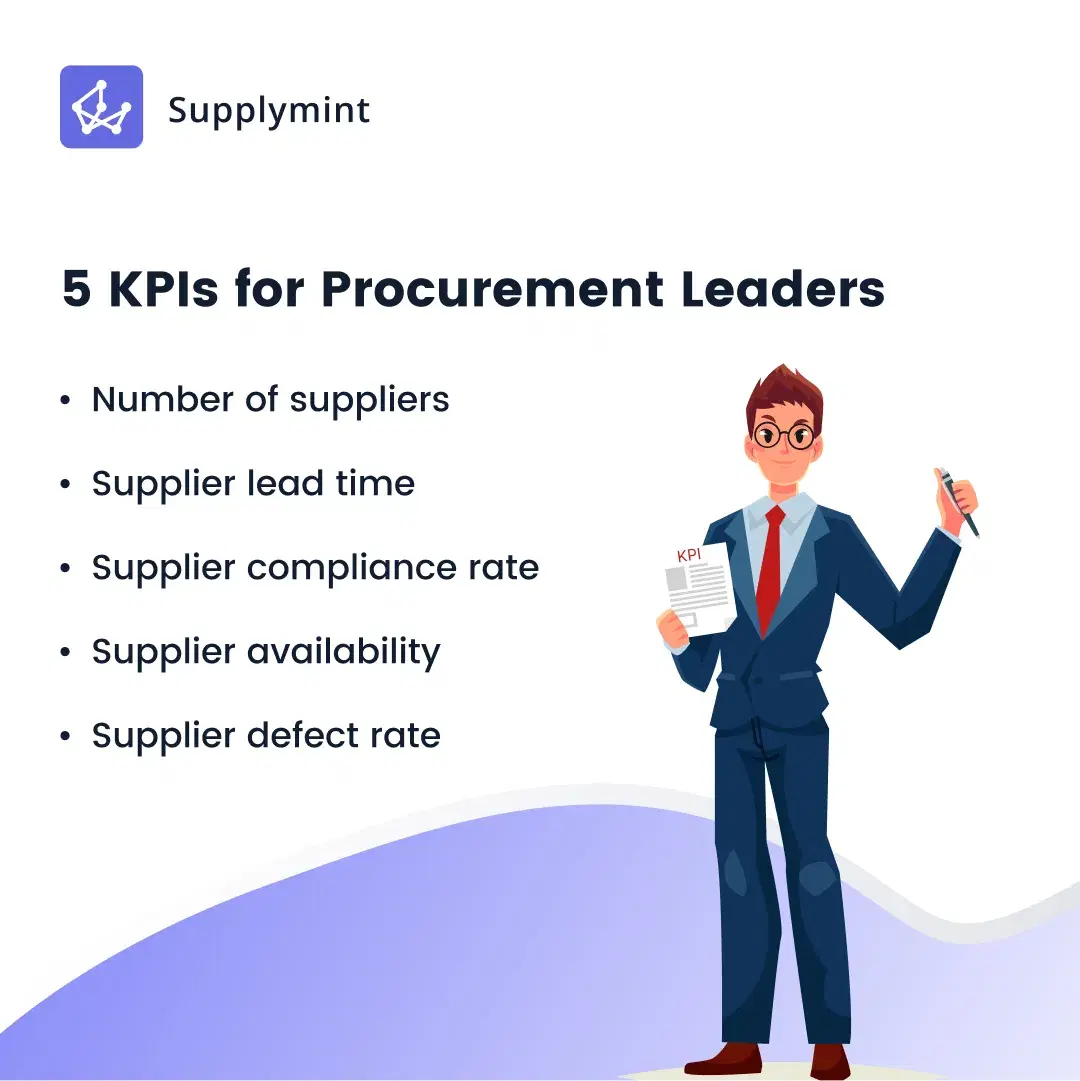
7. Supplier Lead Time
Supplier lead time is the total time between placing an order and receiving the goods. Shorter, more predictable lead times mean you can hold less stock and respond faster. Set target lead times per supplier and watch for repeated misses, which signal a supplier that needs a conversation or replacing.
Formula: Supplier lead time = Delivery date − Order date
8. Supplier Defect Rate
Supplier defect rate measures the quality of what a supplier delivers, as the share of substandard items in what they ship. It is the clearest read on whether a cheap supplier is actually cheap once you count the returns and rework.
Formula: Supplier defect rate = (Defective units ÷ Total units received) × 100
Breaking it down by defect type gives you something to take back to the supplier, rather than just a complaint.
9. Supplier Compliance Rate
Supplier compliance rate measures how consistently a supplier meets the agreed terms of the contract: delivery windows, pricing, discounts, and response times. A falling compliance rate quietly raises indirect procurement spend and is an early warning that a relationship needs attention.
Formula: Supplier compliance rate = (Compliant orders ÷ Total orders) × 100
10. Supplier Availability
Supplier availability measures how reliably a supplier can meet your orders, especially urgent ones. It tells you how much you can lean on a vendor when timing is tight.
Formula: Supplier availability = (Orders fulfilled ÷ Total orders placed) × 100
As a rule of thumb, availability of 90 percent or above signals a dependable supplier and an efficient supply chain.
11. Number of Suppliers
Number of suppliers tracks how many vendors you use for a given category. It is a balancing act rather than a target to maximise or minimise. Too few and you carry concentration risk if one fails. Too many and you lose volume discounts and dilute relationships. The right number is the one that balances risk against buying power for that category.
Compliance KPI
12. Contract Compliance Rate
Contract compliance rate, sometimes called procurement compliance, measures how much of your spend actually goes through negotiated contracts rather than off-contract, maverick purchasing. High compliance means the savings you negotiated are actually being realised. Low compliance means people are buying around the contracts, and the savings exist only on paper.
Formula: Contract compliance = (Spend through contracts ÷ Total spend) × 100
How to Choose the Right Procurement KPIs
You should not track all twelve at once. The right KPIs are the ones tied to your current priorities, measured consistently, and capable of driving a decision. If cost is the pressure this year, lead with cost savings, spend under management, and contract compliance. If reliability is the problem, focus on supplier lead time, defect rate, and availability. Start with three to five that map to your biggest goals, get them measured accurately and reviewed regularly, then expand. A handful of KPIs acted on beats a dashboard of twenty nobody looks at.
How Supplymint Helps You Track Procurement KPIs
Most procurement KPIs are only as good as the data behind them, and that data is usually scattered across spreadsheets and systems that do not talk to each other. Supplymint's Source to Pay solution brings spend, purchase orders, and supplier performance into one platform, so KPIs like cost savings, PO cycle time, supplier defect rate, and contract compliance are tracked automatically in real time rather than pieced together after the fact. Built for retail, apparel, and fashion brands, it turns procurement reporting from a monthly scramble into a live view leaders can act on. When the numbers are accurate and current, procurement stops defending its value and starts proving it.
Frequently Asked Questions
1. What are procurement KPIs?
Procurement KPIs are measurable values that show how well a procurement function is performing against its goals, covering cost savings, supplier reliability, process efficiency, and compliance. They help leaders spot problems early, prove the team's value, and make data-driven decisions.
2. What are the most important procurement KPIs?
The most important ones usually include cost savings, spend under management, purchase order cycle time, supplier lead time, supplier defect rate, supplier compliance rate, and contract compliance. The right priority depends on whether your focus is cost, speed, or supplier reliability.
3. What are the 5 key performance indicators for procurement?
A common core five are cost savings, purchase order cycle time, supplier lead time, supplier defect rate, and contract compliance rate. Together they cover cost, speed, supplier quality, and how much spend actually runs through negotiated contracts.
4. How do you calculate cost savings in procurement?
Cost savings is calculated as (baseline price − actual price) × quantity purchased. Keep hard savings, an actual price reduction, separate from cost avoidance, where you prevented a price increase, so the impact is reported accurately.
5. What is the difference between direct and indirect procurement KPIs?
Direct procurement KPIs track the goods that go into your product, so they lean on supplier quality, lead time, and cost. Indirect procurement KPIs track the goods and services that keep the business running, where spend under management and contract compliance matter most. Many KPIs apply to both.
6. How often should procurement KPIs be reviewed?
Most procurement KPIs are reviewed monthly, with operational ones like PO cycle time and supplier performance watched more frequently. The right cadence is often enough to act before a problem grows, without drowning the team in reporting.