
Ask three people on a planning team to define buffer stock and you'll usually get three different answers. One of them will probably ask if it's just another word for safety stock. It mostly is. But it isn't quite the same thing, and neither term means the same thing as a reorder point. Getting this straight matters less for the vocabulary and more for what you actually calculate, and when you act on it.
This guide walks through all three terms, plus a fourth one that keeps showing up in the same conversations: cycle stock. You'll get a plain definition of each, the formulas, a full worked example that ties them together, and a look at how the mix shifts depending on your industry.
What Each Term Actually Means
Cycle stock is your normal, everyday inventory. It's the stock you expect to sell between one delivery and the next, under ordinary conditions. If demand and lead times were perfectly predictable, cycle stock is all you'd ever need to hold.
Of course, demand and lead times are never perfectly predictable. That's where the other three terms come in.
Safety stock is the extra inventory you hold specifically to cover the gap between what you expected and what actually happens. Maybe a product sells faster than usual one week. Maybe your supplier takes longer than promised to deliver. Safety stock is the calculated cushion that absorbs both of those problems.
Buffer stock covers the same basic idea, but the term gets used more loosely. Where safety stock is specifically about demand and lead-time swings, buffer stock often gets stretched to cover other risks too, a supplier's quality issue, a production delay, a fulfillment mistake. In day-to-day conversation, most retail teams use "buffer stock" and "safety stock" interchangeably. When they do draw a line between the two, safety stock usually means the precise, calculated number, and buffer stock means the broader cushion built on top of it.
Reorder point is a different kind of number. It isn't a cushion at all. It's a trigger, the exact stock level that tells you it's time to place your next order. Safety stock is actually one of the ingredients you use to calculate it, which is exactly why people confuse the two.
In simple words: cycle stock is what you expect to sell. Safety stock and buffer stock protect you when reality doesn't match that expectation. Reorder point tells you when to act.
Summary of Differences
|
Term |
Purpose |
Covers Risk From |
Used For |
|---|---|---|---|
|
Safety Stock |
Prevent stockouts due to uncertainty |
Demand & lead time |
Unplanned demand, delays |
|
Buffer Stock |
Broader buffer for internal/external gaps |
Demand, supply & ops |
Operational smoothness |
|
Reorder Point |
When to reorder inventory |
Lead time & usage rate |
Triggering replenishment timely |
How to Calculate: Safety Stock, Buffer Stock, Reorder Point
Safety Stock: The Basic Formula
The most common version compares your worst-case scenario against your normal one:
Safety Stock = (Maximum Daily Sales × Maximum Lead Time) − (Average Daily Sales × Average Lead Time)
Say a home goods brand sells an average of 25 units of a bestselling lamp per day. On its busiest days, that number climbs to 45. The supplier usually delivers in 6 days, but delays have pushed that as high as 11.
Safety Stock = (45 × 11) − (25 × 6) = 495 − 150 = 345 units
That's the buffer this brand needs to survive a bad week and a slow supplier hitting at the same time.
Safety Stock: The Statistical Version
The basic formula works well for a lot of businesses, but it treats every bad day as equally likely, which isn't quite true. A more advanced version uses statistics instead:
Safety Stock = Z × σ × √Lead Time
Here, Z is a service-level target (how confident you want to be that you won't stock out), σ is how much your daily demand actually varies, and lead time is measured in days. A Z of 1.65 lines up with a 95% service level, meaning you'd expect to avoid a stockout 95% of the time.
Say that same lamp has a demand standard deviation of 8 units a day, and a 6-day lead time, and the brand wants that 95% service level.
Safety Stock = 1.65 × 8 × √6 ≈ 1.65 × 8 × 2.45 ≈ 32 units
Notice this gives a much smaller number than the basic formula. That's because the statistical version accounts for how demand actually behaves instead of just comparing a worst case to an average case. Businesses with more mature planning tend to move toward this version once they have enough sales history to calculate a reliable standard deviation.
Buffer Stock: Usually the Same Shape, Different Inputs
Buffer stock is typically calculated the same way as basic safety stock, just applied to a broader set of risks. Our full buffer stock guide breaks this down by industry, since a fashion brand, a pharma distributor, and a manufacturer each face different kinds of operational risk and calculate buffer differently as a result.
Reorder Point: The Formula
Reorder Point = (Average Daily Sales × Lead Time) + Safety Stock
Using the lamp example again, with 25 average daily sales, a 6-day lead time, and the statistical safety stock of 32 units:
Reorder Point = (25 × 6) + 32 = 150 + 32 = 182 units
Once stock on hand drops to 182 units, it's time to place the next order.
Seeing It All Work Together
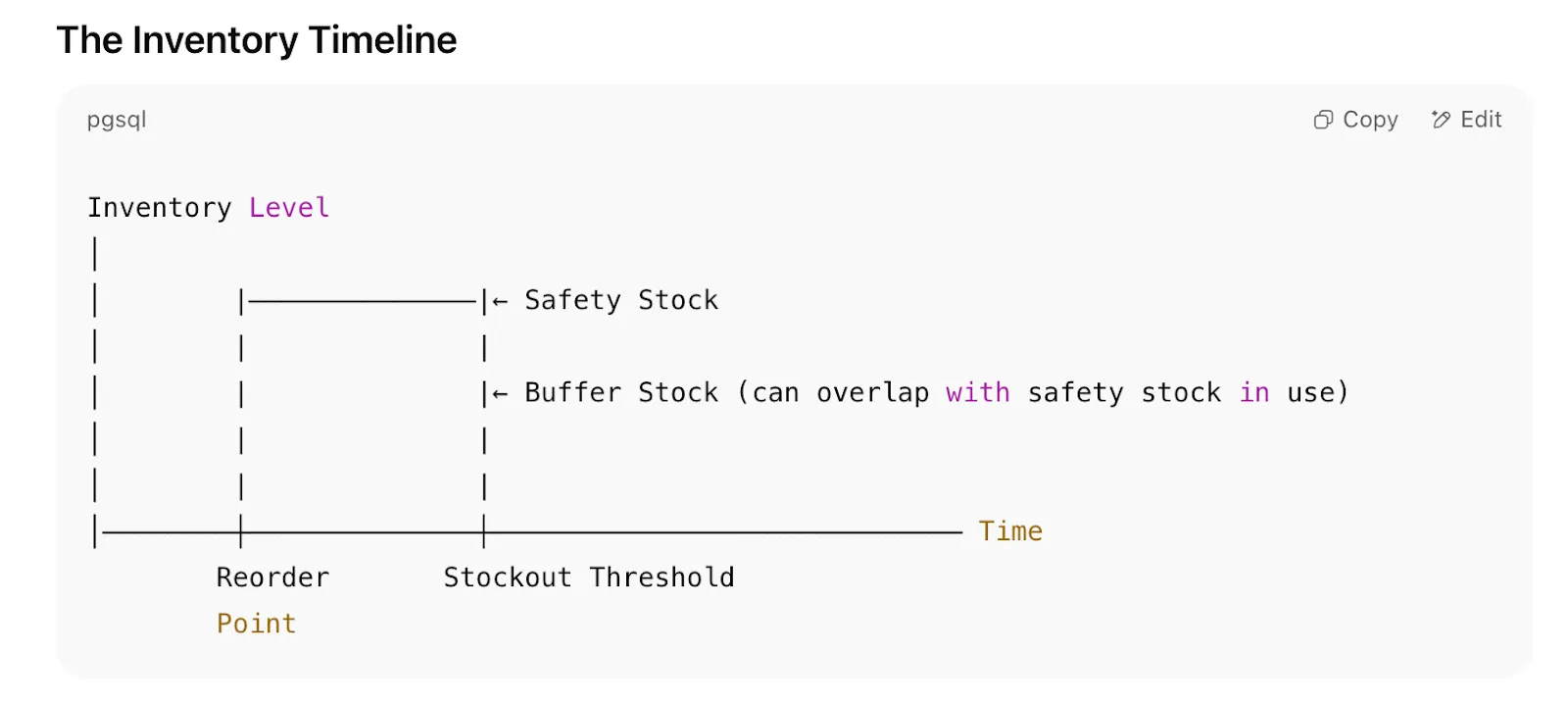
Numbers are easier to follow with one running example, so let's walk through what actually happens on the shelf.
The lamp brand starts a cycle with 500 units in stock. Cycle stock, the normal sales expected before the next delivery, covers most of that. As units sell through, stock drops.
When stock hits 182 units, the reorder point, a new order goes out automatically. At this moment, there's still enough stock to cover the 6-day lead time at average sales (150 units), plus the 32-unit safety stock cushion sitting untouched underneath it.
If sales stay normal for those 6 days, the order arrives right as stock nears 32 units, and the safety stock barely gets touched. If a busy week hits, or the supplier runs a couple of days late, that 32-unit cushion is what keeps the shelf from going empty before the new stock lands.
That's the whole relationship in practice: cycle stock handles the expected, safety stock handles the unexpected, and the reorder point is the number that ties the two together into an actual action.
When to Use Each One
Reach for safety stock thinking when you're deciding how much total protection you need against demand and lead-time swings. This is the "how nervous should I be" number.
Reach for buffer stock thinking when that protection also needs to cover operational risk that has nothing to do with demand, a supplier's quality problem, a production slowdown, a warehouse error.
Reach for a reorder point when you need an actual trigger, the number that tells a person or a system exactly when to place the next order.
You don't pick one of these and ignore the rest. A working replenishment setup uses all of them at once. Cycle stock covers what you expect to sell. Safety stock (or buffer stock) sits on top as protection. The reorder point is what actually fires the next order once combined stock runs low enough.
Industry Examples / Use Cases in Fashion, Electronics, and FMCG
The right balance between these four numbers shifts a lot depending on what you're selling.
Fashion and apparel
Demand splits across sizes and colors, and a single style can sell completely differently from one store to the next. Cycle stock gets calculated at the size level, not just the style level, and safety stock usually concentrates on the fastest-moving sizes rather than spreading evenly across the whole run. Lead times from overseas manufacturing add extra uncertainty, so buffer stock often needs to be more generous here than the basic formula alone would suggest.
Electronics
A single missing component can stall an entire product line, so safety stock on critical parts tends to run higher than the math alone recommends, purely because the cost of getting it wrong is so severe. Reorder points often get automated tightly here, since electronics sourcing frequently depends on a small number of suppliers with real lead-time risk from chip shortages or import delays.
FMCG
Fast-moving consumer goods live and die on availability at the point of sale. A stockout costs a sale immediately, there's no waiting for demand to come back later. Safety stock tends to sit close to the store or distribution point rather than centralized, and reorder points are usually tied directly to point-of-sale data so replenishment triggers the moment shelf stock drops, not days later when someone notices.
Common Mistakes to Avoid
- Treating buffer stock and safety stock as identical in every case: They're close enough for most day-to-day planning. But if a business is holding buffer specifically against a shaky supplier's quality record, that's a different risk than demand variability, and worth calculating separately rather than folding into one number.
- Setting a reorder point without actually including safety stock: A reorder point built only from average daily sales and lead time will trigger the next order right when a demand spike or a late delivery would leave zero cushion. That defeats the whole purpose of holding safety stock in the first place.
- Confusing cycle stock with a problem: Cycle stock is supposed to run down close to zero right before the next delivery arrives. That's normal, not something to fix. Safety stock is the number that should still be sitting there when it does.
- Using the basic formula forever: The basic gap formula is a fine starting point, but it treats every bad day as equally severe. Once a business has a few months of clean sales data, the statistical version usually gives a more accurate, often smaller, safety stock number.
How Supplymint Helps
Getting these numbers right once is one problem. Keeping them accurate across hundreds of SKUs and multiple locations, as demand and supplier reliability keep shifting, is the harder one. That's exactly what Supplymint's Demand Planning Software and the broader Supply Chain Planning platform are built to handle as one connected system.
- Automated Open-to-Buy forecasting that recalculates demand inputs as sales history and seasonality shift, instead of working off numbers set once and left alone.
- ML-based automated replenishment through the ARS module, so a reorder point actually triggers a purchase order without someone reviewing it by hand first.
- Multi-location visibility, so safety stock and reorder points reflect what's happening at each individual store or warehouse, not one blended average across the whole chain.
If you're still calculating these numbers by hand across a growing SKU count, you can book a personalized demo to see how this would work against your own catalog.
Frequently Asked Questions
1. What is the difference between safety stock and buffer stock?
They're close enough that most teams use the words interchangeably. Where a distinction matters, safety stock is the calculated number covering demand and lead-time variability specifically. Buffer stock is the broader term, and can also cover operational risk that has nothing to do with demand forecasting.
2. Is reorder point the same thing as safety stock?
No. Safety stock is a cushion, a quantity you hold in reserve. Reorder point is a trigger, the stock level at which you place a new order. Safety stock is actually one of the inputs used to calculate the reorder point, not a substitute for it.
3. What is cycle stock, and how is it different from safety stock?
Cycle stock is the normal inventory you expect to sell through during a standard order cycle, the baseline stock you'd need even without any demand uncertainty. Safety stock sits on top of that baseline specifically to cover the unexpected.
4. Should I use the basic safety stock formula or the statistical one?
Start with the basic formula if you're new to this or don't have much sales history yet. Move to the statistical version once you have a few months of clean daily sales data, since it usually gives a more accurate number instead of assuming every bad day is the worst-case day.
5. Which of these should I calculate first?
Cycle stock and safety stock come first, since the reorder point is built directly from them. Trying to set a reorder point before calculating safety stock usually means guessing at that part of the formula instead of using a real number.
6. Do I need to calculate all four separately for every product?
Not with the same precision for every SKU. Fast-moving, high-value products are worth the full calculation. Slow-moving, low-risk items can usually run on simpler rules of thumb without much downside.
7. Does a higher safety stock always mean fewer stockouts?
Generally yes, but it comes at a cost. More safety stock also means more capital tied up in inventory and higher storage costs. The goal isn't the biggest possible cushion, it's the right one for how much your demand actually swings and how bad a stockout would be for that specific product.