
- Safety stock is extra inventory held above expected demand during supplier lead time, so you can keep selling when demand runs higher or deliveries take longer than planned.
- The formula is: Safety Stock = (Maximum Daily Sales × Maximum Lead Time) − (Average Daily Sales × Average Lead Time).
- Example: a retailer selling 40 shirts a day on average, peaking at 60, with a usual 5-day lead time that can stretch to 8 days, needs (60 × 8) − (40 × 5) = 280 units of safety stock.
- Set safety stock by product, not as one blanket rule. Fast movers need stronger protection, slow movers need lighter buffers, and seasonal items need temporary changes around peak windows. Indian retailers should also factor in festival demand and regional lead time delays.
- Common mistakes are using outdated demand data, ignoring lead time variability, never recalculating after promotions, and planning manually for too long. Review safety stock monthly for fast-moving categories.
Key Takeaway
A safety stock formula is one of the most practical tools a growing retail business can use to avoid the stress of sudden stockouts and rushed buying decisions.
A safety stock formula is one of the most practical tools a growing retail business can use to avoid the stress of sudden stockouts and rushed buying decisions.
If you have ever watched a fast-moving product disappear just when demand was rising, you already know how painful poor stock planning can feel. It creates pressure across the business, disappoints customers, and leaves teams trying to solve tomorrow’s problem with today’s shortage.
That is why the safety stock formula matters.
It helps you keep a protective layer of inventory on hand, not because you want to overbuy, but because real business conditions are rarely perfect. Demand shifts, suppliers delay shipments, sales spikes happen, and the brands that stay prepared are often the ones that stay trusted.
In simple terms, safety stock is extra inventory you hold so your business can continue selling even when demand is higher than expected or supply takes longer than planned. It is a cushion that gives your team breathing room.
For retail and direct-to-consumer brands, that cushion can make the difference between staying in control and constantly reacting.
Why safety stock matters more than most teams realize
A stockout is not only a supply issue. It is a customer experience issue, a revenue issue, and often a trust issue too.
When products are unavailable, shoppers may delay a purchase, switch to a competitor, or lose confidence in your ability to deliver consistently. Internally, buyers rush urgent orders, planners second-guess numbers, and operations teams spend time fixing problems that better planning could have reduced.
Safety stock helps soften those shocks.
It gives your business a small but important layer of protection against uncertainty. That is especially important in retail, where promotions, festival periods, weather, marketplace demand, and regional buying patterns can change quickly.
What safety stock really means in day-to-day business
Safety stock is the extra quantity you keep beyond expected demand during supplier lead time.
Expected demand covers what you believe will sell in a normal period. Safety stock covers the gap between what you expected and what actually happens when things move faster or slower than planned.
Think of it like insurance for inventory.
You hope you do not need it every day, but when you do need it, it can prevent lost sales, missed targets, and customer frustration.
How the safety stock formula actually works
The most widely used safety stock formula for practical business planning is:
Safety Stock = (Maximum Daily Sales × Maximum Lead Time) − (Average Daily Sales × Average Lead Time)
This formula compares a high-risk scenario with a normal scenario.
Here is what each part means:
• Maximum Daily Sales is the highest number of units you may sell in a day.
• Maximum Lead Time is the longest number of days a supplier may take to deliver.
• Average Daily Sales is your usual daily sales quantity.
• Average Lead Time is the usual number of days needed for replenishment.
The result gives you a reasonable inventory buffer for uncertainty.
It is not a perfect prediction of the future. It is a disciplined way to prepare for variability instead of hoping it does not happen.
How to calculate safety stock step by step
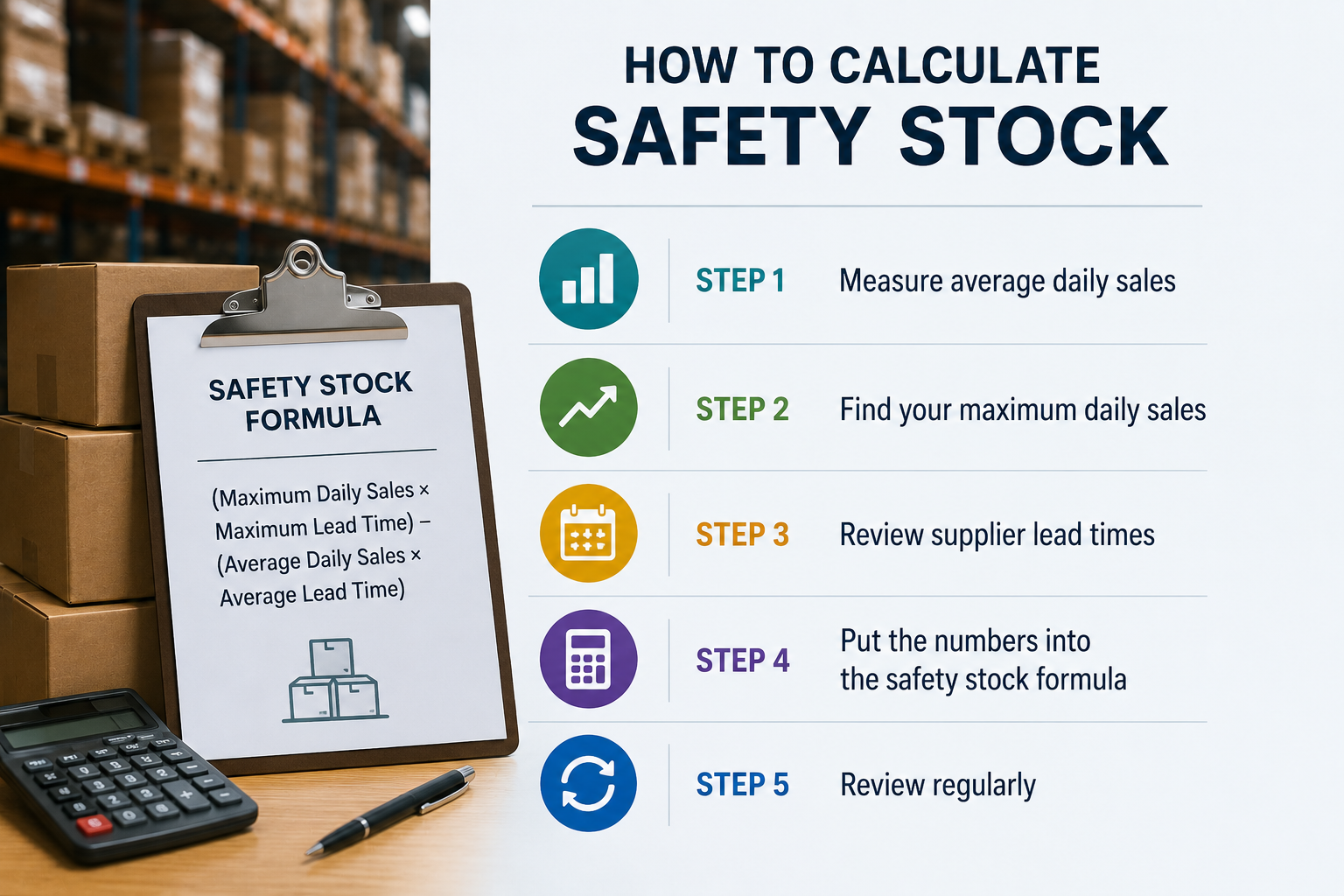
If you are searching for how to calculate safety stock, the process becomes much easier when broken into simple steps.
Step 1: Measure average daily sales
Start by calculating how many units of a product you typically sell per day over a meaningful period. Many businesses use the last 30, 60, or 90 days depending on the category.
Step 2: Find your maximum daily sales
Now identify the highest daily sales volume during that same period. This helps you capture sales spikes that average numbers may hide.
Step 3: Review supplier lead times
Next, calculate how long it usually takes for stock to arrive after an order is placed. Then identify the longest lead time you have actually experienced.
Step 4: Put the numbers into the safety stock formula
Use the full safety stock formula to estimate the extra inventory you should carry for that product.
Step 5: Review regularly
Do not calculate once and forget it. Demand patterns, supplier performance, and buying cycles change over time, so your safety stock formula should be reviewed regularly.
A safety stock example retail teams can apply
Let us walk through a simple safety stock example retail teams can use.
Imagine a fashion retailer sells an average of 40 units of a top-selling shirt per day. On very strong days, sales go up to 60 units. The supplier usually delivers in 5 days, but during busy periods delivery can stretch to 8 days.
Using the safety stock formula:
Safety Stock = (60 × 8) − (40 × 5)
Safety Stock = 480 − 200
Safety Stock = 280 units
In this case, 280 units would be the recommended safety stock.
That does not mean the brand should always buy blindly. It means the business now has a clearer view of the extra inventory needed to protect against demand spikes and supplier delays.
This kind of safety stock example retail teams use is especially helpful for fast movers, seasonal bestsellers, and products linked to promotions.
The difference between expected stock and protected stock
A lot of confusion in planning happens because teams mix up working inventory and safety stock.
Working inventory is the stock you expect to sell under normal conditions. Safety stock is the extra layer you keep for unusual conditions.
That distinction matters.
If everything is treated as one big stock number, teams may believe they have enough coverage when they are actually consuming the protection meant for uncertainty. The safety stock formula helps separate normal need from protective need.
Buffer stock vs safety stock, what changes in practice
The phrase buffer stock vs safety stock can sound more complicated than it really is.
In many businesses, the two terms are used interchangeably. Both refer to extra inventory held to reduce the risk of disruption.
Still, there is a small difference in how people sometimes use them.
Buffer stock is often a broader term for backup inventory held for general protection. Safety stock is usually the more specific planning term used in inventory management to define the extra quantity above expected demand during lead time.
In practice, many retail teams say buffer stock when speaking casually and safety stock when calculating precisely.
So if you are comparing buffer stock vs safety stock, the most important point is this: both are meant to protect sales continuity, but the safety stock formula gives that protection a measurable structure.
Why the safety stock formula should not be the same for every product
One common mistake is applying one rule to the full assortment.
That may feel simpler, but it often leads to poor results. A slow-moving home item, a high-demand festival product, and a replenishment basic should not all carry the same inventory logic.
Your safety stock formula decisions should reflect product behavior.
Fast movers may need stronger protection because the cost of a stockout is high. Slow movers may need lighter protection because excess stock creates holding risk. Seasonal products may need temporary changes during key demand windows.
Better planning happens when categories are treated differently, not when everything is pushed through one blanket rule.
Safety stock inventory management India businesses should consider
For safety stock inventory management India businesses, local operating conditions matter a great deal.
Lead times may shift because of regional holidays, transport bottlenecks, festival demand, weather disruptions, or vendor capacity issues. Customer demand can also rise sharply around celebration periods, sale events, and local market peaks.
That means the safety stock formula should reflect real Indian business conditions, not ideal assumptions.
If your supplier usually delivers in 4 days but regularly slips to 7 during a high-demand period, your formula should reflect that reality. If your category sees strong jumps during festive retail windows, your maximum demand should reflect those spikes too.
A formula becomes useful only when the inputs are honest.
When a simple safety stock formula is enough
Not every business needs a highly advanced model on day one.
A simple safety stock formula is often enough when demand is relatively stable, supplier patterns are somewhat predictable, and the business is still building planning maturity.
For many growing brands, clarity beats complexity.
Starting with a basic safety stock formula is better than relying only on instinct or spreadsheet guesswork. Once the business becomes more complex, planning methods can become more refined.
Where teams usually go wrong with safety stock
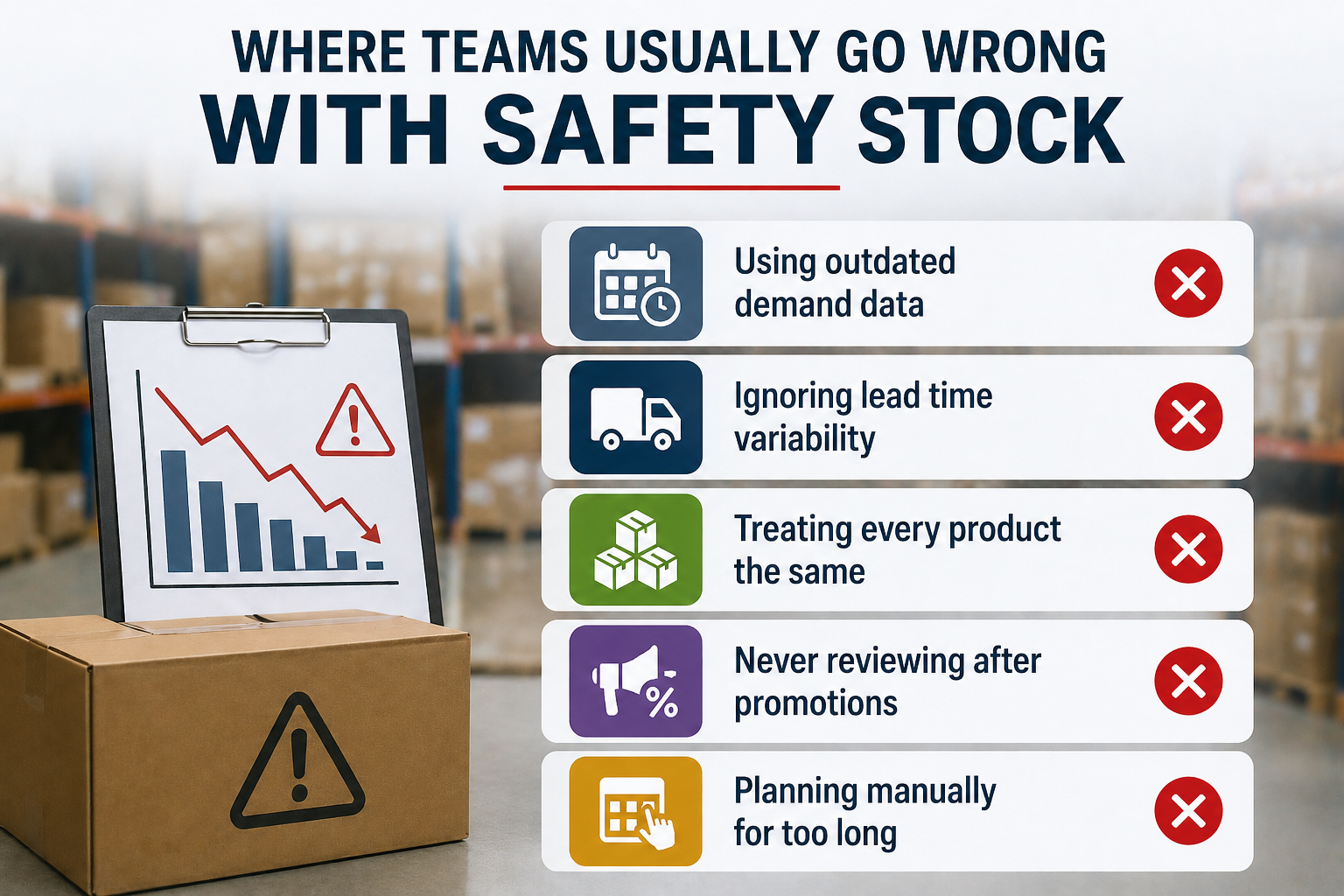
Even when people understand the concept, the execution can slip.
Here are a few common issues:
• Using outdated demand data
If the numbers are old, the safety stock formula will be weak from the start. Product demand should be reviewed using recent and relevant periods.
• Ignoring lead time variability
Average supplier lead time is helpful, but it is not enough on its own. The safety stock formula needs to reflect worst-case delivery situations too.
• Treating every product the same
One fixed buffer across all categories often causes overstock in some items and underprotection in others.
• Never reviewing after promotions
Promotions often distort demand patterns. If teams do not revisit the safety stock formula after a campaign period, future planning may become unreliable.
• Planning manually for too long
Manual planning may work at smaller scale, but it becomes harder as stores, channels, and stock points grow. The more complex the operation becomes, the more valuable connected planning tools become.
How software makes safety stock easier to manage
The challenge is not only knowing the safety stock formula. The harder part is keeping it current across many products, locations, and changing demand patterns.
That is where planning software becomes valuable.
A connected inventory planning system helps teams track stock levels, demand trends, replenishment needs, and supplier timelines in one place. It reduces the chance of relying on stale data and makes it easier to adjust the safety stock formula as conditions change.
For businesses trying to grow without losing control, that visibility matters.
You can explore Supplymint’s inventory planning software to see how smarter replenishment and planning workflows can support more confident inventory decisions.
Practical tips before you finalize your safety stock number
Before locking in your numbers, keep these practical points in mind.
Review demand at the right level. Daily numbers are often more useful than monthly averages when calculating a responsive safety stock formula.
Separate normal periods from unusual ones. If a product had one extreme event, decide whether that event is part of future reality or just noise.
Talk to procurement and operations together. The best safety stock formula is not built in isolation. Sales trends, supplier behavior, and operational constraints all matter.
Use judgment along with math. The formula gives a disciplined starting point, but category knowledge still matters.
Final thoughts
The safety stock formula gives businesses a clearer, calmer way to prepare for uncertainty instead of reacting after stock runs low. When used well, the safety stock formula helps protect sales, improve product availability, and give teams more confidence in everyday replenishment decisions.
If your team is still managing buffer inventory through spreadsheets or manual follow-ups, this is a good time to move toward a more connected approach. Explore Supplymint's Planning for smarter inventory allocation, demand forecasting, and replenishment workflows, or visit the Contact page to speak with the team about building a stronger stock planning process