
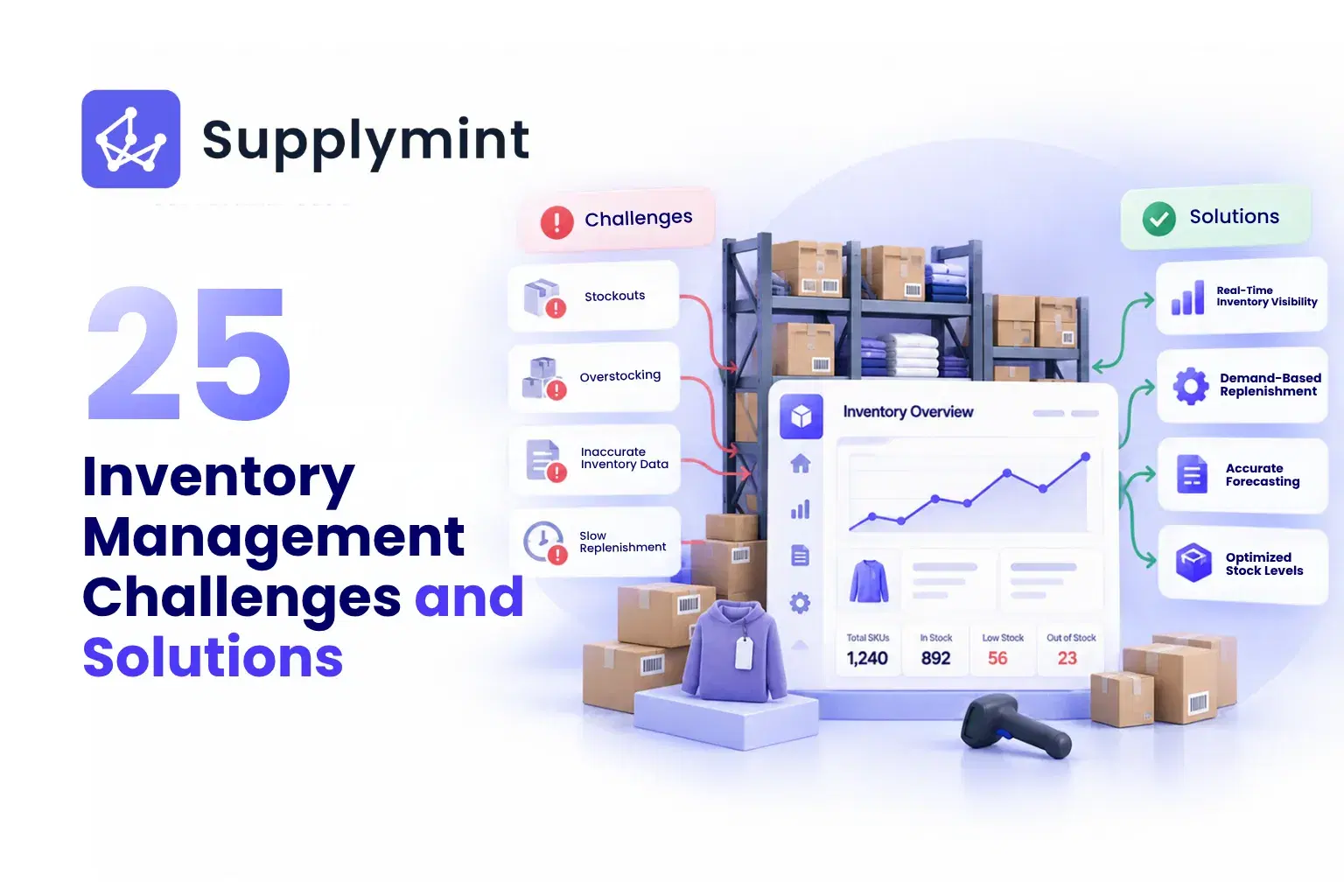
Inventory management can make or break a retail business. One wrong call, running out of stock during a demand spike, or sitting on excess inventory that ties up cash, can turn into a real financial setback fast. As supply chains get more complex and customer expectations keep rising, most of these problems don't stay small on their own. Here are the 25 challenges that come up most often, and what actually fixes each one.
Challenge 1: Data Integrity and Inventory Accuracy Gaps
Manual entry errors, fragmented systems, delayed syncing, and inconsistent SKU identification all chip away at how much you can trust your stock numbers. The result is stock discrepancies, flawed forecasts, and replenishment cycles that run on bad data, all of which quietly raise carrying costs and lower service levels.
Solution: Automated data capture through barcode scanning or RFID, tied to a centralized inventory system, fixes this at the source. Regular audits and anomaly detection catch whatever slips through before it compounds.
Challenge 2: Lack of Real-Time Visibility Across Channels
This is the single biggest search term on this topic by a wide margin, and it shows up as a real operational problem too. Disconnected systems and delayed updates across e-commerce, stores, and warehouses prevent timely decisions and create fulfillment errors.
Solution: A unified system that gives real-time stock visibility across every channel, backed by live dashboards, automated threshold alerts, and proper ERP, WMS, and POS integration, closes that gap. This same foundation is what makes the perpetual inventory system work in practice rather than just on paper.
Challenge 3: Fragmented System Integration
Related to the point above but distinct: when inventory, sales, and ERP platforms don't talk to each other in real time, you get data silos, overselling risk, and fulfillment decisions made on stale information.
Solution: API-driven, modular integration across every system in the stack, backed by real-time synchronization middleware, closes this rather than another manual reconciliation step.
Challenge 4: Missing Inventory KPIs and Performance Tracking
Without defined metrics, there's no way to see inventory health or catch a problem before it gets expensive.
Solution: Turnover ratio, days sales of inventory, fill rate, and carrying cost each need a live dashboard, not a quarterly spreadsheet pull, so a problem shows up while it's still cheap to fix.
Challenge 5: Delayed or Inadequate Analytics and Reporting
Static reports miss demand shifts and disruptions while they're still small enough to correct.
Solution: Real-time dashboards covering turnover, stockouts, excess inventory, and fulfillment times, paired with automated threshold alerts, turn reporting into something that catches problems early instead of explaining them after the fact.
Challenge 6: Demand-Supply Imbalance Driving Overstock and Stockouts
Overstock ties up working capital and inflates storage costs; stockouts cost sales and customer trust. Both usually trace back to weak forecasting and reorder policies that don't adjust to how a product is actually behaving.
Solution: Advanced forecasting paired with a disciplined approach to avoiding stockouts and overstock, through dynamic reorder points and safety stock that flex with product velocity, is what closes the gap rather than just carrying more buffer.
Challenge 7: Weak Forecasting Methods
Traditional forecasting misses rapid market shifts, promotional effects, and disruption.
Solution: Machine-learning-driven models that adapt continuously, combined with collaborative input from sales, marketing, and supply chain teams, catch what a static historical average can't.
Challenge 8: Seasonal Demand Variability
Static replenishment policies fail during predictable but sharp seasonal swings, leading to excess stock after the season or stockouts during it.
Solution: Building a proper seasonal demand forecasting and inventory planning process, including a seasonal demand calendar and dynamic safety stock adjustment through peak, rush, and transition periods, holds up under real seasonal pressure in a way a static policy can't.
Challenge 9: Forecasting for New Products With No Sales History
A launch with no historical data creates real uncertainty, and the usual result is either excessive safety stock as insurance or a stockout when demand outpaces the guess.
Solution: Probabilistic modeling using analogous product performance and pre-launch demand signals, the approach covered in demand forecasting for new products, plus a fast feedback loop with suppliers after launch, narrows that gap quickly.
Challenge 10: Inventory Shrinkage From Theft, Damage, or Admin Error
Every unit of shrinkage is a gap between what your system says you have and what's actually on the shelf, and it erodes both profitability and trust in the numbers.
Solution: Loss prevention such as surveillance, access controls, and staff training catches the cause, while RFID inventory tracking and frequent cycle counts catch it early rather than at year-end.
Challenge 11: Inadequate Cycle Counting and Audits
Irregular or sloppy cycle counts let discrepancies pile up quietly until an audit surfaces a number nobody trusts.
Solution: ABC-analysis-aligned cycle counting focused on high-value, high-velocity SKUs first, with barcode or RFID scanning built in, catches this on a rolling basis instead of once a year. Cycle counting in the Indian retail context covers the compliance and frequency considerations that apply locally.
Challenge 12: Inaccurate Safety Stock Calculations
A static safety stock formula that doesn't adjust for demand variability, lead time swings, or service-level targets either overstocks constantly or leaves you exposed to the next spike.
Solution: Working through the safety stock formula properly, and the buffer stock formula by industry where a single formula doesn't fit every category, replaces guesswork with a number tied to actual demand variability and lead time.
Challenge 13: Obsolete and Slow-Moving Inventory
Dead stock ties up capital and warehouse space long after it's stopped selling, and it complicates both replenishment and demand planning for everything else.
Solution: SKU-level performance analytics that flag aging inventory early, paired with a real liquidation strategy, keep obsolete stock from turning into a write-off.
Challenge 14: Hidden Inventory Carrying Costs
Without visibility into what it actually costs to hold a SKU, including warehousing, insurance, depreciation, and obsolescence risk, there's no real basis for deciding what to cut.
Solution: Cost tracking at the SKU and category level, tied to turnover data, turns "we have too much stock" into an actual, prioritized reduction plan.
Challenge 15: Complex Multi-Channel Inventory
Selling across marketplaces, stores, and wholesale at once creates real synchronization risk: overselling, stock discrepancies, and fulfillment errors, when the channels aren't unified.
Solution: A single system with real-time sync and allocation rules based on channel performance stops one channel from selling stock another channel has already committed.
Challenge 16: Poor Warehouse Layout and Process
A disorganized warehouse means more picking errors, slower fulfillment, and higher operational cost, plus a higher risk of damage from poor space use.
Solution: Data-driven slotting based on SKU velocity, combined with warehouse automation that handles barcode scanning and task automation, fixes this rather than a one-off reorganization.
Challenge 17: Multi-Warehouse and Distributed Inventory Coordination
Coordinating stock, replenishment, and fulfillment across several warehouses gets genuinely hard without centralized, real-time visibility into every location at once.
Solution: Intelligent allocation that accounts for historical demand, lead times, and shipping cost, the core idea behind multi-location inventory management, plus automatic transfers between locations, solves this at scale.
Challenge 18: Inefficient SKU and Product Categorization
A large, poorly organized SKU catalog complicates tracking, forecasting, and replenishment, and it quietly breaks analytics accuracy since slow movers and top performers end up in the same bucket.
Solution: SKU rationalization based on sales velocity and profitability, with standardized categorization, restores that visibility.
Challenge 19: SKU Portfolio Bloat
Related but distinct from poor categorization: too many SKUs, full stop, inflates carrying costs and strains warehousing regardless of how well they're organized.
Solution: Sales-velocity and margin-contribution analytics, applied through a continuous SKU lifecycle review, identify which SKUs to retire rather than letting the catalog grow indefinitely.
Challenge 20: Supplier Variability and Unpredictable Lead Times
An unreliable supplier disrupts the whole replenishment cycle, forcing either a stockout or a defensive buildup of extra buffer stock, which raises holding costs either way.
Solution: Clear supplier performance metrics, vendor-managed inventory or just-in-time practices where they fit, and lead-time monitoring that adjusts reorder points dynamically all reduce how much buffer is needed to stay protected.
Challenge 21: Manual, Fragmented Procurement
Manual purchase order creation and approval introduces ordering errors, delays, and poor supplier coordination, all of which show up downstream as availability problems.
Solution: Automated PO workflows, demand-driven order quantity calculations, and vendor portals with real-time status visibility remove most of the manual error risk.
Challenge 22: Inefficient Returns and Reverse Logistics
Returned goods that are damaged, obsolete, or need reprocessing disrupt inventory accuracy and inflate carrying costs if they aren't tracked properly through the return flow.
Solution: Clear status tracking, inspected, refurbished, restocked, or disposed, with automated inspection checkpoints keeps returns from quietly becoming a second, untracked inventory pool.
Challenge 23: Limited System Scalability
A platform that can't handle growing transaction volume or new sales channels slows down exactly when the business needs it to keep up, creating bottlenecks and data lag under load.
Solution: Cloud-native, modular platforms designed for elastic scaling stop this from becoming a hard ceiling on growth.
Challenge 24: Workforce Gaps and Slow Technology Adoption
Undertrained staff and weak change management are why a good system still gets used badly.
Solution: Role-based training tied to actual system functionality, with a phased rollout and real stakeholder communication, closes the adoption gap faster than a single onboarding session ever does.
Challenge 25: Regulatory Compliance and Traceability
Pharma, food, and electronics categories face real regulatory requirements around traceability: serialization, lot tracking, and recall management. Gaps here aren't just an efficiency problem, they carry legal exposure.
Solution: Serialization and lot tracking built into the inventory system, with automated recall and expiry monitoring, is the baseline most regulated categories now need.
How Supplymint Helps
A good number of the challenges above come back to the same root cause: forecasting, replenishment, and stock visibility running as separate, manual processes instead of one connected system. Supplymint's Demand Planning Software and the broader Supply Chain Planning platform are built around closing exactly that gap.
- Automated Open-to-Buy forecasting that factors in seasonal trends, sales history, closing stock, and planned changes, directly addressing the demand-supply imbalance and forecasting challenges above.
- ML-based automated replenishment through the ARS module, so reorder decisions don't sit in a manual review queue during a peak week.
- Multi-location visibility and transfers, including single POs across multiple sites and system-flagged transfers for aged or non-performing stock between mapped stores.
- Real-time, cross-system reporting comparing actual sales against forecast, closing the visibility and analytics gap that shows up repeatedly above.
V Mart's shift from manual to automated demand and inventory planning and Skechers' automated demand planning journey show what this looks like at real retail scale. If several of the 25 challenges above sound familiar in your own operation, you can book a personalized demo to see how Supplymint would handle your specific catalog and channel mix.
Frequently Asked Questions
1. What's the most common inventory management challenge?
Lack of real-time visibility across channels and locations is the one businesses search for most, and it's usually the root cause behind several others on this list, forecasting errors, overselling, and slow reporting all get worse when visibility is already broken.
2. Can small businesses fix these challenges without enterprise software?
Many of them, yes, at a small enough scale. Cycle counting discipline, basic categorization, and simple safety stock formulas work fine early on. The challenges around real-time multi-channel visibility, automated replenishment, and multi-location coordination are where manual processes stop scaling and software becomes the practical answer.
3. How do you prioritize which challenge to fix first?
Start with whichever one is actively costing money right now, usually stockouts on fast-moving SKUs or shrinkage that's gone undetected for a while, rather than trying to fix all 25 at once. Data accuracy and visibility tend to be worth fixing early since several other challenges on this list get easier once the underlying numbers can be trusted.
4. Do these challenges apply the same way across industries?
The categories are consistent, but the weight shifts. Fashion and apparel feel SKU proliferation and seasonal variability hardest; pharma and food feel compliance and traceability hardest; e-commerce and omnichannel retailers feel multi-channel synchronization and returns management hardest.
5. How often should inventory challenges like these be reassessed?
At least quarterly, and immediately after any major change: a new sales channel, a new warehouse, a catalog restructuring, or a demand shock like a viral product moment or a supply disruption.