

Demand planning and forecasting is how retailers predict customer demand and plan inventory, staffing, and supply chain activity to meet it without overstocking or running out of stock. The two terms work together but serve different purposes. Demand forecasting is the analytical process of using data, trends, and models to estimate future demand. Demand planning is the strategic process of turning those forecasts into action: purchasing, allocation, and replenishment.
For seasonal sales, getting both right matters more than for steady, year-round demand. A festival spike, a monsoon shift, or a back-to-school rush behaves nothing like a normal week, and a forecast that isn't translated into an actual buying and allocation plan is just a number on a slide.
Why Seasonal Sales Need a Different Approach
Seasonal demand isn't just higher; it's more unpredictable. Diwali, Black Friday, and the summer holiday rush can produce sudden spikes that regular forecasting models don't capture well. Unlike steady, year-round products, seasonal items respond to historical sales patterns, promotional campaigns, and external factors like weather and even viral social moments.
In the beverage industry, for instance, cold drink sales can roughly double in summer compared to winter, while hot beverages see the opposite swing. Without a tailored approach, retailers end up with empty shelves during peak days and excess stock right after.
|
Factor |
Year-Round Products |
Seasonal Products |
|---|---|---|
|
Demand pattern |
Steady, predictable |
Sudden spikes and dips |
|
Key influences |
Market trends, economy |
Festivals, weather, promotions |
|
Forecasting method |
Basic time-series models |
Seasonal-adjusted models |
|
Stockout risk |
Low to moderate |
High if unprepared |
|
Overstock risk |
Moderate |
High post-season |
Categories like fashion, apparel, footwear, jewellery, and e-commerce feel this hardest. Product lifecycles are short, a single style can multiply into dozens of SKU variants by size and colour, trends move faster than supplier lead times, and markdown exposure eats directly into margin. Planning has to happen at the variant level, not just the category level, for these categories to avoid both stockouts and dead stock.
Planning for 2026: Volatility, AI, and Faster Cycles
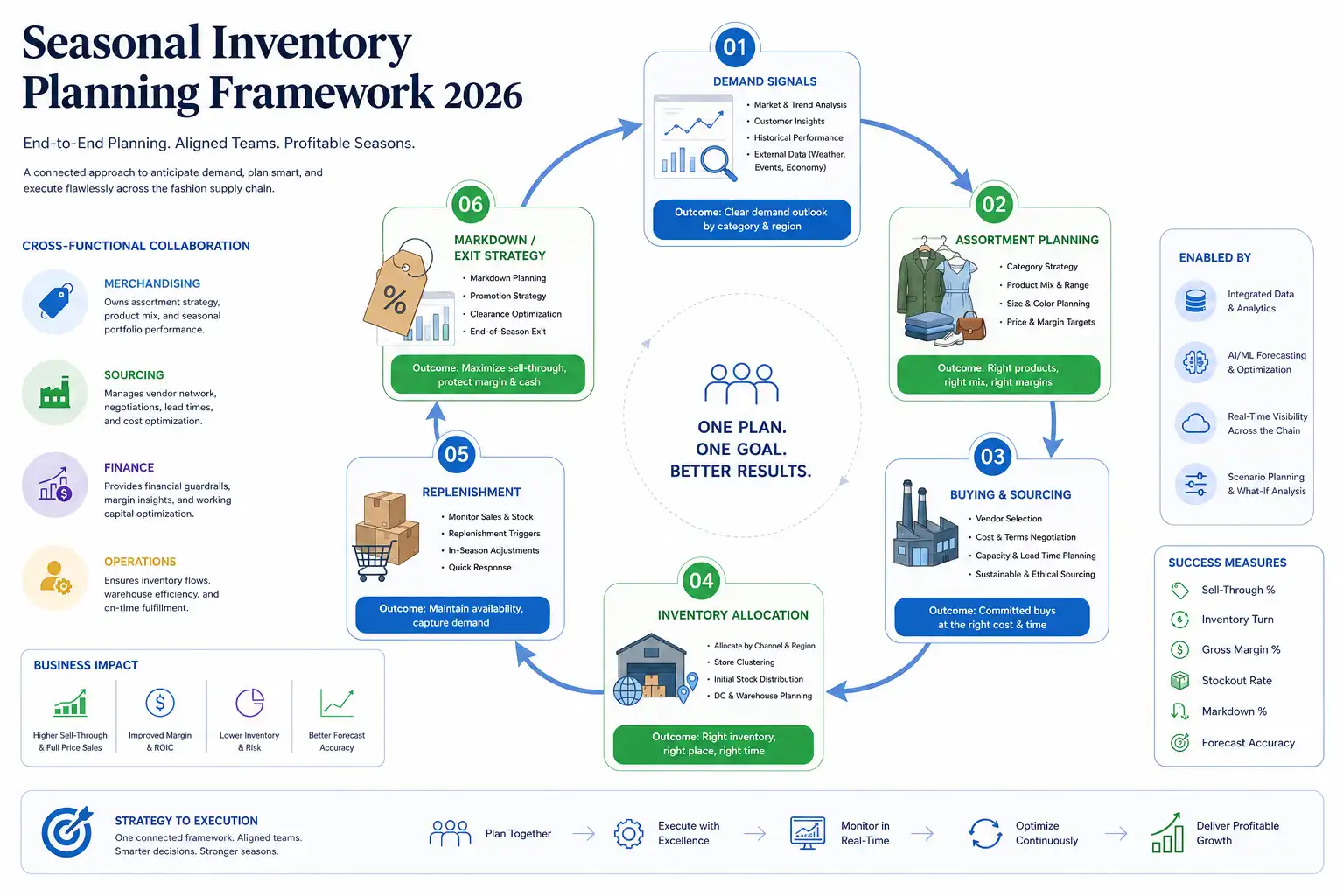
Seasonal planning in 2026 carries a few pressures that weren't as sharp even two or three years ago: tariff and cost volatility affecting sourcing decisions, shifting discretionary spending, and trend cycles moving faster than traditional buying calendars can keep up with. The teams handling this well aren't relying on a single forecast number. They're building low, base, and high scenarios for each major season, so a tariff shift or a demand miss doesn't blow up the whole plan, just requires a shift between scenarios that's already been thought through.
AI-assisted forecasting helps here too, not by replacing judgment but by processing more signals (search trends, weather, social response) faster than a quarterly spreadsheet review can. The section below on forecasting methods covers where this fits in practically.
Build a Seasonal Demand Calendar Before You Forecast
Before running any forecast, it helps to have a demand calendar that aligns merchandising, marketing, and supply chain around the same dates. Five things belong on it:
- Commercial peaks: the big retail dates, Diwali, BFCM, Christmas, back-to-school, Valentine's Day.
- Weather windows: the climate-driven demand brackets that shape seasonal assortments.
- Marketing catalysts: planned campaigns, influencer activity, and marketplace events that will move demand independent of the calendar.
- Product lifecycles: launch dates, shipping deadlines, and planned exit points for each item.
- Supplier constraints: upstream deadlines like material booking and sampling, and downstream ones like PO lock dates and receiving capacity.
Each event on the calendar needs an owner and a set of dates attached to it: a forecast date, a PO lock date, an allocation date, a replenishment rule, and an exit date. Without that, "we're getting ready for the festive season" stays a vague intention instead of a plan with deadlines.
A few patterns are common enough to plan around directly. High-volume festivals and holidays (Diwali, Eid, Christmas) call for early stock positioning and expanded returns capacity. Seasonal triggers like wedding season or back-to-school need responsive replenishment rather than a single pre-season buy, since demand for formal wear or school basics keeps shifting through the window. Climate-driven categories like monsoon wear or winterwear should be timed against actual weather signals, not just the calendar date, since a late monsoon or an early cold snap can shift the whole window by weeks.
Key Demand Forecasting Methods for Seasonal Sales
Seasonal forecasting isn't one-size-fits-all. The right method depends on the product mix, how much sales history exists, and how unpredictable the peaks are. Four methods cover most seasonal retail cases.
- Time series analysis works well for products with clear, recurring seasonal patterns, festive wear ahead of Diwali or holiday décor in December. Analyzing historical sales trends over multiple years helps pinpoint when peaks and troughs are likely to land, which feeds directly into inventory allocation timing.
- Moving averages and weighted moving averages smooth out short-term noise to reveal the underlying trend. A weighted moving average, which gives more importance to recent sales, works better in fast-moving retail environments where preferences shift quickly heading into a seasonal event.
- Regression analysis identifies how external factors move seasonal sales. Higher temperatures driving cold drink demand is the classic example; linking weather, holiday dates, and campaign timing to sales data sharpens the forecast beyond what pure history can do.
- Machine learning forecasting models pick up complex patterns that traditional methods and manual review tend to miss, combining historical sales, real-time market signals, and even social sentiment into a more adaptive forecast. This matters most for the least predictable seasonal spikes, where history alone underrepresents what's actually about to happen.
From Forecast to Action: Planning and Procurement
A forecast only has value once it's translated into a buy. The sequence that works: forecast demand by SKU, variant, channel, and period; subtract what's already available, committed, or incoming; add a safety stock buffer; validate supplier lead times; confirm minimum order quantities, pack sizes, and size curves against supplier capacity; check the numbers against open-to-buy limits and margin targets; then allocate across suppliers and lock the purchase orders.
Safety Stock Planning
Even a well-built forecast can't predict every spike, a viral moment, a surprise festival surge, a sudden weather shift. Safety stock is the buffer that absorbs the gap between forecast and reality without forcing a full re-buy. The right level balances the cost of holding extra units against the cost of a stockout. See the full safety stock formula and worked example here, and for the broader, industry-specific version of the same idea, the buffer stock formulas by industry.
A simple reorder-point formula ties the forecast directly to a trigger: reorder level equals safety stock plus the forecast requirement during the replenishment lead time. The economic order quantity guide covers how to size the actual order once that trigger fires.
Replenishment Triggers
Automating replenishment keeps stock from dipping below a set threshold without someone manually reviewing every SKU. Purchase or transfer orders fire based on forecasted demand and real-time stock data, which matters most exactly when a team has the least spare capacity to react manually, during a peak week. More on avoiding stockouts through replenishment design here.
Different points in the season call for different inventory policies, not one fixed rule. A peak strategy protects hero SKU availability above everything else. A rush strategy shortens the review cadence and allows emergency reorder rules to kick in faster than normal. A transition strategy, as the season winds down, reduces reorder points and stops replenishing weak performers before they turn into dead stock.
Allocating Inventory Across Channels and Locations
Demand isn't uniform across regions or channels, and during a seasonal peak that unevenness gets sharper. Some cities or channels surge while others stay flat, so allocation has to be locked ahead of the season rather than reacted to after the fact, since a stockout at the wrong location during a festival week is a lost sale that isn't coming back.
A few things drive good allocation decisions: balancing channel mix against margin, since direct and D2C channels often carry better margin and better customer data than marketplace fulfillment; positioning stock to hit delivery promises without inflating freight costs through split shipments; making sure high-return categories have fast inspection and restocking flow back into sellable inventory; and keeping full visibility into available-to-promise stock across locations, with clear rules for transferring between them rather than ad hoc decisions made under pressure.
Multi-location inventory management covers the mechanics of this in more depth, store-to-store transfers, allocation logic, and the visibility this depends on.
Managing the Season in Real Time
Once the season is live, review cadence should match how fast things are moving, daily during high-velocity periods, weekly during moderate ones. What's worth tracking: sell-through by SKU and location, stock cover, stockout risk, return rates, supplier delays, and how promotions are actually landing versus plan.
The teams that handle this well aren't reviewing every SKU with equal attention, they're watching for the handful of high-impact variances and acting on a predefined playbook rather than deciding fresh each time: accelerating replenishment or releasing reserves when a hero SKU outperforms, transferring stock between regions when one area runs hot and another runs cold, pausing campaigns or substituting products when supply is genuinely constrained, adjusting price or bundling when sell-through is weak, and triggering backup suppliers when a primary one slips.
Industry Examples of Seasonal Demand Planning
- Retail clothing: Winter jackets, summer wear, and festive collections all require anticipating style trends, climate variation, and regional preference, often six to nine months out. Forecasts that weigh in weather, local events, and past sales help each store get the right size and style mix at the right time, rather than a flat allocation across the network.
- Beverage brands: Iced drinks in summer, hot beverages in winter, sharp seasonal spikes either way. The real challenge is timing production runs and distribution to meet the peak, which is where temperature-linked replenishment triggers do more work than a static seasonal calendar.
- D2C beauty brands: Holiday gift kits, summer skincare bundles, and festival-limited editions all live or die on timing. Missing a launch window or misjudging quantity means leftover stock or a missed revenue window. A small buffer on high-demand SKUs, paired with marketing timed to actual supply readiness, protects against both outcomes.
Planning the Season’s Exit Without Losing Margin
Exit planning has to start before the season opens, not after it's already winding down. A markdown ladder with pre-planned timing, depth, and approval rules keeps discounting disciplined rather than reactive. Bundling protects perceived value and lifts basket size compared to a blanket discount. Outlet and off-price channels give a controlled way to liquidate what doesn't sell through, and carrying forward evergreen colours or classic styles into the next season avoids writing off inventory that still has a market.
Return flow matters here too, fast inspection and restocking on returned goods, repair or refurbishment where it's viable (jewelry, footwear, accessories), and clear rules for what gets donated, recycled, or disposed of rather than sitting in a warehouse.
Markdown decisions work best when they're triggered by data, sell-through rate, weeks of supply remaining, how close the season-end date is, rather than a gut call. Location transfers and bundling are worth trying before a blanket discount, since a blanket markdown erodes margin on units that might have sold at full price somewhere else in the network.
The Post-Season Review
Closing the loop matters as much as the plan itself. Worth tracking after every season: forecast accuracy, stockout rate, sell-through rate, GMROI, aged stock left over, supplier on-time-in-full performance, return rates and reasons, markdown cost, and how much demand shifted to substitute products when something ran out.
A short, honest post-mortem answers a few direct questions: which events over- or under-performed against plan, which SKUs were bought too deep or too shallow, which suppliers created risk versus which ones over-delivered, and which forecast overrides turned out to be right versus just biased guesses. Feed the answers back into next season's supplier scorecards, safety stock policies, and size curves rather than starting the next cycle from a blank sheet.
How Supplymint Helps With Seasonal Demand Planning
Supplymint's Demand Planning Software is built to handle the pieces above without them living across five different spreadsheets.
- Automated Open-to-Buy forecasting. Supplymint factors in seasonal trends, sales history, closing stock, and planned changes to generate OTB projections automatically, while still letting planners upload or adjust the plan rather than treating it as a black box.
- Automated replenishment. The system's ARS module runs an ML-based replenishment process, so reorder decisions during a peak week don't wait on someone manually reviewing every location.
- Multi-location visibility and transfers. A single PO can cover multiple sites, and the system can flag non-performing or aged stock for transfer between mapped stores instead of sitting unsold in one location while another runs short.
- Real-time reporting. Detailed, cross-system reporting compares actual sales against forecast, so a plan can be corrected mid-season instead of only reviewed after it's over.
V Mart's demand and inventory planning journey and Skechers' shift from manual to automated demand planning both show what this looks like in practice at retail scale.
Frequently Asked Questions
1. What’s the Difference Between Demand Planning and Demand Forecasting?
Demand forecasting uses historical data, statistical trends, and market signals to estimate future sales. Demand planning goes a step further and turns that forecast into action: purchasing, allocation, and replenishment decisions that put the right stock in the right place.
2. How Far in Advance Should Seasonal Inventory Planning Start?
Most fashion and apparel brands begin six to nine months ahead, depending on lead times and category complexity. Faster-moving or less trend-sensitive categories can work on shorter cycles, but purchasing generally still needs three-plus months of lead time.
3. How Much Safety Stock Should I Hold During Peak Season?
It depends on demand volatility, supplier lead time, and the service level target for that SKU. Grocery and FMCG categories with fast-swinging demand typically aim for a 95% service level; slower or lower-priority SKUs can run leaner. The safety stock formula breaks down the actual calculation.
4. What Is the Bullwhip Effect, and Why Does It Matter for Seasonal Demand?
It's the way small demand signals get amplified as they move up the supply chain, from retailer to distributor to supplier, through reactive over-ordering at each stage. During a seasonal peak this can turn a modest spike into a serious overstock or a supply shortfall further upstream. Better demand visibility and coordinated forecasting across the chain is what keeps it in check.
5. Can Weather Actually Move Forecast Accuracy?
Yes. A hot spell lifts cold drink sales, an early cold snap pulls forward outerwear demand. Feeding weather data into the forecasting model sharpens accuracy meaningfully during seasons prone to sudden temperature shifts.
6. Can Seasonal Inventory Planning Be Automated?
Yes, and increasingly it has to be at any real scale. Software can automate the forecast itself, the reorder calculations, supplier timeline tracking, and markdown scheduling, while giving planners live visibility into sell-through and stock cover instead of a weekly spreadsheet snapshot.
7. How Does Regional Variation Affect Seasonal Planning?
Seasons and trends don't hit every region the same way, spring arrives earlier in the south, festival timing shifts by state, monsoon onset varies by weeks. Location-specific data, not a single national forecast, is what keeps delivery timing and allocation accurate across a retail network.