
A customer orders the last blue kurta online. At almost the same moment, someone buys that same kurta at the store counter. One of them is about to get a cancellation email. This is the everyday cost of not knowing your stock in real time, and it is exactly the problem a perpetual inventory system was built to fix.
Most retailers feel this pain long before they can name it. Stock that shows as available but is not. Counts that only match reality once a quarter. This guide explains what a perpetual inventory system is, how it works, and how it compares to the older periodic approach, with plain examples along the way.
What Is a Perpetual Inventory System?
A perpetual inventory system tracks your stock continuously, updating records the instant an item is sold, received, or moved. There is no waiting for a month-end count. The moment a transaction happens, the numbers change to match.
That is the whole idea behind the perpetual inventory system meaning: your records stay live. Sell one unit and the count drops by one, right away. Receive fifty units and they appear the moment they are scanned in.
Compare that to the old way, where stock figures were only trustworthy right after a physical count and drifted further from reality every day after. Perpetual tracking closes that drift. It keeps the book count and the shelf count in step, all the time.
How Does a Perpetual Inventory System Work?
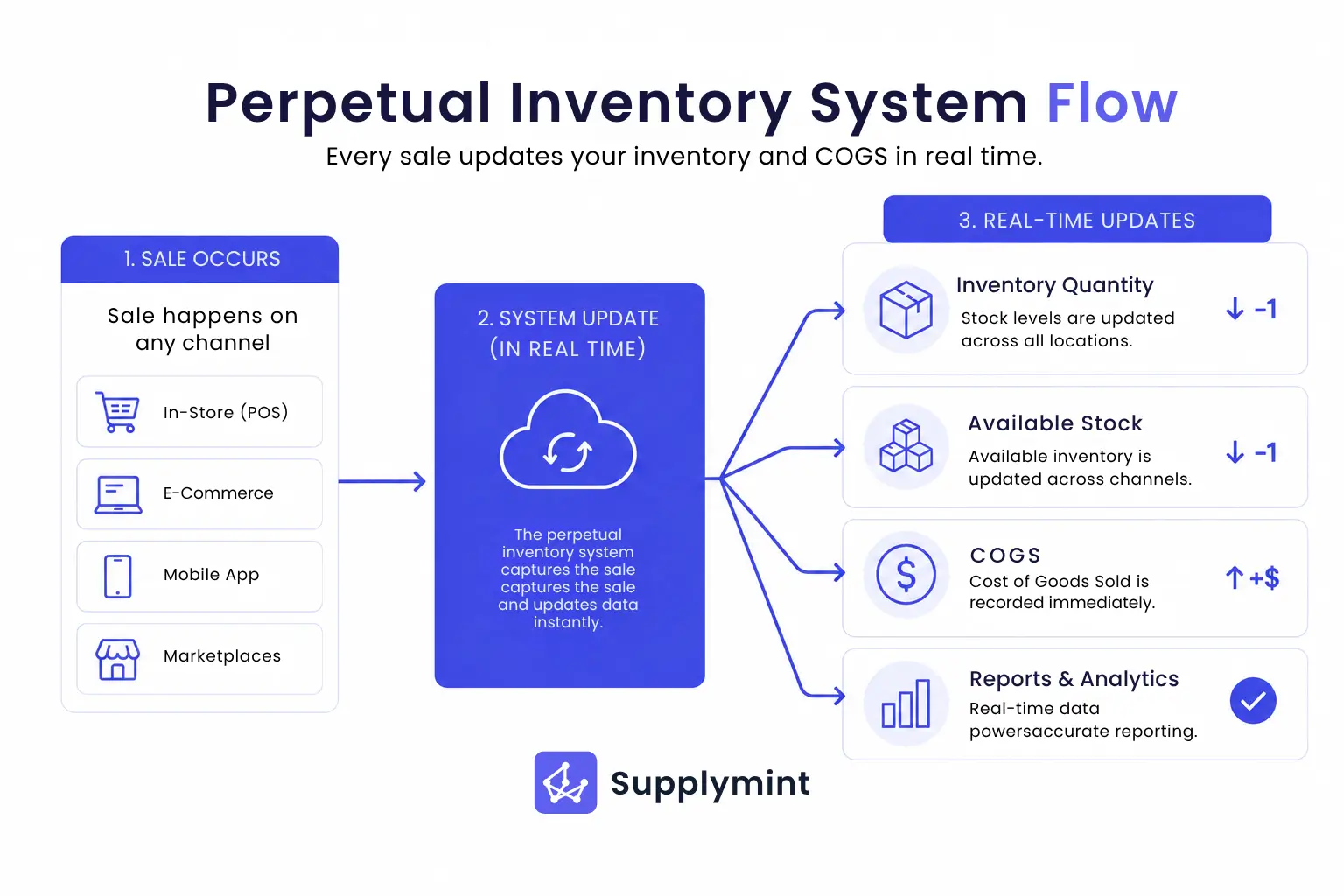
The system runs on transactions, not calendars. Every movement of stock is a data point, and each one updates the record automatically. A few technologies make that possible.
The tools that power it
Barcode scanners and RFID tags do the heavy lifting. When an item is scanned at the counter or during receiving, the system logs it instantly. Point-of-sale systems feed every sale straight into the inventory record. Behind all of it sits inventory software that ties the pieces together and keeps one central count. The same barcode and RFID automation behind wider inventory accuracy is doing the work here.
What updates with each transaction
Stock levels are the obvious one. But a perpetual system also updates the cost of goods sold with every sale. That means your financial picture stays current too, not just your unit counts. A manager can check profit on a product line midweek instead of waiting for the books to close.
This real-time link between stock and finance is what makes the system powerful. It is also what makes it demanding, since the data is only as good as the scanning discipline behind it.
A Simple Perpetual Inventory System Example
Picture a fashion retailer selling one shirt style across a store and a website, both drawing from the same warehouse.
A shopper buys the shirt in store. The POS scan drops the central count from 40 to 39 instantly. Seconds later, the website shows 39 too, because both channels read the same live number. No overselling, no cancellation email. When a new delivery of 100 shirts is scanned at the warehouse, the count jumps to 139 across every channel at once.
Now run the same day under a periodic system. The store and website each work off a count taken last week. Both think there are 40 shirts. Both keep selling. By evening, you have sold stock you no longer have, and someone has to apologize to a customer. That contrast is the entire case for going perpetual.
What Is the Difference Between Perpetual and Periodic Inventory Systems?
This is the comparison most people come looking for, so it is worth laying out clearly. The core difference is timing. A perpetual system updates continuously. A periodic system updates only at set intervals, using a physical count.
|
Factor |
Perpetual Inventory System |
Periodic Inventory System |
|---|---|---|
|
Update timing |
Continuous, in real time |
At set intervals only |
|
How stock is counted |
Automatically at each transaction |
Manual physical count each period |
|
COGS calculation |
Updated with every sale |
Calculated at period end |
|
Technology needed |
Barcode, RFID, POS, software |
Minimal, often manual |
|
Best for |
High volume, many SKUs or locations |
Small, low-volume operations |
|
Accuracy between counts |
High and current |
Unknown until the next count |
The periodic system is not useless. For a tiny shop with a handful of products, a monthly count is manageable and cheap. The trouble starts with scale. Add more SKUs, more locations, or an online channel, and the gaps between counts turn into real money lost. For a wider view of where both methods sit, see our guide to common inventory management techniques.
What Are the Advantages of a Perpetual Inventory System?
The benefits stack up quickly once volume grows. Here is where the method proves its worth.
Real-time stock visibility
You always know what you have. That single fact prevents both overselling and panic overstocking. For a business selling across multiple locations, one live count across all of them is the difference between control and guesswork.
Higher accuracy, less human error
Automated scanning records each movement as it happens. There is far less manual entry, so there are far fewer mistakes. Discrepancies that used to surface only at audit time get caught much earlier.
Smarter reordering
Because the system knows your true stock at every moment, it can flag reorder points automatically. You restock based on live data, not a stale spreadsheet. This ties directly into how inventory replenishment actually works in practice.
Better decisions
Live data feeds better forecasting. You can see which products move fast and which stall, then act on it the same week. When Style Union moved to a system built on this kind of real-time accuracy, the payoff showed up directly in cleaner, more reliable inventory records.
What Are the Limitations of a Perpetual Inventory System?
It would be dishonest to pretend the system has no downsides. It has two worth knowing before you commit.
The first is setup cost. Barcode or RFID infrastructure, POS integration, and software all require upfront investment. For a very small operation, that cost may outweigh the benefit for now.
The second surprises people. A perpetual system does not remove the need for physical counts entirely. Scanning errors, theft, and damage still cause the record to drift from reality over time. That is why regular cycle counting stays essential even with perpetual tracking in place. The system reduces how often you count, not whether you count at all.
Who Should Use a Perpetual Inventory System?
The honest answer depends on scale and complexity. A single small store with slow turnover can survive on periodic counts. Almost everyone else benefits from going perpetual.
If you sell across more than one location, run an online channel alongside physical stores, or carry a large number of SKUs, the periodic approach will eventually cost you sales through phantom stock. At that point a perpetual system stops being a nice-to-have. It becomes the baseline for running the business without constant firefighting.
Making Perpetual Inventory Work for Your Retail Business
A perpetual inventory system comes down to one promise: your stock records match reality at every moment, not just after a count. That accuracy protects you from overselling, sharpens your reordering, and keeps your financials honest in real time. The catch is that it only works with clean data capture and the right system underneath it.
That system is what Supplymint's warehouse management platform is built to provide for retail, apparel, and fashion brands, tying real-time stock tracking across stores, warehouses, and online channels into one live count. If phantom stock and overselling are quietly costing you sales, moving to true perpetual tracking is usually the fix worth prioritizing.
Frequently Asked Questions
1. What is a perpetual inventory system in simple words?
It is an inventory method that updates your stock records in real time, the instant an item is sold, received, or moved. Instead of waiting for a periodic physical count, the system keeps a live count at all times using tools like barcode scanners and POS systems.
2. What is the difference between perpetual and periodic inventory systems?
A perpetual system updates continuously with every transaction, while a periodic system updates only at fixed intervals through a physical count. Perpetual gives real-time accuracy and suits high-volume or multi-location businesses. Periodic is simpler and cheaper but leaves long gaps where records may not match reality.
3. What are the main advantages of a perpetual inventory system?
The key advantages are real-time stock visibility, higher accuracy through automation, smarter automatic reordering, and continuously updated financial data. Together these prevent overselling, reduce manual errors, and support faster, better-informed decisions.
4. Does a perpetual inventory system still need physical counts?
Yes. Even with real-time tracking, issues like scanning errors, theft, and damage cause records to drift over time. Regular cycle counts are still needed to verify the system's numbers against actual stock, though they are needed far less often than under a periodic system.
5. Can a perpetual inventory system use FIFO or weighted average costing?
Yes. A perpetual system works with FIFO, LIFO, and weighted average cost methods. The system updates cost of goods sold continuously, and the valuation method you choose determines how those costs are calculated. The right choice depends on your product type and accounting standards.
6. Is a perpetual inventory system worth it for a small retailer?
It depends on scale. A very small, single-location shop with low turnover may manage fine with periodic counts. Once you add multiple locations, an online channel, or a large SKU count, a perpetual system quickly pays for itself by preventing lost sales from inaccurate stock.