
- Inventory visibility is the ability to see what stock you have and where it is, in real time, across warehouses, stores, in-transit shipments, and third-party locations, including what is committed and what is available to sell.
- Poor visibility leads to stockouts, overstock, markdowns, and overordering, because teams act on stale or incomplete data.
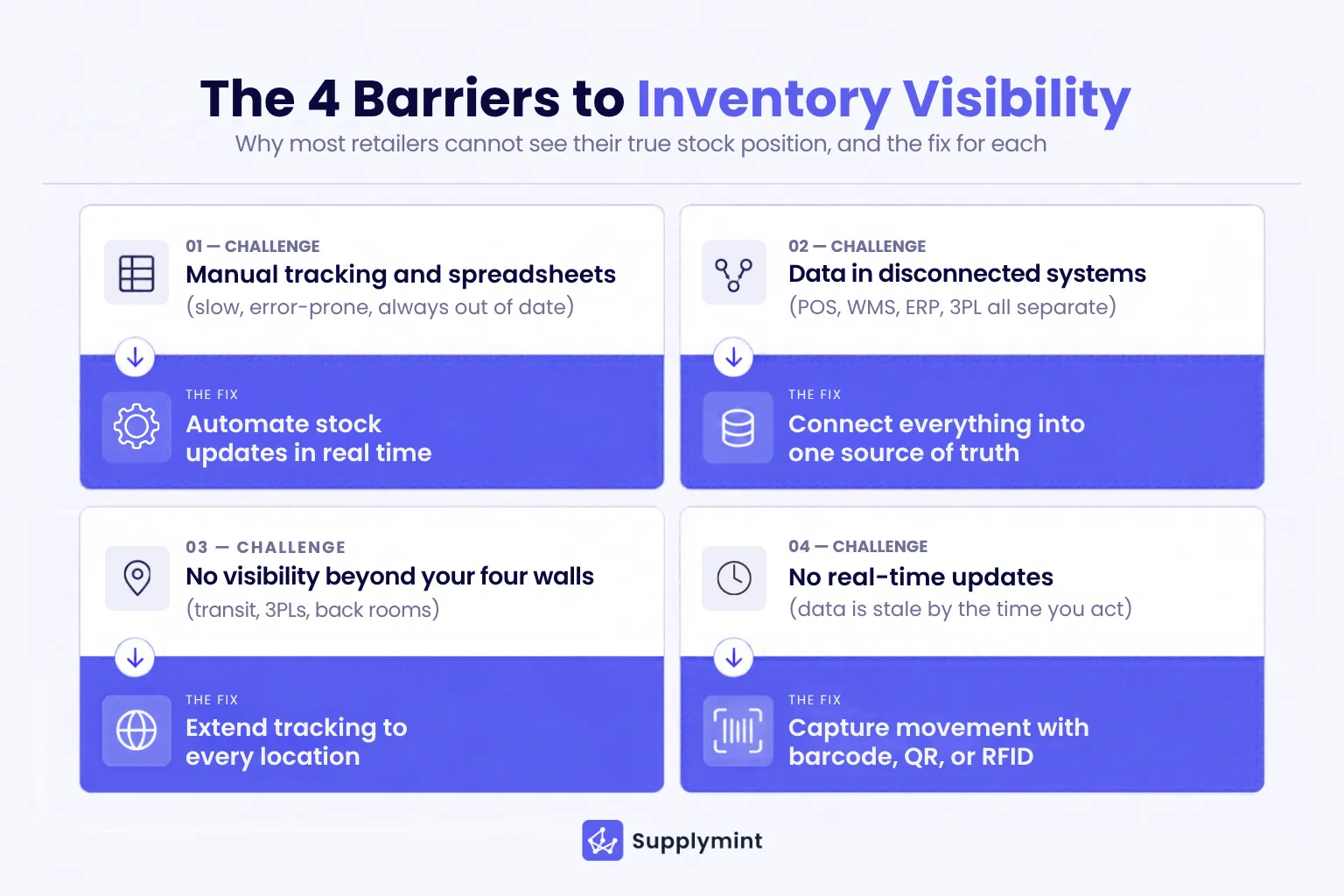
- The main barriers are manual tracking, data spread across disconnected systems, no view into 3PLs or in-transit stock, and no real-time updates.
- To improve it:
- connect POS, warehouse, ERP, and logistics data into one source
- automate stock updates
- extend tracking to every location
- capture movement with barcode, QR, or RFID scanning
Key Takeaway
Inventory visibility clearly means knowing the inventory that you have in hand and where it’s located. This paves a way for a company like yours in monitoring o
Ask most retail teams how much stock they have and where it is, right now, and you will get a pause. The number in the system, the number on the shelf, and the number actually available to sell are often three different things. That gap is the inventory visibility problem, and it is quietly behind a surprising share of stockouts, markdowns, and overordering.
Inventory visibility is the fix: knowing exactly what you have and where, as it moves, across every warehouse, store, and channel. This guide covers what inventory visibility means, the challenges that get in the way, how to improve it, and why it matters more than ever for retail.
What Is Inventory Visibility?
Inventory visibility is the ability to see what stock you have and where it is located, in real time, across your entire supply chain, warehouses, distribution centres, stores, in-transit shipments, and third-party locations. It goes beyond a simple stock count. True visibility means knowing not just how much you have, but where it sits, what is committed, what is in transit, and what is actually available to sell at any moment.
The difference between a stock number and real visibility is the difference between reacting and planning. A business with poor visibility finds out about a shortage when a shelf is empty. A business with strong visibility sees it coming and acts first.
Why Inventory Visibility Matters
Inventory visibility matters because almost every costly inventory mistake, a stockout, an overstock, a markdown, a missed sale, traces back to not knowing the true stock position in time. When teams work off stale or incomplete data, they overorder to play safe, miss demand because stock was stranded in the wrong location, or disappoint customers who were told an item was available when it was not.
Get visibility right and the whole operation tightens. You hold less safety stock because you trust your numbers. You move inventory to where demand actually is instead of letting it sit. And you make faster, more confident decisions, because everyone from the buyer to the store manager to finance is working from the same real-time picture.
Common Inventory Visibility Challenges
Most inventory visibility problems come down to data that is slow, scattered, or manually maintained. These are the challenges that get in the way most often.
Manual Tracking and Spreadsheets
Manually updating stock across warehouses, stores, and distribution centres is slow, costly, and error-prone. By the time the data is entered, it is already out of date, and the bigger the network, the worse the lag. Many retailers simply give up on tracking some locations accurately because the manual effort is too high.
Data Spread Across Disconnected Systems
When inventory data lives in separate systems, the POS, the warehouse tool, the ERP, a 3PL's portal, no one has a single view. Each system holds part of the truth, and reconciling them takes time the business does not have, which leaves blind spots exactly where decisions get made.
No Visibility Beyond Your Four Walls
Stock does not just sit in your warehouse. It is in transit, at a third-party logistics provider, in store back rooms, or with a drop shipper. Without visibility into these locations, you are blind to a large share of your own inventory, which is where stranded stock and phantom stockouts come from.
Lack of Real-Time Updates
Inventory moves constantly as sales, receipts, and transfers happen. If the data only updates at the end of the day, or when someone remembers to enter it, decisions are always being made on a picture that is already wrong. Real-time updating is what separates visibility from record-keeping.
How to Improve Inventory Visibility
You improve inventory visibility by centralising inventory data, automating updates, and extending tracking across every location and channel. A few practical steps do most of the work.
Start by connecting your systems so inventory data from POS, warehouse, ERP, and logistics flows into one place instead of sitting in silos. Automate stock updates so levels adjust in real time as sales, receipts, and transfers happen, rather than depending on manual entry. Extend tracking beyond your own walls to cover in-transit stock, 3PLs, and store back rooms, so no inventory is invisible. Use barcode, QR, or RFID scanning to capture stock movement accurately at the point it happens. And put it all on a platform the whole team can see, so buyers, warehouse staff, and finance share one live view. The common thread is a single, real-time, connected source of truth, which is exactly what a modern multi-location inventory management system provides.
Benefits of Strong Inventory Visibility
Strong inventory visibility delivers fewer stockouts, less overstock, lower costs, and faster decisions. In practice, the benefits stack up across the business:
- Fewer stockouts and lost sales, because shortages are caught before shelves empty.
- Less overstock and dead stock, because you stop overordering to compensate for blind spots.
- Lower carrying costs, because accurate data lets you hold less safety stock with confidence.
- Better stock placement, because you can move inventory to where demand actually is.
- Faster, aligned decisions, because every team works from the same real-time numbers.
- Stronger customer experience, because availability promises are based on real stock, not guesses.
Inventory Visibility in Retail and Omnichannel
For retailers, inventory visibility is harder and more important than almost anywhere else, because stock is spread across many stores, warehouses, and sales channels at once. A customer buying online wants to know if the item is in stock, which depends on visibility into every location that could fulfil the order. A buyer planning the next season needs an accurate read on what is selling and what is stranded. And omnichannel fulfilment, ship-from-store, buy-online-pickup-in-store, only works if the inventory count is trusted across every channel in real time.
This is where cross-channel and item-level visibility become a competitive advantage. Retailers that can see every unit, everywhere, in real time, sell more of their stock at full price and waste less of it on markdowns. In a business where margin is thin and the selling window is short, that visibility is often the difference between a profitable season and a discounted one.
How Supplymint Helps
Supplymint gives retailers real-time inventory visibility across every location on one connected platform built for retail, apparel, and fashion brands. Through Supplymint's inventory planning solution and real-time inventory visibility across every location, teams see stock as it moves, across warehouses, stores, and in-transit, and plan replenishment and allocation on data they can trust. Because inventory connects directly to procurement, planning, and warehousing in the same platform, a shift in stock anywhere updates everywhere, which is what turns visibility from a report into a daily operating advantage.
Frequently Asked Questions
1. What is inventory visibility?
Inventory visibility is the ability to see what stock you have and where it is, in real time, across your entire supply chain, including warehouses, stores, in-transit shipments, and third-party locations. It means knowing not just the quantity, but what is committed, in transit, and actually available to sell.
2. Why is inventory visibility important?
It matters because most costly inventory mistakes, stockouts, overstock, markdowns, and missed sales, come from not knowing the true stock position in time. Strong visibility lets businesses hold less safety stock, place inventory where demand is, and make faster, more confident decisions.
3. What are the main challenges to inventory visibility?
The biggest challenges are manual tracking and spreadsheets, inventory data spread across disconnected systems, no visibility beyond your own warehouse (into 3PLs, transit, and store back rooms), and a lack of real-time updates, which leaves teams deciding on data that is already out of date.
4. How can I improve inventory visibility?
Connect your systems into one source of truth, automate stock updates so levels change in real time, extend tracking to every location including in-transit and third-party stock, use barcode, QR, or RFID scanning for accuracy, and put it all on a platform the whole team can see.
5. What is cross-channel inventory visibility?
Cross-channel inventory visibility is seeing stock accurately across every sales channel and location at once, online, in stores, and in warehouses. It is what makes omnichannel fulfilment like ship-from-store and buy-online-pickup-in-store reliable, because availability is based on real, shared stock data.