
You don’t notice your supply chain when everything works. Orders go out on time, inventory stays balanced, and customers are happy. But the moment something slips, a late shipment, a missing product, or a sudden surge in demand, the cracks show fast.
That’s where supply chain risks quietly live. Not as big dramatic events, but as small, everyday disruptions that build up and hit when you least expect it.
Understanding these risks early is what separates reactive businesses from resilient ones. In this guide, we’ll break down the key types of risks and how to stay in control before they start affecting your operations.
In short, supply chain risks are anything that can disrupt the flow of goods, money, or information across your operation. This guide breaks down the main types and, just as importantly, how to manage each one.
What Are Supply Chain Risks and Why Do They Matter?
Supply chain risks refer to any potential disruptions that can interrupt the flow of goods, data, or finances across your supply chain.
These risks matter because:
- They directly impact product availability
- They increase operational costs
- They damage customer satisfaction
- They slow down business growth
The more complex your operations become, the more exposed you are to common supply chain risks.
The 7 Types of Supply Chain Risks
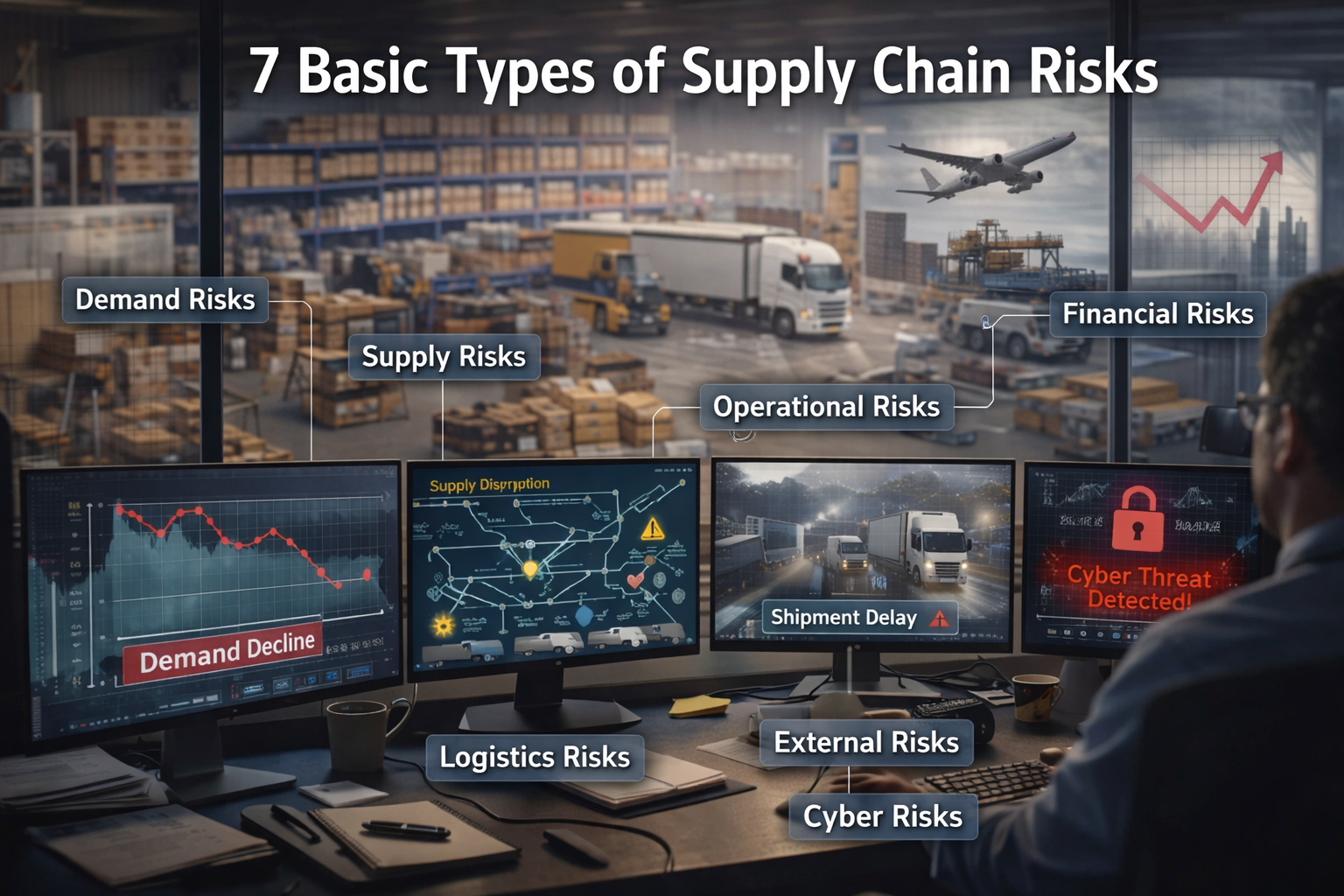
Supply chain risks generally fall into seven types: demand, supply, operational, logistics, financial, external, and cyber. Each hits a different part of the chain, and most businesses face several at once.
1. Demand Risks: When Customer Demand Becomes Unpredictable
Demand risk occurs when there’s a mismatch between what customers want and what your supply chain can deliver.
This can happen due to:
- Sudden market trends
- Seasonal spikes
- Poor demand forecasting
When demand is underestimated, businesses face stockouts. When overestimated, they deal with excess inventory.
2. Supply Risks: When Vendors Fail to Deliver
Supply risks arise when suppliers fail to meet expectations—whether due to delays, quality issues, or shortages.
Common causes include:
- Supplier dependency
- Raw material shortages
- Poor vendor coordination
Even one unreliable supplier can disrupt your entire operation.
3. Operational Risks: Internal Process Failures
Operational risks come from within your business.
These include:
- Manual errors
- Inefficient workflows
- Lack of system integration
For example, if your inventory system isn’t synced with your order system, you may sell products that are already out of stock.
This is where strong systems and automation play a key role in reducing supply chain risks.
4. Logistics Risks: Transportation and Delivery Issues
Logistics risks involve delays or failures in moving goods from one point to another.
These risks can occur due to:
- Transportation delays
- Port congestion
- Fuel price fluctuations
- Last-mile delivery issues
Even a small delay in logistics can lead to missed deadlines and unhappy customers.
5. Financial Risks: Cost Fluctuations and Cash Flow Issues
Financial risks affect your ability to maintain smooth operations.
They include:
- Currency fluctuations
- Rising transportation costs
- Vendor payment issues
- Poor cash flow management
When financial stability is affected, your entire supply chain slows down.
6. External Risks: Factors Beyond Your Control
These are unpredictable risks that businesses cannot control but must prepare for.
Examples include:
- Natural disasters
- Political instability
- Regulatory changes
- Global pandemics
These supply chain disruption risks often have the biggest impact because they are sudden and widespread.
7. Cyber Risks: Digital Threats in Modern Supply Chains
As supply chains become more digital, cyber risks are becoming more serious.
These include:
• Data breaches
• System hacks
• Unauthorized access
Supply Chain Risks in Retail
Retail feels supply chain risk faster than most industries, because the gap between a disruption and an empty shelf is so short. A supplier delay, a demand spike on a trending product, or a logistics hold-up shows up directly as a stockout or a markdown, and in seasonal categories there is no second chance once the window passes. Retailers carry extra exposure on demand risk, because trends move fast and forecasts age quickly, and on supply risk, because large vendor bases multiply the points where something can go wrong. Managing it well means tight demand forecasting, diversified vendors, and real-time visibility across stores and warehouses, so a problem in one location can be solved from another before the customer ever notices.
How Can You Manage Supply Chain Risks Effectively?
You manage supply chain risk not by trying to eliminate it, but by building enough visibility, flexibility, and backup that disruders do not stop you. Five practices do most of the work.
1. Improve Visibility Across the Supply Chain
When you can see what is happening in real time, you can act before a small problem becomes a big one. A centralised platform that tracks inventory, orders, and supplier performance in one place is the single biggest lever for managing risk. Supplymint's supply chain planning and inventory solution helps businesses hold the right stock across locations and respond quickly when demand shifts, which takes the pressure off demand and supply risk at the same time.
2. Diversify Your Supplier Base
Relying on a single supplier increases vulnerability. Having multiple vendors reduces dependency and risk.
3. Use Data for Demand Forecasting
Data-driven insights help predict demand trends more accurately, reducing both overstock and stockouts.
4. Automate Processes
Automation reduces human errors and improves efficiency, especially in procurement, inventory, and order management.
5. Build Strong Vendor Relationships
Good communication and transparency with suppliers help prevent unexpected issues.
6. Build Supply Chain Resilience
Resilience is the sum of the practices above: diversified suppliers, inventory buffers where they matter, and the ability to reroute or re-plan fast when something breaks. The businesses that recover quickest are the ones that built that flexibility in before they needed it. Our guide on building a resilient supply chain goes deeper on how.
Final Words
Supply chain risks are unavoidable, but they don’t have to be damaging. When you understand the types of supply chain risks and take proactive steps, you can turn challenges into opportunities for growth.
The key is to:
• Stay informed
• Use the right tools
• Act before problems escalate
A more structured approach to inventory planning and allocation can make a real difference. Supplymint's Supply Chain Planning helps businesses maintain better stock balance, respond quickly to demand changes, and keep operations running without unnecessary disruption.